Saturday, December 25, 2010

Binayak Sen Case: Condemn the Murder of Justice in Raipur Court!


CRPP PRESS RELEASE: 24/12/10

CONDEMN UNEQUIVOCALLY THE MURDER OF JUSTICE BY THE SESSIONS COURT IN RAIPUR IN THE BINAYAK SEN CASE!

LET US UNITEDLY FIGHT TO REPEAL ALL FASCIST DRACONIAN LAWS INCLUDING UAPA AND THE CHHATTISGARH SPECIAL PUBLIC SECURITY ACT!

The Committee for the Release of Political Prisoners (CRPP) condemns unequivocally the murder of justice in the case of Dr. Binayak Sen, a people’s doctor and one of the first civil libertarians to expose the state sponsored Salwa Judum that was undertaken by the BJP government on the tribal people in Chhattisgarh and ably supported by the Congress which is the opposition party in the state. In fact Dr. Sen while also exposing one of the worst cases in post-47 India of malnutrition and total neglect of the everyday life of the tribal people in the region showed the world the shocking story that was slowly unfolding—a slow genocide of the people in this region. And along with this slow genocide was the barbaric onslaught of the state sponsored Salwa Judum. Yes it was the voice of conviction of Dr. Binayak Sen against this murder, rape and loot of the tribal people that arouse the conscience of the people of the subcontinent as well as all democratic and freedom loving people of the world. To condemn such a person to life imprisonment u/s of 120(B), 124(A) of the IPC and 1,2,3,5, Chhattisgarh Special Public Security Act and Sec 39 (2) of the UAPA (2004 amended) without even an iota of evidence brings once again forth the real face of Indian democracy with the judiciary reflecting the abysmal nadir to which the system has convoluted iself to.

All supposed pillars of democracy of the Indian state are increasingly proving to be hollow for the common people fighting for their livelihoods and those who raise the issues of the most exploited, and oppressed being the target of ire of a state that is day by day churning out more and more anti-people policies and supplementing it with a penal system teethed with the worst draconian laws. The case of Dr. Binayak Sen is a reminder to every democratic and freedom loving people of the subcontinent to once again raise their voice unitedly against such a penal state that is assuming fascist proportions. Notwithstanding the fact that about 22 noble prize winners from all over the world had sought his immediate freedom and lauded the exemplary work Dr. Sen had in the medical sciences, in popularising it among the poorest of the poor, and in providing the best of treatment to the impoverished adivasis in Central India, what the state could give him in return was life imprisonment for a case that hardly has any evidence!

This is the same state that has given blanket protection for all the scamsters and looters, be it the politician, bureaucrat, coporate honchos, and last but not the least judges right from the sessions court to the highest seat of justice in India.

And naturally what can a doctor who is stubborn enough to go to the most impoverished regions of ‘Shining India’ and work among the poorest of the poor for their betterment, let alone survival expect from a system which was always living in a world of denial about the existence of such a world! And his only crime—that he had dared the criminal negligence of a state which had blood in its hands of a slow, but cold and calculated genocide of a people through systematically denying any opportunity to live a life of dignity!

It is high time that all democratic and freedom loving people should join hands to raise their voice against the mockery of justice and once again fight to put an end to all such draconian laws of colonial vinatage. Today it is Dr. Binayak Sen. Tomorrow it can be anyone of us.

In Solidarity,

Gurusharan Singh, President

Amit Bhattacharyya, Secretary General

SAR Geelani, Working President

Rona Wilson, Secretary, Public Relations

COMMITTEE FOR THE RELEASE OF

POLITICAL PRISONERS

185/3, FOURTH FLOOR, ZAKIR NAGAR, NEW DELHI-25

Arundhati Roy on life sentence for Binayak Sen


“A couple of years for the bosses of Union Carbide and a life sentence for Binayak Sen,” said celebrated writer and activist Arundhati Roy, referring to the sentence handed down to those accused in the Bhopal Gas Tragedy of 1984.

“After producing Marx's Das Kapital and a letter from the Indian Social Institute as evidence against him, the crisis of Indian democracy does not get more dangerous than this,” Ms. Roy said, referring to the quality of the evidence marshalled by the police in their case against Dr. Sen.

Friday, December 24, 2010

Dec 24: Binayak Sen Sentenced to Life Imprisonment


Sanhati

India Sentences Doctor to Life for Aiding Rebels By HARI KUMAR

NEW DELHI — In a ruling that outraged human rights advocates, an Indian court on Friday sentenced a doctor to life imprisonment on charges that he committed sedition by aiding Maoist rebels in rural India.

The case of Binayak Sen, 60, had attracted international attention when 12 Nobel laureates wrote to Indian leaders asking that he be released from jail as he awaited trial.

The court in the state of Chhattisgarh convicted him on Friday on two counts of sedition and conspiracy while finding him innocent of a third charge of waging war against the state.

Dr. Sen, a well known figure in Chattisgarh, had provided treatment to poor people in the state since 1981. “This is completely irresponsible,” said his wife, Elina Sen, during an interview on NDTV, a news channel. “There was not a single piece of evidence against him.”

The prosecution accused Dr. Sen of acting as a courier for jailed Maoist rebels and said it had recovered some letters written by militants that were in his possession. Dr. Sen visited jailed rebels on several occasions. He was arrested in 2007 and was not granted bail for two years.

Human rights activists condemned the verdict. “This is completely outrageous and unjustified,” said Rajendra Kumar Sail of the Peoples Union of Civil Liberties, who is also a former colleague of Dr. Sen. “We will definitely go for appeal against the judgment.”

Maoist rebels, who claims to fight for poor people, want to capture political power through armed struggle. They are active in broad swathes of remote regions of rural India and have been described by Prime Minister Manmohan Singh as the biggest threat to India’s internal security. India’s Home Ministry has said that Maoists killed 591 civilians in 2009.


Indian Court Sentences Dr.Binayak Sen to Life for helping Maoists

Wikileaks Beyond Wikileaks?


Saroj Giri

Corporate media buys you off only if you pose a real danger – radical and subversive to ‘power’. While attacking Wikileaks for corporate collusion, therefore, its original radical potential cannot be overlooked.

Wikileaks’ close collaboration with big corporate media and the ‘redactions’ raise serious doubts over whether information is actually flowing freely (Michel Chossudovsky, ‘Who is Behind Wikileaks?’ Dec 13, 2010, Global Research). And yet the Wikileaks’ intervention cannot be cast away in a cynical manner – the only way to welcome it however is by saving it from Wikileaks itself, in particular from its liberal slide. Let us problematise the kind of politics or the ‘attacks on power’ which Wikileaks represents, even as stories circulate about corporate-funding and CIA-backing. Indeed one gets deeply suspicious when for exampleThe Guardian reports that, for the hackers, ‘the first global cyber-war has begun’, ‘the first sustained clash between the established order and the organic, grassroots culture of the net’. On the other hand, for someone like Jemima Khan typical of a whole swathe of liberal supporters, Wikileaks stands for something far less dramatic. In her already apologetic piece, ‘Why did I back Assange?’, she states that it is only about ‘a new type of investigative journalism’, about freedom of information and so on. What is it really?

Let us ask a counter-intuitive question: what if instead of (only) hacking the internet sites of Mastercard, Paypal and Visa, our ‘Anonymous’ hackers had (instead) attempted to connect with the rank and file employees of the company to go on strike or at least voice their concerns, perhaps issue a collective statement deploring the action of their company? And this would not have really asked of our hackactivists to come out in public and expose themselves to possible reprisals and court cases – just releasing a statement making such a call would have worked or at least showed what they are thinking. And yet they did not do anything like that, nor have Wilileaks itself tried to widen their struggle in any way. Instead of calling upon people to come out and protest, the statement of ‘Anonymous’, responsible for the attacks on these companies, displays an unmistakeable, strong and un-self-reflexive behalfism, of acting on behalf of the people or citizens. In typical V for Vendetta style, Anonymous declares: “we are here for all of you, campaign for all of you”. Thus while Wikileaks seems committed to fight ‘power’, and not just fight those in power, they also at the same time display a profound disconnect with ‘people’, even as they claim to fight for the people’s right to know.

Let stretch things a bit more by asking another counter-intuitive question: why is it that students in London protesting against fee hike but also against every symbol of authority they come across, against ‘power’ even when not directly related to the hike, somehow did not turn their wrath against the government for arresting Assange even though it was happening in the same city at the same time? Is the problem with the students, with the people that they get charged up about what looks like a trivial issue of ‘fee hike’ than about the evil workings of US power revealed through nothing less than the ‘9/11 of diplomatic history’? Not at all. Indeed, if the student protests or similar ‘single-issue’ protests often are unable to break out of this single-issueness and place the movement in terms of the larger dynamics of the system as a whole or of the logic of capital and state power, then the problem with Wikileaks is its exceedingly abstract notion of power.

Power is identified only at the top, and it is as though it is in place only through hiding the truth, through manipulation, deceiving the public. It is as though power is on the outside, and is parasitic on society – more seriously, it is as though society functions autonomously (of capitalism), as though society is not internally determined and configured by this power. In the world of Wikileaks, society and power do not meet: ‘power’ is dissociated from the entire mode of organizing production, distribution and consumption in society, and concentrated to some power-mongers and conspirators. Without any such basis, power becomes an excrescence, an absolute deadweight from without, the handiwork of conspirators and CIA agents whose workings can be deciphered only through secret diplomatic cables. From this it of course follows that power can be fought only through dramatic leaks, exposes and revealing truth. From this, it also follows that ‘real struggles’ like the student protests or workers struggles are merely doing shadow boxing and hence not worthy allies in the fight against power.

What such a notion of power forgets is that to the extent that people live, work, consume, enjoy, die and so on in this society, they are invested into it, into capitalism – they are ‘subjectivated’ by it, to borrow a term from psychoanalysis. However this subjectivation is never complete and there is always a remainder – this is where a radical intervention, a transformative politics is always possible, is always already written, as it were, into the script. But radical resistance is not really triggered off as soon as the truth is exposed to all, as soon as citizens know that those in power are this corrupt – for it is not a problem of awareness, not an ‘idealist’ problem of knowledge. Perhaps this is why the Wikileaks revelations themselves did not let loose a social campaign or a movement even though those in power were embarrassed and jolted into anger – the protests in support of Assange that have taken place, as I will explain, follow from the other events that followed the revelations and not from the revelations themselves.

And yet the actions of Wikileaks carried a tremendous radical political charge, which even lot of the mass mobilizations and social movements totally lack. And here we must hand it to Wikileaks that their subversiveness came precisely from the fact that even though they tend to espouse liberal ideas of free flow of information or, in semi-anarchist mode, think of power as merely conspiratorial their attack really came from outside the normal channels professing free flow of information and citizens right to know: they challenged power by challenging the normal channels of challenging power and revealing the truth, even though they are perhaps getting suckered now into the hands of corporate houses and other suspicious players.

Radically subversive

This subversiveness comes from the fact that not only was the truth revealed about power but even those trusted bodies meant to ensure ‘citizens right to know’ were cast aside, transgressed and rendered pointless by the Wikileaks operation. Thus while Sarah Palin and other right-wingers might have asked for Julian Assange’s real head, those whose professed objective is to promote ‘citizens’s right to know’ like Amnesty International were not really welcoming of Wikileaks either. The Wall Street Journal reported that ‘Wikileaks and Mr. Assange risk being isolated from some of their most natural allies in the wake of the documents' publication’.

Amnesty International, Campaign for Innocent Victims in Conflict, George Soros’s Open Society Institute, the Afghanistan Independent Human Rights Commission, and the International Crisis Group have severely criticised Wikileaks for releasing material which might risk the lives of many. However this is not the only ground for their opposition to Wikileaks. In an Open Letter to Assange, Reporters Sans Frontieres faulted Wikileaks for ‘imprudence’ and ‘incredible irresponsibility’, saying ‘you cannot claim to enjoy the protection of sources while at the same time, when it suits you, denying that you are a news media.’ Wikileaks in turn derided the ‘human rights groups’ as US-led and refused to be identified as ‘media’, ‘human rights group’ and so on. John Pilger is quite right when he said that “WikiLeaks has shamed those in the media whom George Bush's press spokesman once called ‘complicit enablers’”.

It is not media, it is not human rights group, so what is Wikileaks? This tussle over finding a proper place for Wikileaks, a given assigned place within the normal functioning of the system is what brings us to the role of big ‘complicit enablers’ like New York Times andGuardian. Writes Michel Chussudovksy, ‘in a bitter irony, Wikileaks partner The New York Times, which has consistently promoted media disinformation is now being accused of conspiracy. For what? For revealing the truth? Or for manipulating the truth?’

Hard-pressed to justify their decision to publish the leaks, these media houses are presenting Wikileaks’ actions as, predictably, mere extension of ‘investigative journalism’ and the right of the citizens to know what their governments are doing. In ‘A Note to Readers: the Decision to Publish Diplomatic Documents’, the Times tries to make the Leaks seem very normal and not all that dramatic. One way it is done in the piece is by stressing a lot on the negotiations the Times had with the Obama administration over ‘redactions’ and how Wikileaks were informed about the administration’s views: looks like all three groups had a common point of understanding. It says, ‘After its own redactions, The Times sent Obama administration officials the cables it planned to post and invited them to challenge publication of any information that, in the official view, would harm the national interest.’

Add to this Jemima Khan’s explanation that ‘WikiLeaks offers a new type of investigative journalism”. That is, the leaks are already part of what big corporate media houses have always espoused for and there is nothing dramatic, anarchist or dangerously political about it. Well, is it? This is where one must assert that no matter what Wikileaks or Assange might claim subsequently, what they have done do not seem to follow from liberal concerns of the citizen’s right to know or the emphasis on transparency, responsible government and an active citizenry. For the liberal idea is also of citizens who are not overly politicized and who merely wants ‘negative liberty’ – non-interference by the state.

In contrast, the Wikileaks expose leads us to assume a highly politicized citizenry, who cannot and do not want to restrict themselves to their private lives and allow a handful of people to rule over them, typical of representative democracy. And further the subversive intent of the Leaks amount to a call for people to bring down those up there –not just know the truth and take legal recourse or wait till the next elections to vote the government out of power! And now, with Mastercard and Visa hitting back at Wikileaks and a cyber-war declared, it does clearly seem that what is at stake is much more than transparency and accountable government. Hacktivists in turn attacking these two companies completes the picture of daggers drawn and the ‘two warring sides’ well-defined – the liberal idea of consensus and a shared ground in which all classes and both the powerful and the powerless can supposedly converge did disappear for good, even if temporarily!

It must therefore be stated in no uncertain terms that Wikileaks clearly embodies a radical rupture in US imperialism’s normal functioning and also from the normal channels of dissent and ‘citizen activism’ set up by imperialism. As it stands, Wikileaks cannot be contained and even understood as part of an impeccably liberal idea of an active citizenry, transparency, accountability and so on. Wikileaks is not just demanding the right of citizens to know about the decisions and actions of those in power but is challenging the very legitimacy of that power. ‘Knowing the truth’ through Amnesty or Reporters Sans Frontieres that are established groups engaging with states through established procedures and legal battles is one thing. Knowing, in terms and conditions that are themselves illegitimate from the standpoint of power, is however another thing – it radicalizes the very meaning and significance of the ‘right to know’. Wikileaks’ action is therefore at one level a purely formal gesture, the audacity of the act, which stands on its own irrespective of how damning the actual contents of the leaks have been for the US and other governments, irrespective of the diplomatic fall-out and embarrassment caused. At least in the way it was received by large majority of people in the world, its action seems to carry an insurrectionary force, highly dissonant and subversive for the ‘established order’.

The later collusion with corporate media does not take away the fact that the original Wikileaks espousal of the free flow of information was less a routine, incremental process of democratization than an open attack on power before it could readjust and absorb this free flow in its normal functioning. It was a deadly sting operation which turned around the ‘citizen’s right to know’ from its decorative functions to an open assault on power – right which is not given but taken, an unconditional right.

Elite radicalism

Thus US officials are not entirely off the mark in declaring that what Wikileaks did was ‘not journalism but anarchism’ – that Wikileaks was challenging the very legitimacy of power, including the manipulations of Empire and the established order. And yet the fact of the matter is that Wikileaks is quickly becoming part of business as usual – anarchism is slowly morphing into journalism! In his recent piece in The Australian, Assange himself has shifted his positions from raising the question of the illegitimacy of power to giving liberal arguments that he was only defending the right of citizens to know. He comes down to quoting the US Supreme Court decision that ‘only a free and unrestrained press can effectively expose deception in government". Worse, he declared Wikileaks as part of the media and that ‘the media helps keep governments honest’.

Assange might continue this liberal slide further but we should not be surprised about this ‘compromise’. For one cannot conceive of another outcome given Wikileaks’ methods and forms of activism purportedly challenging power and undermining US domination through the hacktivism of a handful of tech-hippies. The faceless bohemian tech-libertarians, so long as they remain an underground hacker-elite, must increasingly rely on spectacular releases and big ticket actions: it is through such actions that they will try to short-circuit themselves into prominence. This makes them dramatic as well as vulnerable at the same time. (Wikileaks dissident Daniel Domscheit-Berg has on occassion expressed his dissatisfaction with the over-emphasis on big exposes.) V for Vendetta can inspire Wikileaks, giving us W for Wikileaks, as the Anonymous releases have announced. However even though V too is a rupture, a subjectivity miraculously intervening from the outside and against ‘power’, it is W which is much more vulnerable than V since W is not in a movie but in the real world! And so it is not entirely surprising that the corporate media has already entered the picture.

Some have even argued that in being an elitist cyber-vanguard Wikileaks start becoming a mirror image of the CIA or Pentagon-run spy networks supposed to be as shady. This is an untenable argument even though one can see that it derives plausibility from the fact that the development of the internet was itself part of the military-industrial complex, and the hacking and military computing industry closely competed with each other in their development. That challenging power by constituting oneself as another power, will lead not to the elimination of power as such but only to its replication, is an old argument. Such arguments are however facile, precisely since, as Wikileaks declares, “WikiLeaks needs to be completely opaque in order to force others to be totally transparent". Perhaps not ‘completely opaque’ but they definitely cannot last a day if they were to come out openly in the name of being transparent and democratic, given the highly organised secretive forces that will hunt them down – or coopt them into defending liberal values.

Wikileaks’ spectacular, high voltage attack was in a way a sign of their weakness, proving that at the end of the day, this is not the way you can accomplish change. In declaring that US foreign policy is not decided on the basis of diplomatic cables, Hillary Clinton was perhaps hinting that these leaks will not affect business as usual. Anyways, the masses are not coming out on the streets to overthrow their rulers whose corruption and despotism have been exposed. No point embarrassing the system and the rulers so much, if at the end of the day you have to live with them – that seems to be the attitude of ordinary people who cannot all withdraw into underground hacker sub-cultures even as they realize that this system is built on a lie and mere accountability of the government is not going to really help. We have heard of fears that the revolution will be killed if you expect it to be televised. But with Wikileaks’ crusade against ‘power’, it is clear that the revolution will not be televised – worse, it will be digitized, cyberised!

We can safely conclude that Wikileaks have by now become yet another fact of life, yet another spectacle – in fact journalism and not anarchism! And yet the rupture that is Wikileaks must be upheld in these times of the exhaustion of utopian and radical energies.

Wikileaks beyond Wikileaks

The pure subversive power of Wikileaks’ actions catalysed two developments which, paradoxically, took things beyond Wikileaks, perhaps even in spite of them. One, that ‘power’ is not just a conspiratorial exercise at the top became clear as companies like Amazon, Mastercard, Visa and Paypal turned hostile towards Wikileaks. Here we see that it is not really coded diplomatic cables that are oozing out power in secrecy, but ‘popular’ companies (oops, Visa cards present in every pocket and wallet) revealing where they stand. This brought ‘power’ closer home, as it were, so that the battle got a continuity beyond the initial cable leaks and involved a wider spectrum of forces and people. ‘Anonymous’ cyber-attacks against these companies are of course still shrouded in the style of elite and reclusive hackers and yet the targets now are clearer than just attacking ‘power’. Further the arrest of Assange made the fight concrete with people getting involved in gatherings, campaigns and other mobilizations in London. While this still largely comprises mostly well-known left-wingers (John Pilger, Jemima Khan) and not for example the mass of protesting students in London, Australia has already seen enthusiastic protestors in the streets of Melbourne and Sydney.

It looks like the radical empty subversive action can precipitate a ‘content’, viz., wider more concrete struggles beyond the confines of the elite hacker sub-cultures. Wikileaks’ empty radical gesture can potentially get a life of its own and mobilize people in communities and streets, offices, factories and universities. And that, rather than any major ‘diplomatic fall-out’, is what the powers really fear. For it is by now clear that so far as the diplomatic world is concerned Cablegate was yet another ‘-gate’ – it gets absorbed as one knows from the past. Rather than the revelations or the actual content of Cablegate, what is interesting is the train of events after that, the widening of the fight and the struggle carrying in newer ways.

Once power is no longer understood as flowing out of a secret den of conspirators and manipulators, hiding truth from the people, but is seen as working in and through real people and their aspirations, the mode of struggle too will no longer be ‘Anonymous’, secretive and self-contained but will involve the power of ‘ordinary people’. But bringing in ‘ordinary people’ is not a plea to make the fight loose, dispersed and hence ‘popular’ and ineffective, easily anticipated and neutralised – this is where the radicalism and insurrectionary moment of Wikileaks must be upheld. And yet: Wikileaks beyond Wikileaks.

Monday, December 20, 2010

Free Mumia Abu Jamal


America is always concerned about human rights violations across the world. Be it in China or Cuba, the Empire is very much worried about human rights violations. But Mumia Abu-Jamal's imprisonment exposes its true colour.

Friday, December 17, 2010

Why shouldn't we become Maoists, ask Chhattisgarh tribals


Jagdalpur (Chhattisgarh), Dec 16 (IANS) Many poverty-hit tribals in Chhattisgarh are asking why they shouldn't become Maoists and take up arms, pointing to the latest incident in which two civilians were branded rebels and shot dead by police.

The traumatised residents of the Koleng area of Bastar district are at a loss over the killings of their co-villagers by police early this week and say the two had simply gone to collect rations for others from a nearby forested area.

'It's better to become Maoists and fight against government brutalities than being killed brutally after being branded Maoists. I don't know why police are going after us in a planned manner,' 22-year-old Vohru told IANS.

The restive Bastar region is home to over a million people and has been caught in the crossfire between Maoists and security personnel for nearly three decades.

In Koleng, on the outskirts of Jagdalpur town, the headquarters of the Bastar region, many men and women can be found crying, mourning and expressing their anger against alleged police atrocities after their co-villagers were killed in an encounter on the intervening night of Dec 11-12.

'Two of our men - Mahru and Shyam Shankar - had gone to collect rations along with several others from nearby Netanar village for all of us. They were coming back with the rations but police killed them in a roadside jungle area,' Panduram Nag, sarpanch of Koleng village, told IANS.

'We came to know about the killings Tuesday when police came to the village and asked us to be extra alert as two Maoists were killed in the area and said several others were probably hiding in nearby areas.'

Another villager, Ramo, also received a gun shot in his leg in the incident and is being treated at Jagdalpur, some 300 km south of capital Raipur.

The state government has been tightlipped about the incident, but the Bastar district police chief has admitted the 'civilians killings' after initial hesitation.

'It was the Special Task Force (STF) and the District Force (DF) men that claimed to have killed two Maoists in a roadside jungle in an encounter, but the initial inquiry is clearly showing they were poor civilians and I suspect they were killed in the crossfire,' P. Sundarraj, superintendent of police of Bastar district, told IANS.

He promised to look into the killing incident and do justice to restore people's faith in the police force.

Fear runs deep in the minds of tribals in the 40,000 sq km economically backward Bastar area, of which up to 25,000 sq km is believed to have been intensively mined by the rebels.

Mineral-rich Bastar region is made up of five districts - Dantewada, Bijapur, Narayanpur, Bastar and Kanker - and is known as one of India's most impoverished pockets. It has witnessed nearly 2,000 casualties in Maoist violence in the past decade, including over 1,000 civilian deaths.

Maoists also often kill civilians in Bastar after labelling them as police informers.

(Sujeet Kumar can be contacted at sujeet.k@ians.in)

Thursday, December 16, 2010

which side are you on

Finally, Army moves into Maoist territory


RAIPUR: The Indian army is moving into the conflict theatre of Bastar, arriving at the doorsteps of what is arguably the strongest military base of the CPI Maoist - not for combat, as yet, but ostensibly for training. "Manoeuvre ranges have been finalised in Narayanpur district where training will be given to our troops," confirmed a highly placed official in the army.

Significantly, the hundred square kilometres identified for training lie in the foothills of Abujhmad, a thickly forested plateau, straddling both Chattisgarh and Maharashtra, one of the only regions of India unsurveyed by the government, considered out of bound for the administration, entirely controlled by insurgents, and often described as a Maoist liberated zone.

While the army sought to emphasise that its plans are limited to training, and there will be no active troop deployment against the Maoist insurgency, sources in the security establishment said any training facility would necessitate logistical support. "This means the army would first secure the Kondagaon-Narayanpur axis, placing a large number of troops in a series of camps, before it moves inwards for the purpose of training, somewhere near Orcha in the foothills of Abujhmad" explained a senior official.

Since the Maoists ambushed and killed more than hundred CRPF men in Bastar this summer - incidentally one of the ambushes took place close to the proposed army training range - an intense debate has raged over whether at all the army should be drawn into anti-Maoist operations. For the record, the government has maintained that the army's role would be limited to training. The army itself has shown great reluctance for the job. But sources indicate the army has begun mapping the contours of the conflict, preparing itself for the eventuality of deployment, in case the government decides to declare Maoist affected territories as disturbed areas, like parts of the North East, or Jammu and Kashmir.

While one view is that the training range in Bastar will bring the army tantalisingly close to the Maoists, and hence could be part of future strategic positioning, another view is that the move is purely routine, linked to the army's needs. "Since the army's counter-insurgency training centre in Vairengte in Mizoram is under great pressure, the army has been scouting for training grounds in tropical forests, either in Orissa, Maharashtra, Jharkhand or Chhattisgarh," said a security expert. Recently, the army also announced the setting up of a peace time station, called a sub area command, near Bilaspur in Chhattisgarh, one of the few states where the army has no presence.

Whether strategic or routine, the army's move into Bastar would be significant, pointed out a retired army officer: "Look at this in the light of psychological warfare. It is like telling the Maoists, beware, the tiger is outside your den".


Wednesday, December 15, 2010

Formation of PLGA a turning point in the Maoist movement


Young Naxalite cadres practise at a training camp in an unidentified village of the Dantewada forests of Chhattisgarh.

HYDERABAD: When Naxalites announced the formation of the People's Liberation Guerrilla Army (PLGA) a decade ago, security agencies dismissed it as an attempt by the rebels to regroup their cadres and propaganda to boost their perceived military strength.

Buoyed as they were by the phenomenal success in killing three Central Committee members on December 2, 1999, in an encounter in Koyyuru, the security agencies misjudged the consequences of what was sought to be projected as a “mere nomenclature change.”

Now, the security forces are bracing themselves for intensified attacks in Chhattisgarh, Orissa, Bihar, Jharkhand and West Bengal as the Maoists have announced month-long celebrations coinciding with the 10th anniversary of PLGA formation. All these years, the celebrations were only week-long. “This means bigger strikes can be expected in Maoist-affected States,” authorities concede.

In retrospect, it becomes clear that the formation of the PLGA — on December 2, 2000, first death anniversary of the “Koyyur martyrs” — helped the underground organisation improve its military capabilities spectacularly and register an impressive spatial spread of revolutionary movement in newer areas. So much so that the Centre now deploys 62 battalions of the Central Para Military Forces (CPMF) for anti-extremist operations in different States.

The PLGA consists of three layers: main, secondary, and base forces. The main force consists of platoons, companies and battalions, while the secondary force comprises local guerrilla squads (LGS) and special guerrilla squads (SGS). The base force consists of people's militia which could form themselves into grama rakshaka dalams (GRDs) or self-defence squads (SDS).

Intelligence agencies estimate that while the main and secondary forces constitute around 3,000 fighters, the number of people's militia constituting the base force could be nearly 30,000.

Structural change

The formation of the PLGA, in essence, ushered in a major structural change in the Maoist organisation. Party cadres earlier had responsibilities of military tasks as well as organisational work. With the PLGA formation, the military and organisational work was separated.

Since its inception, the PLGA has waged a relentless war against the security forces, and in the last decade, the rebels killed 2,000 security personnel, injured as many, and snatched nearly 2,500 weapons and one lakh rounds of ammunition, a Maoist document says.

A clear hierarchy has helped the Maoist military wing improve its strike capabilities. A decade ago, its capabilities were limited to hit-and-run attacks against two-or three-member police teams. Today, the PLGA is able to encircle its security forces and engage them in close quarter battles while moving in large formations. It took them just 10 years to improve from hit-and-run tactics to encirclement.

On the organisational level, the PLGA has developed from a force of one or two platoons to having companies and a battalion now. Police officers confirm that the newly formed 10 {+t} {+h} company of the PLGA was moving in the Mahasamund area of Chhattisgarh, barely 70 km from the capital, Raipur.

Another achievement of the PLGA has been transfer of technology. The technology for making and planting Improvised Explosive Devices (IEDs) has been successfully imparted to the large 30,000 base force. “The making and use of IEDs has now taken a mass form,” another Maoist document discloses.

Maoist ideologues take the example of the Mukuram ambush, in Chhattisgarh, on April 6, 2010, in which 75 CRPF men were killed, saying that such attacks on the principles of mobile warfare had blunted the initiative of Operation Green Hunt.

By forcing the security forces to curtail their movements, the Maoists could form Janatana Sarkars (self-government units) in as many as 300 panchayat areas in Bastar (constituting 20 guerrilla bases). Nearly 2,000 villages are being administered by these Janatana Sarkars, the Maoists claim. More than one lakh families occupied three lakh acres of land in nearly 5,000 villages or hamlets in Bastar, all due to the PLGA's intervention.

However, there was an imbalance as well. Before the PLGA came into existence, the Maoist party focussed more on organisational activity and less on militarisation. But now, the party faces the criticism that it gives more importance to military aspects than organisational work. This imbalance has led to a situation where the rebel movement is unable to strike roots in urban and plain areas.

The other drawback, Maoist leaders concede, was the party's inability to win over the non-tribal sections and non-farmer sections among the tribals, even in their struggle areas.

Despite the PLGA's manifold increase in military strength, the security forces managed to hit them severely by killing or arresting top cadre leaders — including directors of military intelligence Patel Sudhakar Reddy and Sakhamuri Appa Rao — in recent times. As many as 17 other top leaders were either killed or arrested over the last two years.

Saturday, December 11, 2010

Support and express solidarity with the Political Prisoners who are on an Indefinite Hunger Strike


Support and express solidarity with the Political Prisoners who are on an Indefinite Hunger Strike in Medinipur Central Jail from 10th December(Human Rights Day) 2010

Nearly 150 political prisoners-mostly under trail--incarcerated in the Medinipur Central Jail-which the government calls 'Correctional Home'-will start hunger strike from 10th December 2010 on the Human Rights Day for an indefinite period-true to the long tradition of hunger strikes organized by political prisoners in Medinipur as also other jails of West Bengal and outside in near and distant past. The prisoners include those arrested on the charge of having Maoist links, or becoming members of the People's Committee Against Police Atrocities (PCAPA) that spearheaded the Lalgarh movement from November 2008, or common villagers standing by the cause. Many of these prisoners have been languishing in jail for years together in abysmal conditions virtually without trial.

The Committee for the Release of Political Prisoners (CRPP) express wholehearted support to the striking prisoners and urge all democratic forces throughout India and other parts of the world to raise their voice in support of their just demands.

The demands placed by the prisoners to the authorities are as follows:

  1. The joint forces should be withdrawn and the 'Operation Green-hunt' stopped immediately and the government should sit for a dialogue with the PCAPA without delay.
  2. Section 144 should be immediately withdrawn, and there should be unrestricted entry of all newspersons, intellectuals and other people.
  3. Legal steps should be taken against the CPI(M) hermads.
  4. Judicial enquiry should be initiated for the murder of all leaders, members and supporters of the People's Committee including Lalmohan Tudu, Sidhu and Umakanto Mahato, and offenders should be brought to book.
  5. The cooked up charges against all the prisoners incarcerated in the jails of West Bengal on political grounds, including those arrested from Jungle Mahal should be withdrawn and the prisoners released unconditionally.
  6. Repeal all draconian acts including the UAPA and the AFSPA.
  7. Prisoners imprisoned on political grounds should be given the status of political prisoners and the government should have to bear the cost of maintaining their families.
  8. Prisoners should be given opportunity to meet the members of their families and receive necessary articles from them in Medinipur court.
  9. After arrest, no participant in a movement should be made to "disappear" illegally. Everyone should be produced in court within 24 hours.
  10. Nobody should be 'shown arrested' by tagging in one false case after another.
  11. Judicial enquiry should be initiated in all cases of rape including those in Sonamukhi and the offenders brought to book.
  12. Old men and women in the Jungle Mahal should be given adequate old-age pension and widows given widow-pension, and all in this connection should be paid off immediately.
  13. All surplus grain kept in the FCI go-downs should be immediately distributed among the poor people of Jungle Mahal, and not to be allowed to either to rot or be burnt.
  14. Stop biased investigation into the Jnaneswari Express sabotage and initiate neutral investigation; a neutral investigation team should be formed with people from cross-sections of society and actual culprits should be punished.
  15. Indian army in Kashmir should be immediately withdrawn. The hopes and aspirations of the people of the land should be honoured.
  16. Persons involved in the destruction of Babri Masjid and subsequent riots should be given exemplary punishment.
  17. Prisoners confined in the cells should be allowed to meet other prisoners. The illegal system that segregates one prisoner from another should be immediately stopped.
  18. Those among the life-convict prisoners who have already passed 14 years of incarceration should be set free immediately.
  19. Telephone service should be introduced inside jails and every prisoner be allowed to avail himself/herself of this opportunity.
  20. Instead of every prisoner being forced to have his beard cut with one common razor, each prisoner should be allowed to have a separate arrangement of his own.
  21. Arrangement should be made for the supply of water inside the cells for 24 hours and the inhuman custom of carrying water drums over shoulders should be stopped immediately.
  22. Arrangement should be made for political prisoners to take political classes inside prisons. No political literature can be seized by the jail authority.
  23. Political prisoners should be allowed to contact media persons outside and they should be allowed the right to have their political writings published in different newspapers.
  24. Intellectuals coming to meet political prisoners should be allowed to have table interview with them.
  25. The newly-proposed system of payment of daily wage@ Rs.100.00 to convicts should be implemented immediately; wages should not be kept due.
  26. Prisoners seeking a copy each of West Bengal Correctional Services Act and the Jail Code should be provided one copy each.
  27. Canteens should be introduced inside Medinipur Jail.
  28. Political prisoners should be provided with all the daily newspapers at government expense.
  29. Proper infrastructure for treatment in Medinipur Jail Hospital should be made and necessary machines installed.

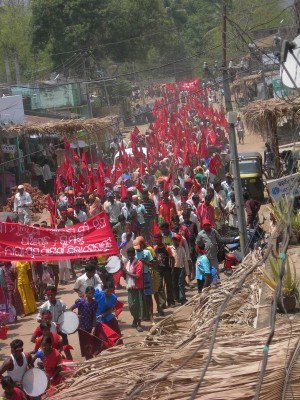
Tribals rally against anti-Maoist operations in Orissa


(This demonstration was held in the last week of November.)
narayanpatna

Tribals opposing ongoing anti-Maoist operation in Koraput district, where most wanted rebel Ramakrishna is suspected to be in hiding, staged a demonstration at Narayanpatna, about 70km from here, today.

The rally was organised by the Maoist-backed Chasi Mulia Adivasi Sangha (CMAS), which had recently forcibly grabbed money lenders’ lands and attacked a police station at Narayanpatna. The demonstrators also demanded immediate release of tribal men and women who were lodged in jail on charge of being rebels and attacking the police station.

About 100 tribals allegedly involved in the two counts are lodged in Koraput jail. Two of them have died in prison. The demonstrators submitted a memorandum addressed to chief minister Naveen Patnaik to local block development officer.

Meanwhile, the police have launched a manhunt for Ramakrishna, who is suspected to have taken shelter in Narayanpatna jungle along with his son Prithvi. The search operation has been stepped up since the arrest of Ramakrishna’s wife Padma on November 14 from an area near Koraput, bordering Andhra Pradesh.

CMAS marches in Narayanpatna, Orissa

Friday, December 10, 2010

"They Don't Care About Us"

Deep down, even Michael Jackson too knew... "they don't really care about us"


And here is the link to the first video

Youtube


"They Don't Care About Us"

Skin head, dead head
Everybody gone bad
Situation, aggravation
Everybody allegation
In the suite, on the news
Everybody dog food
Bang bang, shot dead
Everybody's gone mad

All I wanna say is that
They don't really care about us
All I wanna say is that
They don't really care about us

Beat me, hate me
You can never break me
Will me, thrill me
You can never kill me
Jew me, sue me
Everybody do me
Kick me, kike me
Don't you black or white me

All I wanna say is that
They don't really care about us
All I wanna say is that
They don't really care about us

Tell me what has become of my life
I have a wife and two children who love me
I am the victim of police brutality, now
I'm tired of bein' the victim of hate
You're rapin' me of my pride
Oh, for God's sake
I look to heaven to fulfill its prophecy...
Set me free

Skin head, dead head
Everybody gone bad
trepidation, speculation
Everybody allegation
In the suite, on the news
Everybody dog food
black man, black male
Throw your brother in jail

All I wanna say is that
They don't really care about us
All I wanna say is that
They don't really care about us

Tell me what has become of my rights
Am I invisible because you ignore me?
Your proclamation promised me free liberty, now
I'm tired of bein' the victim of shame
They're throwing me in a class with a bad name
I can't believe this is the land from which I came
You know I do really hate to say it
The government don't wanna see
But if Roosevelt was livin'
He wouldn't let this be, no, no

Skin head, dead head
Everybody gone bad
Situation, speculation
Everybody litigation
Beat me, bash me
You can never trash me
Hit me, kick me
You can never get me

All I wanna say is that
They don't really care about us
All I wanna say is that
They don't really care about us

Some things in life they just don't wanna see
But if Martin Luther was livin'
He wouldn't let this be

Skin head, dead head
Everybody gone bad
Situation, segregation
Everybody allegation
In the suite, on the news
Everybody dog food
Kick me, strike me
Don't you wrong or right me

All I wanna say is that
They don't really care about us
All I wanna say is that
They don't really care about us

All I wanna say is that
They don't really care about us
All I wanna say is that
They don't really care about us

All I wanna say is that
They don't really care about us
All I wanna say is that
They don't really care about us

Followers