Saturday, August 28, 2010

Death By An Inch... Lies By The Mile


Will Azad become Congress’s Sohrabuddin? His post-mortem suggests he was killed in cold blood

Dead men tell no tales. But when the deceased is Chemkuri Azad Rajkumar, the manner of death can speak volumes. The Maoist leader’s post-mortem report, which Outlook has now accessed, categorically establishes that he died in a fake encounter. Read along with the FIR and inquest reports, it exposes the elaborate set of lies drawn by the Andhra Pradesh police to explain his death. The claimed encounter, a much-touted “gain” in the UPA government’s war against India’s “gravest internal security threat”, was in fact a cold-blooded execution by the state. Azad, a key player in the planned negotiations with the government, was picked up and shot with a handgun from a distance barely more than the size of an outstretched palm. The official version, that the Maoists were atop a hill and fired at the police party and Azad died when the cops retaliated from down below, just doesn’t add up.

The post-mortem on Azad’s body, conducted by doctors at the Adilabad district hospital on July 3, two days after the killing, records a 1-cm oval-shaped wound just a few inches above the left nipple where the bullet entered, tore through his heart and exited from the back just between the ninth and the tenth vertebrae. The wound’s entry point, the doctor conducting the post-mortem records, had “darkening (and) burned edge” at the “left second intercostal space (the space between two ribs)”.

In forensic medicine, which also deals with decoding fatal bullet wounds, the words “darkening, blackening and burning” are revealing. Experts with hundreds of autopsies behind them all say that when there is “burning” associated with a “darkening or blackening” of an entry wound, it can only mean that the victim has been shot from a distance less than 7.5 cm or less—practically point-blank range.


‘Near-Shot. Close-Range. Fired From Less Than 7.5 cm.’

Outlook invited three experts to analyse Azad’s post-mortem report, without revealing his
identity. All three say Azad was shot from a distance equal to, or less than 7.5 cm

“If there is darkening, blackening and burning around a bullet entry wound, it is caused by the flame, smoke and gunpowder emerging from the firearm. The flame and the gunpowder, due to low mass, cannot travel very far. These residual marks, therefore, strongly suggest a near shot.” —Dr Sudhir Gupta, Associate Professor of Forensic Medicine & Toxicology at AIIMS, New Delhi. Has conducted nearly 30 autopsies of police encounter deaths.

“While the report mentions burning, there is no tattooing. But if the deceased was wearing a shirt, then the tattooing could be on the shirt and only the burning is visible. The presence of burning in an entry wound accompanied by tattooing clearly indicates a shot fired from less than 7.5 cm.” —Dr B. Umadethan, Former head of the department of forensic medicine, and police surgeon, Thiruvananthapuram Medical College. Author, Principles and Practice of Forensic Medicine.

The oval-shaped wound shows that the bullet was fired at an angle. It is almost certain that the bullet was fired at extremely close range. The weapon used was a handgun and not a rifle like AK-47. My guess is that the bullet that killed this person was fired from a .38” (9 mm) pistol.” — Retired Director of the Central Forensic Sciences Laboratory, Chandigarh, an expert on wound ballistics and the author of several books on ballistics who requested anonymity.


To get a better interpretation and assessment of the observations in the post-mortem report,Outlook gave a copy of it to three of the country’s top forensic medicine and wound ballistic experts in three different cities. To ensure an unbiased and objective assessment, only the contents of the report were made available to them, the victim’s name was not revealed. All three agreed that the probability of a close-range shot, perhaps even less than 7.5 cm, was very, very high.

Dr Sudhir Gupta, a gold medallist in medicine and currently an associate professor of forensic medicine and toxicology at the All India Institute of Medical Sciences in New Delhi, is considered an authority in his field. He is also an expert on encounter deaths, having handled 30 such cases. After going through the Azad post-mortem, Gupta summarised that a very “near shot” had killed the victim.


Silent knight: Gadar singing at Azad’s funeral at Punjagutta (Photograph by P. Anil Kumar)

“No way can firing from below go down a person’s chest and exit like that,” says Azad’s doctor brother.
He explains: “When there is darkening, blackening and burning around a firearm bullet entry wound, then it is caused by the flame and smoke of gunpowder emerging from the gun. These residual marks strongly suggest a near (close-range) shot. The burning is caused by a flame that has no mass. So, it travels a very short distance from the gun and therefore can only cause a burn if the shot is fired from close range. The gunpowder residue which hits the body at near range penetrates the skin and causes the darkening. Please note that the flame and the gunpowder, due to low mass, cannot travel very large distances.” However, exercising the customary caution of a professional, Gupta advocates “test-firing of the gun with the type of ammunition that was used in the original shooting for an accurate assessment of the range of fire”.

The second expert Outlook approached is a name students of forensic medicine are all too familiar with. Dr B. Umadethan is the former head of the department of forensic medicine and a police surgeon at the Medical College of Thiruvananthapuram. His book, Principles and Practice of Forensic Medicine, is a standard text for forensic students. A cautious man, Umadethan makes it very clear that it is difficult and even dangerous to form an opinion from the available data. But he finds the “darkening and burned edges” intriguing. “Usually, a very close-range shot, less than 7.5 cm, leaves behind three telltale marks: the entry wound is burnt; it has a halo tattoo from the unburned gunpowder and blackening created by the smoke. If the deceased is wearing a cotton shirt, then the gunpowder tattoo can be left behind on the cloth. But a burn along with these other indications definitely indicates a very close-range shot.”

“If they kill the very man sent to talk with the Maoist leadership, who do we talk with?” asks Swami Agnivesh.
A third expert who comes with formidable qualifications requested anonymity. A former director of the Central Forensic Sciences Laboratory in Chandigarh, he is an expert on wound ballistics and has authored several books on the subject. “The darkening of the wound’s edge could be due to dirt and deposit of power residues and contusion, but when accompanied by burnt edges, it’s almost certain that the bullet was fired at extremely close range and the weapon used was a handgun, not a rifle like the AK-47. It causes a wound of almost similar dimension but inflicts much more damage to the tissue. My guess is that the bullet was fired from a .38” (9 mm) pistol,” he says.

If the post-mortem report exposes the police claims, then the FIR, lodged on a complaint filed by Circle Inspector Raghunandan Rao on July 2, is an even greater exercise in self-contradiction. It states that the police received a tip-off from the state intelligence police about a 20-25-strong Maoist squad infiltrating into the Wankedi forests from the Maharashtra side. Rao’s team, equipped with night vision devices, found the squad in the midst of hundreds of acres of forests in the dead of the night on July 1. The police claim they challenged the squad, but came under intense fire. The cops too retaliated; the exchange of fire lasted 30 minutes. When the firing stopped, Rao led his team towards the hilltop to halt and rest for the night. Early next day, he resumed his search and stumbled upon two unidentified bodies, each with their individual kit bags, an AK-47 and a 9-mm pistol. One body was Azad’s; the other victim was a freelance journalist, Hemchandra Pandey.

Not only do the first series of contradictions emerge here (see Holes in the Dark), the FIR and inquest report are unable to answer two more key questions:

  • Even if they abandoned Azad’s body, why didn’t the Maoists carry the AK-47 and the 9-mm pistol back with them after the firing had stopped? To the Maoists, an AK-47 and a 9-mm pistol are precious and never left behind.
  • If the police were firing at long range, how did Azad die from a short-range 9-mm pistol bullet?

Swami Agnivesh, who had been asked by Union home minister P. Chidambaram to initiate talks with the Maoists in search for peace, is a perplexed man. “If they kill the very man who was carrying my message to the Maoist leadership in Dandakaranya to begin talks and offer a substantive gesture to show their sincerity, then who do we talk with? Are we keen to end this conflict or are we getting ready for a perpetual war in the heartland of India? When such disturbing facts emerge from the death of such a man, doesn’t it merit a decent inquiry?” For a nation at war with itself, the truth is the least it owes itself.

Else, Azad will become the Congress’s Sohrabuddin. Like their counterparts in Gujarat (who did not budge till the Supreme Court stepped in), the Centre and the state are in denial about Azad and attempting to bury uncomfortable facts. Like in the Sohrabuddin encounter, there is trickery involved in Azad’s death too. The Maoist ideologue, from all credible accounts, had been drawn out for peace talks. Only, instead of allowing him to speak, the government silenced him forever.


Amazing Speech by US War Veteran - A message for our times


Kashmir protests for freedom


Friday, August 27, 2010

"Osama bin Laden is a US spy": Fidel


The Guardian

Fidel Castro meets with Daniel Estulin in Havana
Former Cuban president Fidel Castro meets Lithuanian author and conspiracy theorist Daniel Estulin in Havana today Photograph: Alex Castro/EPA

Fidel Castro has more reason than most to believe conspiracy theories involving dark forces in Washington. After all, the CIA tried to blow his head off with an exploding cigar.

But the ageing Cuban revolutionary may have gone too far for all but the most ardent believer in the reach and competence of America's intelligence agency. He has claimed that Osama bin Laden is in the pay of the CIA and that President George Bush summoned up the al-Qaida leader whenever he needed to increase the fear quotient. The former Cuban president said he knows it because he has read WikiLeaks.

Castro told a visiting Lithuanian writer, who is known as a font of intriguing conspiracy theories about plots for world domination, that Bin Laden was working for the White House.

"Bush never lacked for Bin Laden's support. He was a subordinate," Castro said, according to the Communist party daily, Granma. "Any time Bush would stir up fear and make a big speech, Bin Laden would appear, threatening people with a story about what he was going to do."

He said that thousands of pages of American classified documents made public by WikiLeaks pointed to who the al-Qaida leader is really working for.

"Who showed that he [Bin Laden] is indeed a CIA agent was WikiLeaks. It proved it with documents," he said, but did not explain exactly how.

He made his comments during a meeting with Daniel Estulin, the author of three books about the secretive Bilderberg Club which includes men such as Henry Kissinger, the former US secretary of state, leading European officials and business executives. Estulin says that the club is form of secret world government, manipulating economies and political systems.

Estulin offered his own views on Bin Laden: that the man seen in videos since 9/11 is not him at all but a "bad actor".

However the two men did find something to disagree on.

Estulin has long argued that the human race will need to find another planet to live on because of overcrowding.

Castro was not keen. He observed that man had only made it to the moon, which is entirely unsuitable as a new home, and what lay beyond that was not much better. Better to fix things on earth.

"Humanity ought to take care of itself if it wants to live thousands more years," he said.


Thursday, August 26, 2010

Reaping the Whirlwind: WikiLeaks Releases CIA Study on U.S. as ‘Exporter of Terrorism’


Antifascistencyclopedia.com

By Ellen Nakashima
Washington Post | August 25, 2010

us flag burning 2a vi Reaping the Whirlwind: WikiLeaks Releases CIA Study on U.S. as ‘Exporter of Terrorism’America has long been an exporter of terrorism, according to a secret CIA analysis released Wednesday by the Web site WikiLeaks. And if that phenomenon were to become a widely held perception, the analysis said, it could damage relations with foreign allies and dampen their willingness to cooperate in “extrajudicial” activities, such as the rendition and interrogation of terrorism suspects.

That is the conclusion of the three-page classified paper produced in February by the CIA’s Red Cell, a think tank set up after the Sept. 11, 2001, attacks by then-CIA Director George J. Tenet to provide “out-of-the-box” analyses on “a full range of analytic issues.”

Titled “What If Foreigners See the United States as an ‘Exporter of Terrorism’?,” the paper cites Pakistani American David Headley, among others, to make its case that America is a terrorism exporter. This year Headley pleaded guilty to conducting surveillance in support of the 2008 Lashkar-i-Taiba attacks in Mumbai, which killed more than 160 people. The militant group facilitated his movement between the United States, Pakistan and India, the agency paper said.

Such exports are not new, the paper said. In 1994, an American Jewish doctor, Baruch Goldstein, emigrated from New York to Israel, joined the extremist group Kach and killed 29 Palestinians praying at a mosque at the Tomb of the Patriarchs in Hebron, it said. That helped trigger a wave of bus bombings by the extremist Palestinian group Hamas in 1995, the paper noted.

As WikiLeaks disclosures go, this paper pales in comparison with the organization’s recent releases. Last month the group published 76,000 classified U.S. military records and field reports on the war in Afghanistan. That disclosure prompted criticism that the information put U.S. soldiers and Afghan informants at risk, along with demands from the Pentagon that the documents be returned. WikiLeaks says it is still planning to release 15,000 more Afghan war records that it has been reviewing to redact names and other information that could cause harm.

CIA spokeswoman Marie Harf played down the significance of the paper: “These sorts of analytic products – clearly identified as coming from the Agency’s ‘Red Cell’ – are designed simply to provoke thought and present different points of view.”

While counterterrorism experts focus on threats to the homeland, al-Qaeda and other terrorist groups “may be increasingly looking for Americans to operate overseas,” the paper said.

And if the made-in-America brand becomes well-known, foreign partners may become balky, perhaps even requesting “the rendition of U.S. citizens” they deem to be terrorists. U.S. refusal to hand over its citizens could strain alliances and “in extreme cases . . . might lead some governments to consider secretly extracting U.S. citizens suspected of foreign terrorism from U.S. soil.”

http://www.washingtonpost.com/wp-dyn/content/article/2010/08/25/AR2010082506591.html


Tuesday, August 24, 2010

Maoist Leader Hosagadda Prabha escapes from Karnataka Cops Net


BANGALORE:Hosagadda Prabha,a Naxal leader, wanted in a number of cases, gave the police a slip after getting treated at a private city hospital.
A senior police officer told Express that Hosagadde Prabha is "still alive and nothing has happened to her during the treatment".
Her Naxal comrades led the police to believe that Prabha had died in the hospital due to dengue fever on August 18. The police thought that the cadres had somehow removed the body from the hospital and cremated it in an unknown location. Even a section of the media fell for that story.
The police officer admitted that the intelligencegathering system, believing in her 'death', could not trace her movement. Thus, the police had failed to arrest her while she was undergoing treatment.
But that was just a cookedup story. "She was admitted as Susheela for treatment and getting better, she vanished from the hospital giving the police the slip," he said.
Sources said Prabha escaped just a day before police got wind of her presence in Bangalore.
Prabha has been an active Naxal leader in the Western Ghats area for more than 10 years.
The state police has announced a reward of Rs 5 lakh for her arrest. "We don't have sufficient evidence to prove whether she is dead of alive. So, I cannot comment on this issue," said A R Infant, ADGP (Law and Order).
There are 26 cases registered against her at Sringeri, Aldur, Balehonnur and Jayapura police stations.
Prabha, also known as Netra, Vindhu, Sandhya and Madhu, belongs to Hosagadde village of Thirthahalli in Shimoga, and is the wife of B G Krishnamurthy, the frontline cadre of Naxals in the state.
"The Shimoga police did not have any evidence of her death but believed that she was dead," said a police officer.


About Prabha

Prabha and her husband Krishnamurthy went underground following their close association with the Naxal leader Saket Rajan, who was gunned down in a police encounter in February 2005.

She has been active as a naxal leader in Western Ghat area for more that 10 years.

She joined 'Mahila Jagruthi' a voluntary organisation, and fought for women's empowerment.

Prabha also took part in various people's movements such as 'Tunga Ulusi' (Save River Tunga) and the Kudremukh agitation by the indigenous Adivasis.

A firebrand, she joined the Red Brigade after she met Saket and Krishnamurthy. The state police already had announced Rs 5 lakh reward for her arrest.

A total of 26 cases were registered against Prabha at Shringeri, Aldur, Balehonnur and Jayapura police stations.

She is accused in the Gandaghatta Venkatesh murder, Thanikodu checkpost destruction, vandalising Kerekatte Forest Office and Matholli blast.

Mumia Abu Jamal on Hip Hop


Lohandiguda, India: We won’t give up our land!


Land nor Freedom

August 22, 2010,The New Indian Express

‘Nahi denge zameen!’ (we won’t give our land) – said one villager of Lohandiguda, as over 150 villagers – Sarpanches and ward members with their families, stood up, and walked out of the meeting with government officials on the 12th of May of this year. In 2005, the villagers in Lohandiguda didn’t even know their land was up for acquisition by Tata Steel – they learnt about it after they read the newspapers.

It is a known fact that the Adivasis have existed long before there was any idea of India. And there are estimates that there has been more displacement by development projects in India than by the Partition, and a majority of the displaced have been Adivasis.

It’s therefore not surprising that the Maoists don’t believe that India has attained independence. In a school in the liberated-zones of Dantewada, a lone poster of Chandrashekar Azad remains, there’s no sign of Gandhi or Nehru. In the Red Corridor, the Maoist squads go to schools in the middle of their Independence Day celebrations, remove the tricolour, holster up a black flag, distribute sweets or biscuits to the children and leave.

63 years after independence, the history of the tribals in Independent India has been wrought by promises never kept.

In 1955, Prime Minister Jawaharlal Nehru had addressed an All India Conference of Tribes in Jagdalpur, Bastar District of Chhattisgarh (Then Madhya Pradesh) and had said: ‘Wherever you live, you should live in your own way. This is what I want you to decide yourselves. How would you like to live? Your old customs and habits are good. We want that they should survive but at the same time we want that you should be educated and should do your part in the welfare of the country.’

Today, Rights guaranteed to the tribals by the constitution, embodied in the PESA are floundered routinely all across the Fifth Schedule areas. The PESA enables the adivasis to govern themselves through Gram Sabhas, and the state has no right to acquire lands, nor dish out mining leases without the permission of the Gram Sabhas. Yet the State of Chhattisgarh, is using a ‘Colonial-era law’, the Land Acquisition Act, 1894, to acquire lands.

‘They asked us to hold a Gram Sabhas and there was police everywhere.’ Said one of the village-leaders of Sirisguda, in a meeting with the Express a few days ago, ‘And yet we said no to Tata!’

Nevertheless, the next day, all the local newspapers were reporting that the villagers of Lohandiguda had accepted Tata’s plan for acquisition. This pattern would repeat itself regularly throughout the years. A public hearing would be held, the villagers would say no, and the local press would print their assent.

‘We always say no! And you write yes!’ they screamed at the press at Lohandiguda.

Today, the discrepancies in numerous Gram Sabha resolutions and public hearings held in Chhattisgarh rarely find any report in the Chhattisgarh press, nor the national press, but only in a citizen-run initiative called CGNet Swara.

CGnet Swara is an innovative audio-based news service. One simply has to call 08041137280 from their mobile phones, and can either press 1 to record news, or 2 to listen to the news. After some cross-checking, the moderators release the recordings, which include reports on public rallies, discrepancies in the PDS, water issues, medical issues, arrests of activists, fake encounters, child labour issues, anti-liquor campaign issues, and every issue governing adivasi and village life.

Yet they have been particularly useful in bypassing a compromised local press and giving grass-root reports about public hearings. For instance, a public hearing held on the 5th of May, this year in Dantewada district, regarding the NMDC in Kirandul, was considered fraudulent as many of the villages who’d be directly affected by the project weren’t even present during the hearing.

‘The public hearing was held 50 kilometres away from the affected villages, and the people at the hearing were contractors and other lackeys of the NMDC.’ Said a news report from CGNet Swara, in Hindi.

Similarly, another public hearing was held in Raigarh district in Chhattisgarh on the 3rd of July organized by Hind Multiservices for a 15,000 TPA Ferro Alloy Plant, where the affected villagers weren’t even informed of the hearing.

‘Only 32 people showed up, mostly activists, and it is safe to say, there are no affected villagers here because they were not informed. This whole hearing was a farce.’ Said another news report from CGnet Swara.

Each report from CGnet Swara explicitly begins to highlight the muted voice of the adivasis in their own fate, whether it is the public hearing or the Gram Sabha. And this brings us to an interesting Censored Chapter.

The Censored Chapter

A recent study by the Institute of Rural Management, commissioned by the Panchayat Raj Ministry, on the functioning of Panchayat Raj highlighted the violations in the Panchayat (Extension to Schedule Areas) act, or PESA. To quote:

‘The central Land Acquisition Act of 1894 has till date not been amended to bring it in line with the provisions of PESA and to recognize the Gram Sabha, while a newer bill meant to replace it is yet to be tabled in parliament. At the moment, this colonial-era law is being widely misused on the ground to forcibly acquire individual and community land for private industry.’

‘In several cases, the practice of the state government is to sign high profile MOUs with corporate houses (Government of Jharkhand 2008 and IANS, 2010), and then proceed to deploy the Acquisition Act to ostensibly acquire the land for the state industrial corporation. This body then simply leases the land to the private corporation – a complete travesty of the term ‘acquisition for a public purpose’, as sanctioned by the act.’

‘In some cases, administrations run through the motions of a PESA consultation, but in no instance has the opposition expressed by tribal communities to acquisition of their land resulted in a plan for industry being halted, suggesting the disempowerment of the Gram Sabha.’

There was no surprise that the chapter, aptly titled, ‘PESA, Left-Wing Extremism and Governance: Concerns and Challenges in India’s Tribal Districts’ was entirely taken out of the final report released by the government, for it is a damning indictment of the state’s pro-industrial policies. The report even goes on to mention, that the growing strength of the Maoist movement in central India is inextricably linked to the government’s ‘exclusionary’ policies:

‘Some analysts read the resurgence and spread of left-wing extremism as a phenomenon of tribal self-assertion. They point to the co-incidence in the rise of economic reforms and the deepening of the Maoist movement in India’s polity, the latter being a retort to the exclusionary nature of these policies. According to one senior politician, ‘If the state is neglectful and oppressive, as it has been, it provides the water in which the guerilla fish swim.’ Another senior politician seconded, ‘PESA has not yet been honestly implemented in a single district yet. If it is, we will solve the Naxal problem.’

Lohandiguda also finds mention in the censored chapter of the PESA report.

‘Resident Mahangu Madiya has Rs 55 lakh in his account, but does not even own a mobile phone. He has no use for most such material possessions. Or even this significant sum of money, which he has not touched since it landed in a bank account this January as ‘compensation’ given by the state, in return for acquiring his 35-acre farm for a proposed steel plant. “I am concerned with farming. My land is important to me. What will I do with this money?” asked the middle-aged farmer’.

Eventually, resistance to the land grab began to accentuate. The Communist Party of India had no influence in Lohandiguda before Tata showed up. They only found footing as they’re openly anti-displacement and anti-corporate land grab. Both the BJP and Congress have supported Tata’s project, but today only CPI party workers, or those explicitly anti-displacement work in Lohandiguda.

‘I remember telling people, that we need to protest first, we need to organize ourselves first, and then only will people come and support us.’ Said Advocate Girju Kashyap, who at some point, was also detained by the police and prevented to appear in court.

Most of his clients are villagers from Lohandiguda with cases slapped against them.

Yet even the CPI has not been able to hold off Tata’s project, and there is a severe sense of frustration with the villagers of Lohandiguda.

The Meeting

Lohandiguda is far from the theatre of war at first sight. Yet there’s a permeable tension that everything shall burn. On the 11th of May, the Naib Tehsildar of Lohandiguda PR Marghya had began a ‘bhoomi puja’ (inaugration ceremony) near the proposed project site for Tata’s steel plant, at Dhuragaon village. A few villagers of Lohandiguda would then beat him up, mistakenly believing, he was commencing with Tata’s project on their land.

The next day the administration decided to talk to ward members and Sarpanches of all the villages of Lohandiguda.

They had asked them to come at three in the afternoon.

On that afternoon, the villagers at Tarkeguda weren’t interesting in attending the meeting. They were busy with a family dispute. A forty-year old lady was being screamed at by her husband and her 20 year old son, as some twenty other villagers sat around them.

Hidmo Ram Mandavi, one of the leaders of Tarkaguda, was almost dismissive of the meeting with the government.

Meanwhile, the story of the family dispute would come to light. The Mother-Wife had apparently gotten drunk and slept with a man half her age.

At some point, her son charged at her in a fit of rage. His mother would scream back at him, asserting her rights. Eventually, she would leave with her young toy boy. Her family screaming at her to never come back.

That’s two more tribals out of Lohandiguda.

Yet eventually the meeting (that the villagers of Tarkeguda didn’t care for) commenced at five in the evening. The Superintendent of Police, the Collectorate and members of the local press arrived to meet villagers who had been waiting for two hours.

Machinegunned policemen spread across the area, surrounding the villagers.

The meeting commenced as the Upper-Collector Fulsingh Netaam stands up and speaks politely to the villagers. He started by speaking about everything the administration has done for the people and how much more they will be doing. The reaction is lukewarm. No one is interested.

‘We will give you land for land,’ he finally said.

‘Where is that land?’ Asked one villager loudly, ‘Show us the land.’

‘It’s there. Don’t worry.’

The meeting only lasted some two minutes after that. One man screams ‘nahi denge zameen’ (we won’t give our land) and the villagers got up raising their fists, screaming at the Collector, the Superintendent of Police and every other official. An old lady with a baby tied to her chest, stood before all the officials, screamed vociferously, gestured violently and then only walked away.

The police videographed every loud protestor, every violent gesture, and eventually they all drove away.

Meanwhile, the local administration claims that out of the 1707 affected families, 1163 families have already accepted compensation. When asked about alternative land, the Upper-Collector responded, ‘we are ready to give land, but they don’t come to us.’

Many villagers still allege deceit and corruption, and the intimidation and arrests of village leaders who opposed Tata, some of whom were all forced to sign blank sheets of paper.

The most effective tactic employed was however, distrust – turning family members against family members, villagers against villagers.

‘Whoever took Tata’s money should be thrown out of the villages.’ Said an elder from Sirisguda.

Yet many people in Lohandiguda, have refused to withdraw the money that was put into their bank accounts. And no one knows who withdrew their money, and who didn’t. Everyone suspects the other village of accepting compensation, and the other home of taking money.

‘Some people went and took Tata’s money, and spent it, and now they’re back.’ Said the village elder, ‘It’s because of them, things are like this. Some people had to get greedy.’

Maoists outdo govt offer on surrender


Cleverly turning the tables on the government's "reward money" campaign

Snigdhendu Bhattacharya, Hindustan Times

Kolkata, August 23, 2010

In a unique show of one-upmanship, the banned Communist Party of India (Maoist) has offered to reward all non-Maoist political workers (read CPI-M cadres) for surrendering arms and returning to the mainstream.

On July 28, the West Bengal government made an offer to lure the rebels to the mainstream. Now, the Maoists have made a seven to 10 times bigger counteroffer to disarm the CPI(M) cadres.

The deal was announced by the Maoists’ Bengal-Jharkhand-Orissa ‘Border Regional Committee’ in a leaflet distributed in areas of Purulia and Bankura districts. The leaflet said, “Members of the CPI(M)’s harmad (armed raiders) brigade can surrender and return to the mainstream.” It also warned: “We urge all harmads to surrender. If they do otherwise, the people will show no mercy towards them.”

The Bengal government offered Rs 25,000 for a machinegun and Rs 15,000 for an AK-47 assault rifle, besides a stipend of Rs 2,000 for three months for taking up vocational training. Another Rs 1.5 lakh is offered to be deposited in a bank account in the Maoist or his nominee’s name.

The rebels are offering Rs 1 lakh for every AK-47 and INSAS self-loading rifle, Rs 70,000 for a Sten gun or a pistol or a branded revolver and Rs 50,000 for non-automatic rifles. As for ammunition, the rebels claimed they would offer “market rates”.

Indian government rejection of Vedanta bauxite mine a “landmark victory” for Indigenous rights

Dongria Kondh protesting Vedanta's bauxite mine project

Amnesty International :: 24 August 2010

Amnesty International today described the Indian government’s decision to reject the bauxite mine project in Orissa’s Niyamgiri Hills as a landmark victory for the human rights of Indigenous communities.

India’s Ministry of Environment and Forests today rejected the mine project proposed by a subsidiary of UK-based Vedanta Resources and the state-owned Orissa Mining Corporation, after finding that the project already extensively violates forest and environmental laws and would perpetrate abuses against the Dongria Kondh adivasi and other communities on the Hills.

“The Dongria Kondh and other local communities have been struggling for years for this decision, which is a very welcome one,” said Amnesty International’s Asia-Pacific Deputy Director, Madhu Malhotra.

“The companies and the Orissa government should now guarantee that they will not attempt to simply move the project to another site without ensuring adequate safeguards – they must ensure they will respect the human rights of Indigenous and local communities wherever the companies operate.”

Amnesty International also welcomed the government’s decision to suspend the clearance process for the six-fold expansion of the Lanjigarh refinery at the foothills of Niyamgiri, operated by Vedanta subsidiary Vedanta Aluminium, after a government’s expert committee found it to be illegal.

“The authorities should order a clean-up of the Lanjigarh refinery, which has caused air and water pollution, seriously affecting the rights of neighbouring communities who are finding life there unbearable”, said Madhu Malhotra.

Amnesty International called on government authorities to establish a clear and transparent process that seeks the free, prior and informed consent of any Indigenous communities who may be affected by such projects, and respect their decision, in accordance with national and international law.

The Ministry-commissioned expert report that underpinned today’s decisions, documented the companies’ legal violations and human rights abuses. Its findings and the rejection of the project are consistent with Amnesty International’s extensive report published in February 2010, Don’t Mine us out of Existence: Bauxite Mine and Refinery Devastate Lives in India.

For eight years, the Dongria Kondh and other communities in Niyamgiri have been protesting against bauxite mining plans by Vedanta Resources subsidiary, Sterlite Industries India, and the Orissa Mining Corporation.

The communities were concerned that the project, which would have been situated on their traditional sacred lands and habitats, would result in violations of their rights as Indigenous peoples to water, food, health, work and other rights to protection of their culture and identity.

“After years of struggle and visits by committees our voice has finally reached Delhi,” a Dongria Kondh leader today told Amnesty International.

Arundhati Roy - We


This is a 'must see' 64 minute documentary film. In 1997 Arundhati Roy won the Booker Prize for her novel "The God of Small Things". In 2004 she was awarded the Sydney Peace Prize. The film examines the widely unregarded worlds of Anthropology and Geopolitics in a very dynamic manner, and is probably stylistically quite unlike any documentary that you have previously seen. It covers the world politics of power, war, corporations, deception and exploitation. It is particularly hard hitting when it comes to the United States and western powers in general. Its unconventional style has proven to be very successful in engaging younger viewers - many of whom find more traditional content dealing with these subjects quite dry and uninteresting. It is almost in the style of a music video, featuring contemporary music (lush, curve, love & rockets, boards of canada, nine inch nails, dead can dance, amon tobin, massive attack, totoise, telepop, placebo and faith less) overlaid with the words of Arundhati Roy, and images of humanity and the world we live in today.

Mahatma Ayyankali, the Great Revolutionary


Today marked the birth anniversary of Mahatma Ayyankali whom the mainstream left forgot when it wrote Kerala's history. But its important for all those who are serious about social change to have a proper understanding of this great leader. It was Ayyankali who launched the first ever agrarian workers' strike in India. Here is a useful link for those who would like to know about this great leader from Kerala, South India.


Its important for the Marxists who are really serious about the caste question to investigate the unique features of caste that made it so useful for the exploiters of the South Asian subcontinent throughout centuries and its implications for democratic revolution.

And here is also a review of Anand Teltumbde's 'Anti-Imperialism and Annihilation of Caste'.


Anti-Imperialism and Annihilation of Caste

– Dr V. Lakshminarayana

by Anand Teltumbde, Ramai Prakashan, Dombivile(W) , Thane (Dt)-421202. Price Rs. 165.

Annihilation of caste – a specific agenda of the Indian left - has been perceived by various intellectuals and activists from varied viewpoints. The debates on caste-class relationships and social versus political changes which were initiated in the Ambedkar era are being carried forward even to date. The literature on interpretation of caste-class projects, the relationship between these, and also between anti-imperialists and anti-caste struggles have been scanty. The present book by a radical Ambedkarite, Anand Teltumbde (and incidentally one of the grandsons of Dr.Ambedkar) is a significant contribution to the contemporary debate. In a situation wherein the whole gamut of dalit leadership is engaged in caste-based struggles and many times degenerates to opportunism, we find few dalit intellectuals trying to comprehend the complex socio-political issues from a Marxist perspective. The arguments of Teltumbde are noteworthy, valuable and very interesting.

Historically, the anti-imperialist struggles had neglected the organic proletariat throughout, which pushed the dalit and anti-caste struggles to the periphery. It is important to note that daits were never considered as a national minority. Teltumbde forcibly argues that caste is the central issue for any social change in India . The new generation of dalits that emerged due to the reservation policy is not of any use to dalit masses. This is because caste politics is cleverly manipulated by the ruling classes to divide the dalits, who themselves are in a state of disarray.

The author, while dealing with the caste-class debate, says that the understanding of caste in the Indian context has wide ramifications and caste is very much part of class. The mechanical interpretation of base-superstructure by the Indian communists has done great damage to the understanding of the caste question. Anti-imperialist consciousness never considered the caste consciousness and treated it as something of a corollary. However, the basic consciousness of Indians continues to be caste consciousness. The caste contradiction needs to be dialectically resolved by the dalits who are the vanguards of anti-caste struggles.

Teltumbde is very critical of Indian Marxists who have fallen into the trap of unilinear understanding of development of capitalism and are blindly following the European model. Karl Marx had forewarned against this kind of development. With this approach, the Indian Marxists failed to see the importance of caste system and totally ignored the specificity of India and thereby got into an idealistic mould. The mechanical argument of putting caste in the superstructure was a grave mistake. The author goes on supporting his arguments from various sources. He strongly condemns the attitude of glorifying armed insurrection and downplaying the social movements with the argument that they are reformist movements.

The doctrinarian approach of the Marxists blocked the objective understanding of the communists regarding anti-imperialist movements and thus alienated the anti-caste movement. Tracing the anti-imperialist consciousness amongst dalits, Teltumbde interrogates the communist perspective on the same and finds a fundamental mismatch between the dalit and communist perspectives. The paradox of dalit leadership making use of colonial manipulations, which wanted the people divided, as leverages for emancipatory struggle is notable. This trend continues even today. Alien rule of Muslims and British has helped dalit consciousness to rise against the Brahminical consciousness. The dalit leadership, including Ambdedkar, came to locate the caste problem predominantly in the non-class. The leftist circles still are to grapple with this question of dalit consciousness. Nowadays, though nobody adheres to the mechanical interpretation of caste in terms of one-sided base-superstructure relationship, even then there is no clarity on the issue of caste. The author passionately calls for the leftists to support the genuine struggles of the dalit masses. He strongly believes that the dalit intellectuals need to be transformed as Gramscian organic intellectuals.

The interrogation of the Marxists' position by the author continues on the caste and the class question. Asiatic mode of production has been referred to against the unilinear model of capitalist development. But the author has not elaborated or submitted the whole argument in the context of Asiatic mode of production. Teltumbde's conclusion that the Indian revolution is elusive since the communists have neglected the peasantry is too simplistic an argument and it lacks sufficient facts and arguments.

On the question of dalit response to imperialism, the author has dealt in detail the understanding of Ambedkar with regard to nationalism and imperialism. The author opines that liberalism and neo-liberalism have very little to offer to dalit masses but offer something only to the dalit elites who are enjoying the fruits of globalization. Teltumbde thinks that the mindset of dalits is unlikely to be impressed by the general discourse on the economists of globalization. He presents no data or arguments in justifying his statements. However, the discussion in detail on the impact of globalization on dalits is his strong point in the book.

Teltumbde makes a passionate plea to the anti-imperialist struggle for incorporating the anti-caste struggle as its integral part. He is of the conviction that the anti-imperialist and anti-state-elite struggle should incorporate both caste and class consciousness. The author makes a very valid point regarding dalit struggle, which looked at caste as a simple offshoot of Hindu religion. This approach ignored the role of caste in economic structure and its subordination to religious ideology which has led to partisan struggles of the dalits.

Further, the perception of Teltumbde is strategically based on the basic concept that caste has to be fought both in the realm of economics and in the realm of culture. He makes a significant statement that this strategy has been cleverly used by the bourgeoisie in the electoral games, but not by the revolutionaries. The need of the hour is to support all the genuine struggles of the dalits by anti-imperialist forces. It is only by creating class consciousness amongst the people the caste can be overcome. This concept is of paramount importance in the present-day dalit politics and signifies the maturity and intellect of the emerging dalit intellectuals. To support the statement, an analysis of various non-Brahmin movements has been made. The logic of the elites who are the beneficiaries of the above movements is explained in detail.

Even Ambedkar with correct articulation against caste system could not muster the wherewithal to achieve his aim of annihilation of caste (P. 211). The limitation of Ambedkar, after his conversion to Buddhism, is dealt in detail. The statement, 'The dalit movement should be considered as an essential stage in the annihilation of the caste and it can be accomplished with non-caste idiom (p213)', is of profound nature.

The logical approach of annihilation of caste is to attack its manifestations. They are as follows: 1) caste atrocities; 2) discrimination and 3) deprivation. In this process, dalits of organic proletarian quality are added to the anti-imperialist camp. The author believes this will be the virtual tsunami of the rural proletariat. He calls for the convergence of the anti-imperialist and dalit camps. The mistakes committed by the communists in the past are enumerated and earnest appeal is made to learn from the past.

Teltumbde, after analyzing the limitations of the present-day demands of the dalit movements, states that the dalit question is also the land question. The irreconcilable contradiction between landholders and the landless labor has to be handled in a prolonged and tactful manner since non-dalit castes are becoming the strong defenders of the caste hierarchy. The opportunism of the politicians of the OBCs in not aligning with dalits is analyzed in detail. The limitation of the BSP politics has also been referred to.

The dalit emancipation project has undergone many transformations since the non-Brahmin movements of India , particularly in Maharashtra , Karnataka and Tamil Nadu. After these movements exhausted their steam, with the consolidation of the non-Brahmin elites, the banner of anti-casteism was carried forward by dalits. The great ideologue Ambedkar with his firm belief in bourgeois liberalism was the lone voice. He remained an anti-communist, vacillating between Hindu reformation and political reformation. Ultimately, he embraced Buddhism as an alternate to Hinduism and communism. With this, one stage of dalit emancipation project ended with him.

The emergence of dalit panthers in early '70s was the reaction against the then fossilized dalit leadership and the Congress. This protest was transient and later degenerated to various opportunistic factions. The Karnataka experience, with which the reviewer has associated himself, since the inception of the dalit movement is more interesting. In a state where the traditional left has been weak, the Dalit Sangharsha Samithi could expand into the vast expanse of rural Karnataka and has been the lone voice for more than a decade. Inevitably, the petty-bourgeois dalit leadership, instead of deepening the struggle went in for shortcut to power politics and splintered into irreconcilable groups. Apart from greed for power and comforts the right-left sub-caste divide amongst dalits played a crucial role to this degeneration. In the absence of identity and direction, today they are trailing behind one or other bourgeoisie party. They have not identified themselves with the communists. The Lohiyaite social democratic influence is partly responsible for this kind of formation.

The post-Independence dalit emancipation project had many tendencies within it. One of the tendencies of the dalit movements, which challenged established leadership at one point of time, slowly degenerated and got tagged behind the ruling parties. The same dalit petty bourgeoisie who were in a hurry to seize power is now rallying around the BSP. Another powerful stream comprises dalits who are in the revolutionary communist camps. They constituted the bulk of the glorious anti-imperialist and anti-feudal struggle. The intellectuals of this stream are demanding deepening of the caste-class and the proletarian leadership debate. It is in this context Anand Teltumbde's present book draws rapt attention. Teltumbde's views represent the presentday demand of the Marxist who wants to make anti-caste struggle an important aspect of every struggling class organization. Since caste is not only an ideology but also a relation of production, class organizations have to include this concept into their fold.

Teltumbde's book has done only one half of the interrogation of the anti-imperialist and anti-caste struggles and in the end suggests the convergence. The other half due is the evaluation of the anti-caste movement of Ambedkar and others. In particular, Ambedkar's bourgeois liberal beliefs, his social radicalism and state socialism need to be evaluated historically. This is the need of the hour because Ambdekar is being extensively used by a whole spectrum extending from Congress to BJP.

The Indian proletarian movement cannot go forward without understanding the dalit question and Ambedkar's contribution. The contrary is also true. Treating the dalit question only as a new social movement like women' movement and environmental movement etc. is not adequate for anti-imperialist and anti-caste projects


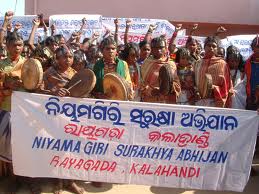
Anti Vedanta leader Lada Sikaka Majhi released


Both the SPs of Rayagada and Kalahandi deny that anti-Vedanta activist Lada Sikaka Majhi (35) was tortured in custody. But the deep injury marks on Majhi’s body have something else to say. Majhi is associated with the Niyamgiri Surakshya Parishad, which is opposing the Vedanta Group’s proposed mining lease in Niyamgiri hills, spread over Kalahandi and Rayagada districts, both about 550 km south-west of Bhubaneswar.

It is meant to be a captive unit of the group’s R8,400-crore, 500,000-tonne aluminium plant in Orissa.

On August 9, Majhi was on his way to Raipur in Chhattisgarh in a vehicle, along with two other anti-mining activists, to board a train to New Delhi. They were to attend a meeting on the Forest Rights Act.

As their vehicle was passing through the Niyamgiri forest, more than 12 armed men with AK-47 rifles stopped their car, snatched the car key and a mobile phone, and dragged out Majhi, his companion Sana Majhi and a woman activist. The men packed them into another vehicle and drove towards Rayagada. They threw Sana Majhi and the woman out of the vehicle on the way.

“I could not see where they were taking me because I was blind-folded. After about four hours, my blind-fold was removed and I found myself in a police station,” Majhi said.

“There they started beating me with bamboo sticks. They accused me of being a Maoist, organising Naxal meetings on the Niyamgiri hills and uniting the Dangria Kandhs (tribe) to protest against Vedanta.

“I told them that I was not a Maoist and organising meetings of the Niyamgiri Surakshya Parishad, fighting for the protection of the hills. But they did not listen to me and beat me.”

This continued for the next three days, he said. The police then coerced out of Majhi a statement saying that he had sheltered Maoists. On the fourth day, they took his left thumb impression on a blank piece of paper and let him off with a warning: “No further meetings.”

When asked why Majhi was taken into custody, Rayagada SP Anup Krishna said: “We had information that he had Naxal links. We let him go the day after we found that he was just organising meetings for the Niyamgiri Surakshya Parishad.”Kalahandi SP Sudha Singh and Krishna denied that Majhi was beaten up. “He is lying,” Singh said

Source: Hindustan Times

Monday, August 23, 2010

Hurt Feelings and the Ground Zero Mosque


Chronology of a Bizarre Controversy

By GARY LEUPP

Here is the order of events producing this bizarre “controversy.”

2009: A Muslim organization having arranged to purchase an abandoned Burlington Coat factory on Park Place in Lower Manhattan plans to build a 13-story Islamic community center. It will feature a culinary school, conference hall, basketball court, swimming pool, and place of worship among other things and while principally servicing the Muslim community be open to all. It is to be called the Cordoba House, an apparent allusion to Muslim Spain in which Islam flourished alongside Christianity and Judaism from the eighth century up to the “Reconquest.”

In its mission statement the group says the center “will be dedicated to pluralism, service, arts and culture, education and empowerment, appreciation for our city and a deep respect for our planet. [It] will join New York to the world, offering a welcoming community center with multiple points of entry. With world-class facilities, a global scope and strong local roots, [the center] will offer a friendly and accessible platform for conversations across our identities.”

It will be four big city blocks away from where the World Trade Center once stood (“Ground Zero”). But since there are already about eight mosques in Manhattan, and a significant Muslim population in that highly diverse section of New York City, there is nothing remarkable about the group’s application to tear down the old factory building and construct the center.

The key organizer, Kuwait-born Feisal Abdul Rauf, is an imam of the Sufi school of Islam, generally described as “moderate” and mystical. He holds a degree in physics from Columbia University, had been hired by the FBI to conduct sensitivity training among their agents, and had worked with the U.S. State Department. He had met New York City mayor Mike Bloomberg, who strongly supports the plan for the center.

In December 2009 the New York Times runs an article on the project. It is generally positive, citing two Jewish leaders and the mother of a 9-11 victim in support. In the same month conservative commentator Laura Ingraham, guest-hosting FOX News’ “The O’Reilly Factor,” interviews Rauf’s wife, Daisy Khan. The interview is as Salon’s Justin Elliot later notes “remarkable for its cordiality.” “I can’t find many people who really have a problem with [the project], declares Ingraham. “I like what you're trying to do.”

On May 6, 2010, after a public hearing in which New Yorkers express strong feelings pro and con, the New York City community board committee unanimously votes to approve the project. Enter Pamela Geller, who maintains a blog called Atlas Shrugs. She has written a book about Barack Obama in which she alleges his real father was Malcolm X. She leads an apparently tiny wacko group called Stop the Islamization of America. Seeing the opportunity to have her moment in the sun (and she is soon interviewed by FOX News and CNN), she lashes out at Cordoba House. She declares on her blog, “this is not about religious liberty. No one has suggested abridging the First Amendment to stop the mosque, and to oppose the Ground Zero mosque is not to oppose the First Amendment. There are hundreds of mosques in New York, thousands in America. This is not a religious issue. This is an issue of national dignity and respect for those who were murdered at that site in the name of Islam.” She begins to organize a protest at the Park Place site.

Soon New York Post columnist Andrea Peyser references Geller’s group, falsely describing it as a “human rights group.” This brings the movement against the “Ground Zero mosque” out of the blogosphere and into the mainstream press. She sensationalizes the issue, falsely reporting that the center is to open on Sept. 11, 2011. A “controversy” erupts.

On July 16 Sarah Palin weighs in. Addressing not Muslims specifically but “Peaceful New Yorkers,” Sarah Palin twittered: “ pls refudiate [sic] the Ground Zero mosque plan if you believe catastrophic pain caused @ Twin Towers site is too raw, too real.” She adds two days later (after ammending “refudiate” to “refute”), “Ground Zero mosque is UNNECESSARY provocation; it stabs hearts. . .” Former House Speaker Newt Gingrich expresses outrage in multiple statements over the next month: “There should be no mosque near Ground Zero in New York so long as there are no churches or synagogues in Saudi Arabia.” “It’s not about religion,” he insists, “and is clearly an aggressive act that is offensive.” He says the center will be a symbol of Muslim “triumphalism,” and that building the mosque near the site of the 9/11 attacks “would be like putting a Nazi sign next to the Holocaust Museum.”

He writes, “‘Cordoba House’ is a deliberately insulting term. It refers to Cordoba, Spain–the capital of Muslim conquerors, who symbolized their victory over the Christian Spaniards by transforming a church there into the world’s third-largest mosque complex... every Islamist in the world recognizes Cordoba as a symbol of Islamic conquest.” In response to this absurb allegation the center organizers change the name to “Park51.”

(Gingrich who postures as an historian and scholar might have noted the Visigothic church was purchased by the conquering emir after 718 and that the Arabs during their rule in Spain pursued a policy of far greater religious tolerance than the Christians had before them. They allowed churches and synagogues to operate freely. When the Christians regained power, they expelled all Jews and Muslims, or forced them to convert, and conducted the Spanish Inquisition.)

Republican politicians smelling blood and opportunity continue to lash out. Minnesota Governor Tim Pawlenty says, “I think it’s inappropriate... From a patriotic standpoint, it’s hallowed ground, it’s sacred ground, and we should respect that. We shouldn’t have images or activities that degrade or disrespect that in any way.” Former Arkansas Gov. Mike Huckabee asks on his FOX program August 4, “Even if the Muslims have the right to build it, don’t they do more to serve the public interest by exercising the responsible judgment to not build it?” “The fact that someone has the right to do something doesn’t necessarily make it the right thing to do,” echoed Ohio Rep. John Boehner.

Former Massachusetts governor Mitt Romney’s spokesman adds: “Governor Romney opposes the construction of the mosque at Ground Zero. The wishes of the families of the deceased and the potential for extremists to use the mosque for global recruiting and propaganda compel rejection of this site.”

On August 13 President Obama hosts representatives of the Muslim community at the White House. “As a citizen,” he tells them, “and as president, I believe that Muslims have the same right to practice their religion as everyone else in this country. That includes the right to build a place of worship and a community center on private property in lower Manhattan, in accordance with local laws and ordinances. This is America, and our commitment to religious freedom must be unshakable.”

A Republican running for Congress in Maryland, Andrew Harris, denounces the statement: “He is thinking like a lawyer and not an American, making declarations without America’s best interest in mind.” Rep. Peter King, R-N.Y., also responds immediately: “President Obama is wrong. It is insensitive and uncaring for the Muslim community to build a mosque in the shadow of ground zero.”

Bob Schieffer, CBS News’ chief Washington correspondent observes that Obama’s attention to the mosque issue “elevates it to a national issue. Clearly, Republicans are trying to take every advantage of this they can... every single Democratic candidate now running for office is going to be asked about it.”

Democratic Party leaders quickly distance themselves from the president’s remarks. . “The First Amendment protects freedom of religion,” says a spokesman for Senate Majority Leader Harry Reid adding that the senator “respects that but thinks that the mosque should be built someplace else.”

Obama himself, startled by the response to his comments, has to elaborate almost immediately. “I was not commenting, and I will not comment,” he said, “on the wisdom of making the decision to put a mosque there. I was commenting very specifically on the right people have that dates back to our founding. That’s what our country is about.”

A CNN poll published in August 11 shows 68% of Americans opposed to the center, and a FOX poll published August 13 shows that 61% of U.S. residents support the legal right to construct Park 51 but 64% don’t want the Muslim group to construct it. This becomes the mandatory position of all politicians: they’ve got a right to do it, but they shouldn’t. It would not be politically wise to suggest a general ban on mosques or Islamic community centers. But everyone has to say, this particular project is wrong because it showsinsensitivity to the feelings of “Americans” particularly family members of the 9-11 victims. Justin Quinn, who maintains the “U.S. Conservative Politics Blog” for example, justifies his disapproval by suggesting the building will hurt “thousands of people who continue to mourn the loss of loved ones who were turned to dust in the attacks.”

But there is another issue as well. New York gubernatorial candidate Rick Lazio, Gingrich, and Quinn all call for an investigation of the center’s funding, suggesting that some of it might come from “Islamic terrorists.” Lazio speaks ominously about the “the questionable backers of the Cordoba Mosque at Ground Zero” and calls for a public investigation. Quinn says, “let’s at least find out where the money is coming from to pay for this thing.” Soon House Speaker Nancy Pelosi is on board the program, although, alarmed at the backlash from Obama’s remarks, she suggests the “anti-mosque” movement should also be investigated.

By innuendo they assert that Rauf is linked to international terrorism. That seems unlikely since he’s been hired by the FBI since 2001 to offer sensitivity training to agents and has also just been asked by the State Department recently to tour the Middle East to “foster greater understanding” about the U.S. and its Muslims.

The charge seems based solely on the fact that in a June 2010 interview with Aaron Klein of New York’s WABC Radio, he declined to say whether he agreed with the listing of Hamas as a “terrorist organization.”

He declined to do, replying, “I’m not a politician. I try to avoid the issues. The issue of terrorism is a very complex question.... I’m a bridge builder. I define my work as a bridge builder. I do not want to be placed, nor do I accept to be placed in a position of being put in a position where I am the target of one side or another.”

(I see nothing damning here. Hamas, initially promoted by Israel as an alternative to secular Palestinian nationalism, has resisted Israeli occupation of Palestinian lands. It maintained long-term ceasefires with Israel ended due to Israeli action. It won a fair election in 2006. The U.S. State Department has considered it a “terrorist organization” since at least 1994 but the European Union only added it to its blacklist in 2003 under U.S. pressure. Many people including former President Jimmy Carter have asked that it be removed from that list, which is highly political and arbitrary and under no meaningful Congressional oversight. A U.S. Appeals Court recently ruled that the State Department must review its decision to list the People’s Mujahadeen Organization of Iran as “terrorist.” These things are very political, and no one should demand that Rauf endorse the listing. Certainly not those opposed to “Big Government” and its expectations of passive obedience from the citizenry.)

There are also wild accusations (aside from Gingrich’s cited above) that the center is designed to rub 9-11 in our noses. “The mosque at Ground Zero,” Quinn insists, “is being pursued to prove a simple political point -- that Islamic fundamentalists can knock our buildings down, murder our citizens and then use our own laws against us so they can laugh in our faces.”

There are also hateful, provocative comments. Tea Party Express leader Mark Williams blogs his followers: “The monument would consist of a Mosque for the worship of the terrorists’ monkey-god (repeat: ‘the terrorists’ monkey-god.” if you feel that fits a description of Allah then that is your own deep-seated emotional baggage not mine, talk to the terrorists who use Allah as their excuse and the Muslims who apologize for and rationalize them) and a ‘cultural center’ to propagandize for the extermination of all things not approved by their cult. It is a project of American Society for Muslim Advancement and the Cordoba Initiative, essentially the same group of apologists (but under 2 different names) for terrorists and the animals who use it as a terrorist ideology. They cloak their evil with new age gibberish that suggests Islam is just misunderstood.”

* * *

Thus by mid-August a modest project by a mainstream U.S. Muslim group backed by the New York City mayor and unanimously approved by the New York City community committee has been transformed into a general attack on Muslim rights in this country. The scary thing is that disapproval is so widespread, bipartisan, and driven by irrational fear if not hatred.

What does this tell us about this country? It tells us that nine years after 9-11 (and nice centuries after the First Crusade), Islamophobia is rampant and politically useful. Even though U.S. troops are supposedly fighting to help Muslims in two countries and both Bush and Obama have officially (for whatever reasons) emphasized that the U.S. is not against Islam, Islam is a religion of peace, we value our Muslim citizens, etc. the “us vs. them” mentality remains strong.

The prevalent argument against the center---that it may hurt people’s feelings---is an argument that people should be hurt by the mere existence of an Islamic site near “Ground Zero.” That they should feel hurt at the site of a Muslim establishment as they walk around Lower Manhattan, associating it with the 9-11 hijackers. That they should conflate Mohamed Atta and Rauf, or that at least if they do, their feelings should be respected. Of course Rauf’s hope is to counter precisely such feels by encouraging understanding and dialogue. (The fact in any case is that according to an August 10 Marist poll only 31% of Manhattan residents oppose the center!)

What about the feelings of U.S. Muslims, including those who had family members perish in the 9-11 bombing? They read about the plans of the “Dove World Outreach Center” in Gainesville, Florida---a “New Testament church, based on the Bible”---to promote an “International Burn a Quran Day” this September 11. They read about anti-mosque campaigns in Murfreesboro, Tennessee; Temecula, California; Sheboygan, Wisconsin. The Tea Party movement and mainstream politicians enthusiastically embrace the anti-mosque movement. I imagine there are some hurt feelings among people unfairly associated with terrorism just because a handful of Saudis attacked the U.S. nine years ago. To be told “this sacred ground---our Americanground” so we don’t want your Muslim center here “degrading” and “disrespecting” it (Pawlenty’s terms) is to be told you’re not really a full citizen and your religion (as opposed to, say, Catholicism) isn’t an American one. It must be insulting.

The notion that “they attacked us”---that the whole Muslim world attacked “us”---is so preposterous that only the simplest minds can believe it and the most devious exploit their ignorance for political gain. The U.S. has attacked Muslim countries, or intervened to impose regime change, repeatedly in the post-war period. Since 1967 it has provided nearly unconditional support to Israel, inevitably endorsing or accepting its grotesque mistreatment of the Palestinians. It cruelly maintained sanctions against Iraq throughout the 1990s, resulting in at least half a million children’s deaths. It provides massive aid to hated dictators like Egypt’s Hosni Mubarak. It has killed hundreds of thousands of civilians in its latest attack on Iraq. It maintains an increasingly unpopular occupation of Afghanistan and by its drone attacks on Pakistan has thoroughly alienated the Pakistani people. It is natural for Muslims globally to see themselves under U.S. attack. That a few have responded with terrorist attacks is unsurprising; the CIA calls it “blowback.” It is also natural for most, like Rauf, to want to respond to all this with peaceful education and dialogue.

The problem isn’t limited to the U.S. Other western countries are also manifesting Islamophobia, placing Muslims on the defensive. In March 2005 the French parliament voted to ban Islamic head scarves in public schools. This has forced French Muslim schoolgirls to choose between following rules set down in the Qur’an and receiving public education. In 2005 the Danish right-wing newspaper Morgenavisen Jyllands-Posten “invited members of the Danish editorial cartoonists union to draw Muhammad as they see him.” Since Muslim teaching forbids depiction of the prophet, and since it was assumed many cartoons would depict him a terrorist, this was a deliberate provocation. In December 2009 Swiss voters voted in a referendum to ban further construction of minarets in the country. There are only four.

There are a lot of hurt feelings about violent attacks, and Muslims in Gaza, Lebanon, Iraq, Afghanistan, Pakistan and elsewhere frankly have more cause for them than the people of New York City. The loss of 2976 people on 9-11 was tragic. But more than that number of civilians were killed by U.S. bombing between October 2001 and March 2002, and the loss of life in Iraq due a war based on lies (including the Islamophobic conflation of al-Qaeda and Saddam) has been catastrophic. And there are lots of hurt feelings over discrimination, experienced throughout the western world.

The controversy over the Islamic center shows us that neither the politicians nor pundits nor people in general understand that, and so seem hell-bent on generating more Muslim resentment. Nothing good can come out of that.

Gary Leupp is Professor of History at Tufts University, and holds a secondary appointment in the Department of Religion. He is the author of Servants, Shophands and Laborers in in the Cities of Tokugawa Japan; Male Colors: The Construction of Homosexuality in Tokugawa Japan; and Interracial Intimacy in Japan: Western Men and Japanese Women, 1543-1900. He is also a contributor to CounterPunch's merciless chronicle of the wars on Iraq, Afghanistan and Yugoslavia, Imperial Crusades. He can be reached at:gleupp@granite.tufts.edu

Followers