Thursday, October 21, 2010

DEMOCRATIC FRONT AGAINST OPERATION GREEN HUNT, PUNJAB HOLDS A MASSIVE CONVENTION AT JALANDHAR!


ICAWPI

DEMOCRATIC FRONT AGAINST OPERATION GREEN HUNT, PUNJAB HOLDS A MASSIVE CONVENTION AT JALANDHAR!

BUILD A BROAD SPECTRUM OF RESISTANCE MOVEMENTS!

OPPOSE NEO-LIBERAL POLICIES AND SUPPRESSION OF PEOPLES’ MOVEMENTS THROUGH ARMED FORCES!

On 17th October, when people were celebrating Dussehra to mark the victory of Good over the Evil, the Democratic Front Against Operation Green Hunt, Punjab, held a massive Convention in Desh Bhagat Yadgar Hall, Jalandhar on “War against the people & Role of Democratic Forces.” It was addressed by noted pro-people thinker & Booker Award winner writer Arundhati Roy and Gandhian social activist Himanshu Kumar. Hundreds of people from all walks of life – University Professors, Research Scholars, Students, Artists, littérateur, cultural activists, press-persons, farmers, agricultural & industrial laborers, trade unionists, thinkers etc., participated from all across Punjab & Chandigarh. The Convention Hall having a seating capacity of 900 was overfilled & hundreds of people were left to hear the programme from outside the Convention Hall.

The Convention Hall was tastefully decorated with flex-hoardings having appropriate messages. The theme hoarding had the poem by Pastor Martin Niemoller – ‘FIRST THEY CAME FOR THE COMMUNISTS’, with a painting depicting peoples’ struggle in the background. Two others were having poems by two noted peoples’ poets of Punjab Sant Ram Udasi- MAGHDA RAHIN VE SURJA (Shine O Sun brightly) & Pash- ASIN LARANGE SATHI(Comrade! We will fight). There were quotations from Shaheed Bhagat Singh, ‘HAWA MEIN RAHENGI MERE KHIALON KI BIJLIAN’ (I may or may not live, but my ideas will remain galvanizing the air eternally)

The Convention was presided over by a presidium consisting of Dr. Parminder Singh (Professor Guru Nanak Dev University, Amritsar), Prof. A.K.Maleri (Ludhiana), Sh. Yash Pal (Retired Teacher and Editor VARG CHETNA), Prof. Ajmer Singh Aulakh (Noted pro-people Punjabi Dramatist), Com Gandharav Sen Kochhar & Sh. Naunihal Singh(both from Desh Bhagat Yadgar Committee, formed to honor the martyrs of Gadar Movement).

Arundhati Roy opened her speech with the remark that the Indian state has been waging a war against its own people in many parts of the country such as North East, Kashmir, Punjab and many other places for the last 60 years using military and the police to ruthlessly suppress them. She paid rich compliments to the poor people and tribals living in the forests of Chhattisgarh, Jharkhand, Orissa, Andhra, West Bengal & Maharashtra, who were fighting valiantly to save their lands, forests, water & mineral wealth from being plundered by the world’s richest companies. Preaching non-violence to the tribals of Chhattisgarh is immoral. To those, who accuse the tribals of being violent, she asked: ‘When people are forced to die of hunger, when they are uprooted after depriving them of their lands & livelihood, in the name of development, is it not violence?’ Is it not ironic to advise those, who have empty stomachs and empty pockets, to follow the Gandhian tools of hunger strike and boycott of foreign goods?

She said that to oppose Operation Green Hunt, one need not go and fight in the jungles of Dantewada. Fighting against injustice at our own place is also an important contribution to this cause. Struggles against SEZ and the exploitative Commission Agent (ARHTIYA) system in Punjab are part of the fight against Operation Green Hunt. She called upon the intellectuals and toiling sections of the masses to build a broad spectrum of resistance movements against the neo-liberal policies of the State and its onslaught on the peoples’ movements in the form of armed operations such as Green Hunt.

Commenting on the ongoing events in the states under Operation Green Hunt, she said that there is a strong link between development and genocide. There is genocide under the façade of development. When the people are uprooted from their lands, culture sources of livelihood, they are doomed to die. In India Crores of people suffer from the AIDS of malnutrition. Malnutrition not only leads its victim to death, but casts its agonizing shadow on the next generations also.

She said while the Naxals are fighting a protracted war against the capitalist system and big corporates, the Indian state was fighting war against its own people. She suggested having diverse methods of resistance in a wider struggle to challenge oppressive policies of the state.

She said the Green Hunt began in Punjab earlier than Chhattisgarh, with the advent of “Green Revolution”. Green Hunt is in fact the phenomenon to deprive the people of their land and the resources attached to it such as water, forests, mines etc. Green Revolution and the farmers’ suicides in its aftermath is pointer to this. About 1,80,000 debt trapped farmers have committed suicides in the country.

She deplored the Punjab Govt for having branded the 17 organizations of farmers and agri-labourers as Naxalite front organizations. Those who raise their voice against injustice are branded as Naxalite. If the rulers continued to follow the policies of privatization & liberalization, then they shall have to deploy army in the whole country. In two decades of neo-liberal policies, the number of people below poverty line have increased manifold, while 100 people own 25 percent of national wealth.

She said the Indian democracy has become shallow. Democracy doesn’t mean mere periodic elections. Democratic rights of the people are being trampled under the foot. Indian Constitution has lost its meaning as the judiciary, media & Parliament have all been made to serve the corporates and monied people. Media is in the hands of corporates. Courts have gone beyond the reach of common man and have become a tool to endorse neo-liberal anti-people policies of the State.

There was a lively discussion on her speech and she answered most of the questions raised by the participants.

Noted Gandhian Himanshu Kumar, who had gone on a cycle-yatra of Rajasthan, Gujrat & Maharashtra, after addressing 16 conventions against Operation Green Hunt throughout Punjab on the invitation of the Democratic Front, shared his assessment of the situation prevailing in those states. He said the situation was explosive everywhere. There were many Dantewadas in the making due to anti-people policies of the rulers. He said in Gujarat, the Forest Rights Act envisages grant of land up to 10 acres on lease to tribals in the forest areas. But Modi Government has not granted even an inch of land to them. But the same Govt has gifted away 1,02,000 acres of land to 176 corporate houses. A functioning university has been closed to provide land to Tata’s Nano plant. A hundred people of this country control 25 percent of its wealth.

Our Prime Minister says the people are becoming violent. But the question is why after six decades of independence, there is violence. Are only the Naxalite responsible for this violence? In fact the development model being implemented by the rulers is resulting in the poor becoming poorer and the rich becoming richer. Development has become synonymous with depriving the poor of their livelihood resources, such as land, water, forests, mineral wealth etc., to fill the coffers of the rich. It will definitely breed violence. Instead of following the principles of social justice and equity, we are following the law of jungle, where might is right.

This situation has to be changed. Quoting Gandhi & Vinoba Bhave, he said that if injustice and inequity persists in the society, violence is inevitable, because the victims of injustice & inequity cannot be expected to take the things lying down; they will definitely revolt to change the system, to assert their rights. He said injustice must not be tolerated. It should be resisted at all costs. Non-violence should never become an excuse to run away from the fight against injustice.

Both the speakers were presented with the portraits of Shaheed Bhagat Singh, a poster with Pastor Niemoller’s poem, and a set of three books- ‘History of Gadar Party’, ‘History of Naujwan Bharat Sabha’ & ‘Dialogue with the Revolutionaries’. Mrs. Veena wife of Himanshu Kumar, who spent 18 years with him at Dantewada, serving the tribals was also honored.

After the convention Arundhati Roy held an interaction with Research Scholars & students from three universities of Punjab & prominent historians in the Gadar Museum Hall. She along with Himanshu Kumar & his family and Sanjay Kakd went around the museum evincing keen interest in the revolutionary history of Punjab, particularly the Gadar movement.

At the end of the convention the participants passed resolutions with raised hands demanding an end to Operation Green Hunt; withdrawl of military and para-military forces from the tribal areas; disbanding Salwa Judam & such other fascist organizations; recognizing the rights of tribals over their forests, lands, water and natural resources; stopping SEZ and uprooting of tribals in the name of development; roll-back neo-liberal policies of privatization, globalization & liberalization; repeal black laws such as Armed Forces Special Power Act, Unlawful Activities Prevention Act etc.; stop false encounters and implication of innocent people in false criminal cases; revoke the ban imposed on CPI Maoist and its front organizations; allow the pro-people press-persons and democratic organizations to visit tribal areas; hold judicial inquiry in the killing of Maoist leader ‘Azad’ in a fake encounter; stop the conspiracies to foist false cases on Arundhati Roy, Himanshu Kumar, Nisha Biswas, and other noted intellectuals; punish the murderers of peasant leader Sadhu Singh Takhtupura and Pirthipal Singh Alisher and the killers of peasants at Khanna Chamiara in Punjab; Stop implicating leaders & activists of mass organizations of farmers, agri-labourers, employees, unemployed youth in Punjab & other states in false criminal cases and torturing them; Close all the interrogation centers such as the one at Amritsar known as Joint Interrogation Center.

From jail, Kobad Ghandy submits paper on inclusive growth to New Delhi seminar


Kobad Ghandy after his arrest

The Times of India, Oct 20, 2010

NEW DELHI: Maoist leader Kobad Ghandy has been in custody in the Tihar jail for months now, but his views on development seem relevant for those trying to address the issue of inclusive growth.

Sitting in his jail ward, Ghandy, one of the senior members of CPI (Maoist) politbureau and known for his intellectual inputs to the Maoist movement, presented a paper at the National Seminar on Development on Monday.

The two-day seminar, which ended on Tuesday, also had representatives from corporates like Microsoft India and the Tata Group, who tried to find ways of development that could include the masses.

Interestingly, the seminar — organised by Forum for Promoting Includisve Growth — that included speakers like CPI leader Sudhakar Reddy and civil society members like Sujato Bhadro among others had Ghandy’s eight-page hand written paper read out.

Apologising for not being able to write a better paper than the one that was presented for “lack of access to relevant information in jail”, he quoted profusely from government data as well as from UN reports to build his case that there is tremendous imbalance in development in the country. He quoted from the Atharva Veda and the Bible to explain the need to maintain an environmental balance while undertaking overall development.

Criticising the government’s lack of “spending on poverty alleviation measures” that could produce “long lasting and tangible” welfare measures that could sustain a people, Ghandy said, instead the government is spending on “airports, expressways, internet connectivity,” which he claimed “primarily benefits industry and businessmen.” He criticised the government welfare schemes, saying, “the bulk of government schemes are mere doles like the NREGA, SJPSY, AAY, APL, BPL etc. None of such projects are geared to create something tangible that can benefit the country in the long term and also benefit the individual in the form of providing irrigation, employment, health care, etc.”

NREGA, he explained, involves 36% in Tripura, 14% in UP and MP, 8% in Chhattisgarh, Jharkhand and Bihar. “So where did all the money go?” he asked. He accused the government for not even building proper infrastructure for storing food grains, which are rotting when so many people go hungry.

Parliamentarians, he pointed out, have given themselves a 300% hike in salary and perks. The approach “requires remedial measures.”

Wednesday, October 20, 2010

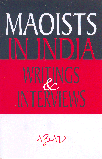
New book: Maoists in India-Writings and Interviews by Azad


This book is also available in PDF (142 pages) in Banned Thought.


This is to announce a new book – Maoists in India: Writings & Interviews by Azad, published by Friends of Azad. Below are the Preface and Table of Contents to generate your interest. The book is priced Rs 100 in India and $ 6 outside India. The books can be had from Varavara Rao, 203, Lakshmi Apartments, Malakpet X Roads, Hyderabad, India 500036.
With regards

Friends of Azad

In Honour of Our Friend

We, the friends of Cherukuri Rajkumar (Azad), present this bouquet of his writings and interviews collected from popular newspapers and websites, to all those who are interested to know the ideas of the Maoist politics in India in general and Azad’s articulation of the politics in particular. Azad has been our friend for more than thirty years and as much time, two thirds of his short life of 56 years, he spent developing, exploring, elucidating and debating these ideas.

A voracious reader and prolific writer that he was, the writings collected here might be less than a tenth of his literary output. Much of his writing was anonymous or under different pseudonyms in clandestine journals and documents and we leave it for future research to prepare his collected works, most probably with active support from the party for which he was a spokesperson, member of Central Committee and Politbureau at the time of his brutal killing by police on July 2, 2010 in Adilabad forests of Andhra Pradesh.

His death brought back his memories to us and we, from different walks of life, began cherishing his recollections more after his death. Indeed he began living amongst us more vigorously after his death, justifying the saying “a tyrant dies and his rule is over, a martyr dies and his rule begins”. Azad’s writings, statements, opinions, letters and his expositions of the revolutionary movement that is spreading leaps and bounds are reverberating in the present more vociferously. During the last three months after his cold-blooded killing by the police his name is more visible in the news than when he was alive.

We, as friends of Azad, thought it was our duty to propagate his ideas, his personality and his thoughts and writings. Even as we understand that his party would be in a better position to undertake that effort, we also wanted to add our bit to the task. Within one week of his death, we brought out a small collection of obituary articles written by prominent journalists and civil libertarians in Telugu. We were overwhelmed by the international response against his killing and brought out another slim volume of statements of solidarity and condolence issued by various parties, oraganisations and individuals across the world.

This book, in that process, is our third attempt to propagate Azad’s ideas. All these articles and interviews appeared in popular newspapers like Economic and Political Weekly, The Hindu, Mainstream, People’s March, etc. and available on the net. We gratefully acknowledge all the publications and websites.

We distributed our earlier publications to all those people we knew but we thought this book should be available to all those whom we may not know, but really want the book. We would like to remind all those that given the kind of repression prevailing in India now it would be difficult to identify ourselves. Hence we requested revolutionary writer Varavara Rao, who was an emissary of the CPI (Maoist) when the latter had peace negotiations with the government of Andhra Pradesh, to lend his address to the book. We are thankful to him for accepting our request.

Our friend Azad lives here in his words. In his eloquence. In his turn of phrase. In his penchant for truth. In his meticulous approach. In his incisive analysis. In his steadfast practice. In his supreme sacrifice. Azad continues to inspire.

Table of Contents

Preface

A Brief Biography

Azad’s Writings and Interveiws

1. Maoists in India October 2006

2. On the ‘Comprehensive Peace Agreement’ in Nepal December 2006

3. Interview on the Developments in Nepal May 2008

4. On V Prabhakaran May 2009

5. On Patel Sudhakar Reddy & Venkataiah May 2009

6. On the Election Boycott Tactic of the Maoists September 2009

7. Interview on the Governments’ military offensive October 2009

8. On Talks October 2009

9. On Balagopal October 2009

10. On Telangana December 2009

11. On Sakhamuri Appa Rao & Kondal Reddy March 2010

12. On Dantewada Guerilla Attack April 2010

13. Interview to The Hindu April 2010

14. Letter to Swami Agnivesh May 2010

15. On Jnaneswari Express Tragedy May 2010

16. On Bhopal Verdict June 2010

17. A Last Note to A Neo-Colonialist July 2010

Monday, October 18, 2010

The Communist Hypothesis


A short review appeared in the Irish Left Review on Alain Badiou latest book The Communist Hypothesis.

Seán Sheehan

Alain Badiou could be the most important philosopher alive today - time will tell - and his work is gradually reaching English-speaking readers. His magnum opus, Being and Event, took 17 years to appear in English but its follow-up Logics of Worlds only three and his What is The Meaning of Sarkozy (see the ILR review here) has hit the mark in the UK as well as in France. Badiou’s term Communist Hypothesis has been circulating since The Meaning of Sarkozy appeared, first in a piece he wrote for the New Left Review early in 2008 and then at the On The Idea of Communism conference in London last year.

Along with Žižek and other important voices opposing the pop-politics of postmodernism - the age of ideology is over, its us versus Islamic fascism, the big society, we’re all in this together, save the planet - the conference asked what meaning communism can now have for us. Is it not a discredited term, already in the dustbin of history and waiting for the lid to be firmly closed before being taken off and recycled as pap for academics and dumbed-down scare stories for our grandchildren?

We seem to be at a point of impossibility when it comes to radical change and fidelity to emancipatory politics. InThe Communist Hypothesis Badiou traces two historical sequences: the first from the French Revolution to the 1871 Paris Commune, the second from the Bolshevik revolution of 1917 to the Cultural Revolution in China. We are now in a limbo, like that between 1871 and 1917, an ‘interval phase dominated by the enemy’ and the challenge is to break through to a third sequence - hence the communist hypothesis. What there cannot be is a belief in some ‘objective’ agent written into the social order and destined to subvert it; nor the concomitant belief in a party organizing this agent of change. What there must be is the belief in, a commitment to, a world not run for private profit. Without holding on to this, Badiou argues, if post-modern capitalism and parliamentary politics is accepted as the only game in town, then the other possibilities are simply not seen even though they are inherent in the situation.

‘We have to convince ourselves that there is nothing ridiculous or criminal about having a great idea. The world of global and arrogant capitalism in which we live is taking us back to the 1840s and the birth of capitalism …. Too many people now think that there is no alternative to living for oneself, for one’s own interests. Let us have the courage to cut ourselves off from such people.’ (p. 67)

The hypothesis has to be a communist one because otherwise we will find ourselves being persuaded by listening to something very similar coming from the mouths of a Cameron or Obama. It is not that difficult to imagine one of them using a similar form of words to those just quoted in their next election campaign. Communism means not buying into some fatuous ‘vision thing’, subtracting out instead and thinking a new kind of politics based on the dispossessed, not aligned with existing parties and institutions.

Of course the word ‘communist’… has been cheapened and prostituted. But if we allow it to disappear, we surrender to the supporters of order, to the febrile actors in the disaster movie …. a politics reinvented at the grassroots level of the popular real, and the sovereignty of the idea …it will distract us from the disaster movie and remind us of our uprising. (P. 100)

What, though, prevents communism from being unrealizable, visionary, intrinsically unsafe given Stalin, the show trials, the gulags? Badiou’s transformative philosophy, a metapolitics that seems quite improbable given its basis in the mathematics of set theory, is the short answer to this. His central claim that ‘mathematics is ontology’ does not mean that being is mathematical but that mathematics expresses the ontological truth that there is no ‘one’, no ultimate harmony or consistency to being. There is no God, not totality, only what Badiou calls the ‘multiple’. So while a set presents a unified grouping it only does so because multiplicity is counted, as a ‘one’. What this means in practice is that the seemingly impossible, that which is not counted, is possible.

The realm of politics is concerned with the contingencies of every situation, the forms of subjectivity that can arise, and the unpredictability of the new. Revolutionary change is the bringing into the count what was previously excluded, the undoing of the rules, insurrection by the uncounted, and the challenge to the State which operates to stabilize the multiple, to limit the possibilities. Most of The Communist Hypothesis is about how this happened in May 1968 in France, in China’s Cultural Revolution and in the Paris Commune of 1871 and how a truth, a term of special meaning for Badiou, emerges from the consequences of these ‘events’. A term that also has a special significance in Badiou, an event is a rupture in the normal order of things that inaugurates possibilities from the seemingly impossible. This abstruse territory is the concern of the last section of The Communist Hypothesis but it is rooted in real life and one realises how the philosophy does give substance to the political. In practice and as consciousness, a blending of ‘facts’ with possibilities is always there, an elusive dimension that connects an ordinary individual with the idea that surprises happen, things could be very different. This is the idea of communism and the name is worth keeping because it connects us with all those who struggled in the past and keeps the possibility of change in the foreground. ‘We can, so we must’ Badiou concludes.

The Communist Hypothesis, like The Meaning of Sarkozy, can be read unaided but when it comes to most of his other works readers are likely to banjaxed without some assistance. Alain Badiou: Key Concepts can be recommended as a sound introduction to the range of Badiou’s thought. Its virtue, especially for a collection by different writers, is an unpretentious style that carries the reader along despite some fairly difficult ideas. The essays on Ontology and Politics relate most directly to The Communist Hypothesis but there is plenty more to whet your appetite and point the way forward to a reading of the formidable Being and Event. There is a title in the Reader’s Guides series from Continuum that sets about explicating the text. The style is off-putting at times, overloading itself with academese but it provides useful pointers and before you know it you’ll be googling set theory and back at school poring over mathematical symbols.

Sunday, October 17, 2010

Revolution Highway - Book by Dilip Simeon


The Revolutionary Road - Review by Subodh Verma

What happens to a dream deferred?

Does it dry up
like a raisin in the sun?
Or fester like a sore—
And then run?
Does it stink like rotten meat?
Or crust and sugar over—
like a syrupy sweet?
Maybe it just sags
like a heavy load.
Or does it explode?

It was 1951 when these famous lines were penned by Langston Hughes, a Black writer and poet who shot to fame in the Harlem Renaissance of the 1920s. He was, of course, thinking about the American Blacks' struggle for dignity and justice. Dilip Simeon's novel on the Naxalite movement in the late sixties comes close to giving answers – if rhetorical questions like these need answers.

Naxalbari dramatically came into the public consciousness in 1967 and, for the next few years, a violent peasant revolution was on the agenda – or so it seemed. Simeon sketches out the ingredients of what went into making those heady, intoxicating days. There was a worldwide upsurge against the brutal US war against Vietnam, with dozens of US university campuses turning into battlefields. In France, a student rebellion broke out backed, for some time, by a general industrial strike. The Chinese Communist Party emerged as an active supporter of all kinds of uprisings in the third world, propelled by its extreme Cultural Revolution ideology. Within China, intellectuals and party leaders were thrown aside as students quit their studies and left for the countryside to continue the revolution.

Inspired by this ferment, and angered by extreme poverty and injustice in India, many middle class intellectuals and students joined the Naxalite struggle. Among these were a group of students from Delhi's St. Stephen's college. Simeon narrates their story, referring to the college by its other, less well known name, Mission College. Although his sympathy lies with the students, Simeon spares nothing in describing their doctrinaire understanding, their Chaplinesque attempts to incite the leaden peasant to revolutionary acts, their pathetic attempts to understand their failures. Simeon's knowledge of those years and events is authentic, right down to the hideouts in north Delhi's poor colonies and the strains of Hendrix and Joplin. The depressing inevitability of what is to come – complete and total rout – fills the whole book. Mercilessly ground down by the police, the movement descends into squabbling, bloodthirsty packs fighting a bitter battle for survival on the streets of Calcutta.

It is a vast, epic theme – the crushing of dreams – and Simeon succeeds in showing that it was foretold – because of false premises and erroneous means. The text is deconstructed, flitting between times and places. The prose is laconic, often unattractively so, although Simeon's penchant for Hindi swear words is in full play.

Yet, the novel leaves one tortured – is there no hope? Is all action futile? Is injustice infinite? Simeon is unable to hint at anything because this work is an attempt to show that all violence is doomed to fail. In that ahistorical straitjacket, answers are not easy. One is reminded of lines from a Pink Floyd song, ca.1979 – "The child is grown, the dream is gone. I have become comfortably numb.

Naxals spread wings, more Bengal districts want LWE-affected status

Maoist road blockade in Lalgarh area of West Bengal. Naxals spread wings, more Bengal districts want LWE-affected status

Express News Service, October 15, 2010

Kolkata: The Left Front may be claiming success in the anti-Maoist operations in Junglemahal but an internal government report indicates that the ultras who till now had been confined to Junglemahal — Purulia, West Midnapore and South 24 Parganas — have spread to other nearby districts.

The police and local administrations of Birbhum, Nadia and Murshidabad districts have submitted a report to the state home department requesting that some police stations in their districts should be brought under the ambit of Left Wing Extremism-affected area considering the increased activities of the Maoists there.

According to the reports submitted by the state police to state home department, eight police stations in Nadia, six police stations in Birbhum and three police stations in Murshidabad have seen increased Maoist activities in recent months.

“The reports and the recommendations have been submitted to us and we have forwarded it to the state home department. After scrutinizing the facts, the report will be sent to the Centre for approval from the state home department,” said Surajit Kar Pura Kayestha, IG (Law and Order).

Police sources said Dubrajpur and Khairashol police stations in Birbhum district, which have been mentioned as Maoist-affected areas, had always been a safe haven for the Maoists. “Several senior Maoists leaders, including Kalpana Ruidas, were arrested from the area,” said a senior police officer.

The report accessed by The Indian Express further states that the Maoists have formed a regional committee in Nadia and an area committee in Jalangi. There are over 30 members in the area committee. “The Maoists started setting up their base in the area after forming an outfit called Mazdoor Krishak Sangram Samity, which works like a frontal organisation of the Maoists much akin to the People’s Committee Against Police Atrocities (PCAPA) in West Midnapore,” said a senior police officer.

“As per the information we have gathered till now, the area committee is led by Prasanta Das alias Raja, a resident of Kotwali,” the officer added.

“Das is the key person in the area who is strengthening the cadre’s base in Murshidabad and Nadia districts. They have started spreading their influence in the colleges of the district,” the officer said.

Saturday, October 16, 2010

How Many Indias...


According to a report filed by the Arjun Sengupta Committee, which was formed to study the working and living conditions of workers in the unorganised sector, about 836 million people (77% of India’s population) subsist on Rs 20 a day each (about 26 UK pence) or less.And the National Sample Survey Organisation’s report on Household Consumer Expenditure in India, 2006-07, reports that the average Indian spends just Rs 440 or less in a month on food. In 1991, when the liberalisation process began, India was ranked 123rd in the UN’s Human Development Index. Today, it proudly occupies the 128th place.However India media is not interested in reporting things like this. Instead they are after news items like the one given below.

Mukesh Ambani ready to move into mansion in the sky


High living
Mukesh Ambani's 27-floor Antilia on Altamount Road took seven years to build.
MUMBAI: Antilia, the luxe 27-storey home of India's richest person Mukesh Ambani in south Mumbai, is ready for housewarming during the ongoing festive season. The building, which stands taller than most buildings in the vicinity and is visible from a distance in every direction, bears the name of a legendary island in the Atlantic Ocean.

Mukesh Ambani, chairman of Reliance Industries, India's largest private sector company, whose personal wealth is estimated to be $27 billion, is set to move into his mansion by the end of the month. The palatial building, completed after seven years of labour, has three helipads on the top floor and has been billed as the most opulent home of an individual anywhere in the world. The Ambani scion has invited the who's who of the country for a sneak preview and celebrations on October 28.

Ambani's multi-million-dollar customized skyscraper in Altamount Road would have Kumar Mangalam Birla, scion of the Birla family, as one of his neighbours.

The glass tower that stands 570 feet tall features a swimming pool, a health club, a salon and a mini-theatre. The first six levels comprise the garage where more than 160 cars can be parked. Atop the parking lot is Antilia's lobby, which has nine elevators.
The lobby leads to numerous lounges, powder rooms and a ballroom. The top floors, with a sweeping view of the city, are where the 53-year old business magnate, his wife Nita and children Akash, Anant and Isha will reside. Nita, who has been managing the affairs at Dhirubhai Ambani International School and the Mumbai Indians IPL team, has been involved in every detail and aspect of the mansion, roping in international architecture firms Hirsch Bedner Associates and Perkins Will. No two rooms in the building look the same.

"I have seen several houses, including that of Lakshmi Mittal (owner of Arcelor Mittal). But Antilia is marvellous. I remember the house having a Picasso painting, it was one of its kind," said the chairman of a diversified telecom-to-retail business. The ballroom, according to him, was just stunning. He confirmed that he has an invitation to visit the new Ambani home on the 28th. For some others, it has become a talking point.

Currently, the elder Ambani brother shares the address with his estranged brother Anil Ambani, who manages Reliance Anil Dhirubhai Group of companies, at Sea Wind in South Mumbai's posh Cuffe Parade. Incidentally, the elder brother bought the plot on Altamount Road soon after the spat between the brothers became public. The two have patched up recently.


A Song for Azad


Kabir Suman, popularly known as the Bob Dylan of West Bengal, has been one of the strongest voices against the Indian government's crackdown on anyone who speaks up. If poverty and malnutrition disturbs you, and you voice your discontent loudly, the govt. terms you a Maoist. Speak up against the millions of tribals whose houses are burnt or women are gangraped - because those tribals wouldn't let the corporates grab their only possession, their land - then the govt. calls you a Maoist.

And so was Maoist leader Azad killed. In this video, Kabir Suman sings out the irony of lies floated by the govt., with regards to Azad's "encounter" death. Really, how many more encounters will it take before we realise what a farce democracy, what a rotten government, and most importantly, what a silent voyeuristic populace we are?

Please download the song before it is deleted from this site by a paranoid govt. This home-made video is not of the best quality, but those of you who would want a better quality audio (mp3 format) of this song, write to me at aa.priyanka@gmail.com

Mao Mao...A Song from Godard's La Chinoise


song from godard's la chinoise (1967) written by Claude Channes:
translated in english:
Vietnam burns and me I spurn Mao Mao
Johnson giggles and me I wiggle Mao Mao
Napalm runs and me I gun Mao Mao
Cities die and me I cry Mao Mao
Whores cry and me I sigh Mao Mao
The rice is mad and me a cad
It's the Little Red Book
That makes it all move
Imperialism lays down the law
Revolution is not a party
The A-bomb is a paper tiger
The masses are the real heroes
The Yanks kill and me I read Mao Mao
The jester is king and me I sing Mao Mao
The bombs go off and me I scoff Mao Mao
Girls run and me I follow Mao Mao
The Russians eat and me I dance Mao Mao
I denounce and I renounce Mao Mao
It's the Little Red Book
That makes it all move

Punjab - Statements condemn illegal detention of democratic rights activists


Punjab - Statements condemn illegal detention of democratic rights activists

Press Statement from People’s Union For Democratic Rights

October 13, 2010

PUDR strongly condemns the picking up and illegal detention of Gurmeet Juj , Punjabi writer and rights activist , and three other activists Harbans Singh, Satish and Raju apparently by the Ferozepur police on the 11th of October . As per information dug out by Gurmeet Juj’s wife with great difficulty, he is being held at the the CIA Staff Police Station for being interrogated by CBI and Punjab CID on his political views concerning Operation Greenhunt.

The illegal detention of the four raises serious questions: What is the crime for which they have been detained? If indeed the police has any such information about criminal activity why haven’t they been arrested and due legal processes followed? If the police has only taken them for questioning on suspicion, why again haven’t the families been informed? The absence of evidence and criminal procedures clearly indicates that they are being detained, harassed and perhaps tortured for their politics, rather than any crimes they have committed. This becomes evident when we consider that Juj is a reputed poet, singer and democratic rights activist whose opposition to Operation Greenhunt is already very much in the public domain as he is a member of the ‘Democratic Front Against Operation Green Hunt’.

Gurmeet Juj and the other three activists’ detention is part of the concerted efforts of the Punjab government to repress all peoples’ organizations and voices of dissent in the state. In March, 2010 Dr. Darshan Pal of the Peoples’ Democratic Front of India and several other members of BKU were picked up when they were part of large scale protests against the police. Mr. Surjit Singh Phool, President BKU, and Mr. Sanjiv Kumar of Krantikari Pindu Mazdoor Union (KPMU), both organizations working for farmers’ rights were arrested in November, 2009 and May, 2010 respectively. Both were subjected to torture at the Joint Interrogation Center and CIA Staff office, known torture centers the threat of which was also used to terrorise others called for questioning as found by PUDR in a factfinding conducted jointly with AFDR, Punjab.

The illegal detention of the four activists in Punjab not only exposes the fascist nature of a state that muzzles freedom of belief and protest ; but it also once again reveals the blatant violation of rule of law by the very state that claims to uphold it. Moreover it draws attention to the various state agencies that exist and operate with a high level of secrecy and absolute impunity, in direct contradiction to the claims of transparency and democratic functioning being made by that government.

The secret , illegal custody of Gurmeet Juj, Harbans Singh, Satish and Raju raises suspicions about the state’s intentions, and makes us seriously concerned about their safety and well being .

PUDR demands that:

1. Gurmeet Juj, Harbans Singh, Satish and Raju be immediately produced before a magistrate. 2. Their families be informed of immediately informed of their whereabouts. 3. All four be unconditionally released. 4. The officials guilty of illegal detention of the four be immediately prosecuted. 5. The CIA Staff be shut down pending a judicial inquiry into its activities. 6. Freedom of political belief and democratic protest be respected by the state.

Moushumi Basu and Asish Gupta

(Secretaries, PUDR)

**************************************************************************** Press Statement by Forum Against War on People (Delhi)

Raising Voice Against Government’s War (Operation Green Hunt) on Adivasis is a Democratic Right of the People

October 12, 2010

Gurmeet Singh Juj, a Punjabi writer and cultural activist of All India League for Revolutionary Culture, AILRC and a State Committee member of ‘Democratic Front Against Operation Green Hunt, Punjab’, and three other persons Harbans Singh, Satish and Raju (all are progressive social activists) were taken into police custody in Ferozepur on 11.10.2010. The police did not inform anyone, about the case or FIR under which they has been arrested or where they have been kept during detention.

After a lot of running around finally Gurmeet Singh’s wife and friends were able to find out that he was being detained in the CIA Staff Police Station. Some police officials told them that he is to be interrogated by the Central Govt’s Intelligence Bureau & Punjab CID officials from Chandigarh about his political views and his activities against Operation Green Hunt. This is clearly another assault on the democratic movement and extension of Operation Green Hunt to the urban areas. The arrests need to be strongly condemned. It is also an attempt to terrorize the intellectuals, to keep them away from supporting the struggles of the people against neo-liberal policies of the rulers.

The Punjab police have arrested these activists with a view to disturb a convention against Operation Green Hunt scheduled for the next week in Jalandhar. The police may torture Gurmeet Singh Juj and implicate him in some false cases. All the democratic and progressive forces should raise voice against these illegal arrests.

We from the Forum Against War on People, Delhi strongly condemn the arrest of the cultural activists who have been consistently raising their democratic voice against the military operation on the people of Central and Eastern India code named Operation Green Hunt with a view to hand over people’s land and mineral resources to the big corporate houses. We demand that the arrested activists should be released immediately and unconditionally, and no false cases should be foisted on them.

SAR Geelani, G N Saibaba, Mrigank Convenors Forum against War on People

************************************************************************

Another Assault on Democratic Movement

A Report by N. K. Jeet (Lok Morcha, Punjab)

October 12, 2010

Gurmeet Judge, a Punjabi writer, and member of ‘Democratic Front Against Operation Green Hunt’, was taken in custody by Ferozepur police on 11.10.2010. The police did not inform anyone, about the case or FIR under which he has been arrested or where he was to be kept during detention. After a lot of running here and there, his wife and friends were able to find out that he was being detained in the CIA Staff Police Station. Some police officials told them that he is to be interrogated by the Central Govt’s Intelligence Bureau & Punjab CID officials from Chandigarh about his political views and his activities against Operation Green Hunt. This is clearly another assault on the democratic movement and needs to be strongly condemned. It is also an attempt to terrorize the intellectuals, to keep them away from supporting the struggles of the people against neo-liberal policies of the rulers.

Death stalks Dantewada


The Hindu

Death stalks Dantewada

Aman Sethi

— PHOTO : Special Arrangement

Five-year-old Sodi Jogi and her infant sister in Tartmetla village where, residents say, 25 people have died of suspected water-borne diseases this monsoon season and diarrhoea and many more are ill.

CHINTAGUPHA (CHHATTISGARH): The soldiers who inspect all that passes through the barbed wire barricades at their checkpoint here have spotted villagers bearing a tragic and unlikely burden.

“Bodies,” said Chintagupha Town Inspector Kurre, “I've seen at least 20 corpses in the last month; bodies in vehicles, bodies carried on simple wooden stretchers.” Bodies of Adivasis from interior villages in Chhattisgarh's conflict-ridden Dantewada district.

A sickness is sweeping through Dantewada's Konta block on the Andhra Pradesh-Chhattisgarh border, killing more Adivasis this year than the guerrilla war between the Indian state and fighters of the Communist Party of India (Maoist).

Residents of Tarmetla, Chintagupha, Burkapal and Chintalnar say that at least 40 Adivasis have died of dysentery and vomiting this monsoon season, and many more are ill.

The district administration has confirmed 19 deaths from vomiting and dysentery, yet the remoteness of these villages has meant that many, like two-month-old Madavi Dulle of Burkapal, were born, struck down by illness and buried without enumeration in the records of the administration.

Village healers

The almost complete absence of trained doctors has forced traditional village healers, called Vaddes, to tackle a gastrointestinal infection that kills patients within as little as 12 hours. The illness manifests as a slight fever followed by vomiting and watery stools.

The hands and feet shrivel up, and “it sucks up all the blood,” said Muchaki Kosa of Tokanpalli. “The veins collapse, the eyes start rolling back in their sockets. It is as if the person has become a corpse before he dies.”

As the infection accelerates, most patients die in two days.

Burkapal's Vadde, Madakam Joga, said he has seen nothing like this before. To treat his patients, Joga begins by lighting a purifying fire before the patient and praying to the village Ayo — a Gondi term for ‘Mother Goddess.' He then prescribes a combination of herbs and extracts that he collects from the forests. If the treatment is successful, he accepts gifts of food and alcohol in Ayo's name, but refuses money for his services.

“If I accept money, the treatment won't work,” he said. Joga has successfully treated 14 villagers this month; the 15th, Madkam Lakke, came to him too late and died despite his prayers and potions.

‘Extreme dehydration'

“The symptoms suggest that the villagers are dying from fluid loss and extreme dehydration,” said Binayak Sen, who has worked extensively in rural Chhattisgarh and is a recipient of the Paul Harris award for service to the rural poor. “The treatment is straightforward using oral rehydration or intravenous drips to keep patients hydrated until they recover.”

Dr. Sen explained that in normal circumstances, the human body absorbs fluid from the intestinal tract; in case of infection, the process reverses, whereby patients are unable to absorb water from their intestinal tract and instead steadily lose fluid.

It is believed that the epidemic could be caused by contaminated drinking water. For instance, in Tarmetla, where 25 people have died of acute gastro-enteritis this year, none of the bore-wells in the village are operational, forcing villagers to drink water out of a muddy ditch.

If true, rehydrating patients using the same contaminated water could only worsen the situation.

Lack of infrastructure

The epidemic ravaging the Konta block is symptomatic of a larger malaise afflicting Dantewada and neighbouring districts. Apart from Dantewada, at least 100 people have died of “dysentery-vomiting-diarrhoea” in Bijapur district this year, pointing to a complete breakdown of the region's medical and civic infrastructure.

The district administration's response to the crisis is no different from the village Vadde.

“Everything in Dantewada is being run by Ayurvedic doctors,” said Dharmendra Nayak, the Ayurvedic practitioner at Chitalnar, a village at the centre of the current epidemic. Dr. Nayak is the sole occupant of a public health centre (PHC) that is supposed to have six other staff, including an allopath.

Twenty-four of the 30 PHCs in Dantewada and Bijapur are staffed with Ayurvedic doctors, and the remaining six centres have no doctors at all.

Dantewada, a district with a population of 0.7 million, has 12 doctors with an MBBS degree. Only three PHCs in the urban areas of Barsur, Kirandul and Bacheli have an MBBS doctor — the remaining nine doctors are either posted at the district hospital or fulfilling administrative duties.

‘No remedy'

As Ayurveds are prohibited from prescribing allopathic medication by law, the district medical system, for all practical purposes, is being run on Ayurvedic principles — the ancient medicinal system more suited to dealing with chronic medical conditions rather than immediate relief.

“The Ayurvedic system does not have a remedy for active diarrhoea,” said Ashok Shukla, Dantewada's District Ayurvedic Officer. Dr. Shukla said that under the AYUSH scheme of the Union Ministry of Health and Family Welfare, each PHC is supposed to have an allopathic doctor for emergencies and short-term conditions and an Ayurved to treat long-term conditions.

While the Ayurveds have been assigned to their posts, the district administration has been unable to find allopathic doctors willing to serve in rural areas.

To raise salaries

Dantewada Collector Prasanna R. has sent medical teams into the area to assess the extent of the current illness and has promised to post more trained doctors at the PHCs. In his prior posting as Collector of Bijapur, Mr. Prasanna made up vacancies by raising doctors' salaries using money from the National Rural Health Mission, and said he would attempt the same in Dantewada.

“The State government provides a salary of up to Rs. 30,000 per month,” he said. “We are willing to pay our doctors between Rs. 50,000 and Rs.1,00,000 if they opt for a posting in the interior areas.”

Reluctant

Mr. Prasanna said the district administration is in talks to post a highly qualified doctor at Konta, but noted that qualified doctors were reluctant to stay in remote parts of the district. While the security situation in Dantewada remains precarious, the CPI (Maoist) has not attacked a single doctor to date.

Followers