by Bruno Astarian
More than a text on communisation, what follows actually describes the relationship between capitalism and communism, from the perspective of the crisis, in the present period.
In the first section, I tried to define the crisis activity of the proletariat in the insurrectional phases of its history. It seemed important to bring to the fore the specific features of those moments of struggle, which differ qualitatively from the day-to-day process of class struggle. The latter, which is the focus of so much attention by many comrades, gives only an indication (which certainly should not be underestimated) of what happens when the proletariat rises up against exploitation in a violent and generalized way. At that moment, the proletariat confronts capital in a way that brings out in the open the issue of overcoming the social contradiction, something it does not do in demands-oriented (“revendicative”) struggles.
In the second section, I wanted to highlight the specific conditions today of what was said above, even though the present crisis has seen only relatively marginal phases of proletarian uprising. Greece and Bangladesh do, however, furnish useful indications of what could happen in a probable phase of deepening crisis.
The third section raises the issue of communisation. It concerns the onset of an effectively revolutionary process based on the crisis activity specific to the present period. This could be called the revolutionary exit from the crisis, in the sense that the proletariat raises its struggle against capital to the level of building actual practical situations that abolish class relations and overcome value and the economy. That level was not in fact reached by the uprising of the proletariat in Greece or Bangladesh.
Introduction
The current crisis raises the issue of what could be a revolutionary exit from the crisis. Crisis is generally the crucible in which communist theory is forged, in its specificity as neither a science nor political, neither economic nor philosophy, but a category of its own. What makes this theory unique is that the class that upholds it is also unique: the proletariat is the first (and last) exploited class in history, whose exploitation periodically results in the impossibility of working and calls into question its most immediate reproduction. When the capitalist crisis breaks out, the proletariat is forced to rise up in order to find another social form capable of restoring its socialization and immediate reproduction. Throughout the history of capitalism, this alternative form was called communism, even though the content attributed to the word varied greatly depending on the period. However, communist theory has in any case always been characterized as the iterative movement between analysis and critique of capitalist society and the projection of the exit from the capitalist crisis brought about by the proletariat. The communist society projected at each period had its own specific features derived from the historical conformation of the relationship between capital and proletariat. In other words, the notion of communism has a history, just as the class relationship itself does. The invariance of the fundamental content of the capitalist social relationship (extraction of surplus value) does not exclude its historical embodiments.
Until now, what characterized communist theory was its construction around a program of measures to be applied once the proletarian insurrection has taken power. This general formulation differed depending on the period. TheManifesto program (nationalizations) is not the same as that of the Paris Commune (direct collective democracy), which in turn differs from that of the Russian and German revolutions in 1917-1918 (workers councils). Despite these differences, however, the principles are the same: in one way or another, the outcome of the insurrection to which the proletariat is compelled by the capitalist crisis is the seizure of political power and the dictatorship of the proletariat, which dictatorship always, whether democratic (the councils) or autocratic (the party), amounts to dispossessing the capitalists of their property and imposing work on everyone. At that point begins the transitionperiod during which society must move from the reign of necessity to that of liberty. Such is the so-called programmatic schema of the communist revolution. It is obsolete.
The aim of this working document is to present the so-called communizingalternative to the programmatic schema. On the scale of history, this is a new alternative, since its birth can be dated to the crisis in the 60s-70s.
I – CRISIS AND CRISIS ACTIVITY
The crisis has to be considered as a social, not an economic, phenomenon, as a crisis of the social relationship between capital and the proletariat. When the crisis of the capitalist social relationship deepens and turns insurrectional, the proletariat’s activity changes qualitatively from what it was in the ordinary course of the class struggle, which never stops even in times of prosperity. I call this peculiar form of the proletariat’s struggle in an insurrection crisis activity. It is in this very specific moment that the whole issue of communism has its roots, because it is here and only here that the question of the link between a capitalist society (in crisis) and communism (as the overcoming of the labour/capital contradiction) arises socially. And it is from here that the communisation of the society will eventually start. In the history of the proletariat, crisis activity appears in the 19th century Parisian barricades as well as in today’s riots. In these moments, one can understand the specificity of this notion. If the current crisis unfolds in insurrectionary phases, the crisis activity will of course have specific traits marking the historical level reached by the contradiction of the classes. And the limits of the current riots will have to be transcended, quantitatively and qualitatively, for a real possibility of communisation to take form.
I.1 With the crisis of the reciprocal presupposition of the classes, automatic social reproduction disappears
In the capitalist mode of production as in the other modes, the classes of labour and property presuppose each other. With the capitalist mode of production, this reciprocal présupposition is immediately stronger due to the fact that the proletariat, as soon as it stops working, is totally separated from the means of production.In the precapitalist modes of production, this is not the case, or only partially. The reciprocal presupposition of the classes is even more tightly knit when capital has established its real domination over labour, for then it is the entirety of the proletariat’s life that is directly controlled by capital. For example, capital has striped labour of its skills, and handicraft is no solution for all those proletarians that the crisis has left out of work. In farming the situation is the same. In the industrialized countries, agriculture is purely capitalistic, and only the most marginal proletarians will attempt going back to the country, ending up close to a situation of slum life. Likewise in the developing countries, the transformation of the countryside prevents those who left it to find a job in towns from returning when unemployed. This is what happened with the Asian crisis in 1998, and in China today.
The interdependance of the two classes is today tighter than it has ever been. This is another way of saying that the proletariat cannot save the jobs imperiled by capital without saving capital itself, i.e. working harder for less pay. As skilled work left its hands to become incorporated into fixed capital, the proletariat can no longer claim, as under the formal domination, that it could simply take over the means of production and produce without the capitalists. This claim was illusory at the time of skilled trades. Today, even skilled workers know that most of the technical-material conditions of their activity are incorporated into machines, computers, the vehicles that are their means of labour. In other words, the function of property today is no longer – assuming it ever was – to enjoy the resulting income, but to manage a system of production and reproduction that it developed precisely to escape the control of the working class, completely and definitively. Even after eliminating all the dividend-cashing capitalists, a working classrevolution that envisions only the reappropriation of the means of production could not avoid entrusting the management of those means to a particular category of workers who would become the collective capitalist. Today, self-management is a pipe dream for middle managers.
The reciprocal presupposition of the classes tightly links them together around an enormous mass of fixed capital. This preempts any notion of a revolutionary outcome of the crisis that would affirm the working class and work against the capitalists, who would be eliminated. If the proletariat is to abolish capital, this will only be possible by abolishing wage labour, the fixed capital that dictate its content to work and work itself.
As long as the capitalist society reproduces itself normally, the proletariat’s activity derives automatically and directly from the succession of different phases of the cycle[1]: once the labour force is sold, the content of work itself, followed by rest and reconstituion of the labour force -are directly dictated by capital. Far from a voluntary and chosen act, the sale of the labor force itself is imposed on the worker as soon as his wage has been consumed, ie immediately after the end of the cycle.
All these automatisms in the social reproduction disappear when the crisis explodes. Then, the proletariat’s activity is forced to turn to invention. In the insurrecttional crisis, the relationship of reciprocal presupposition becomes confrontation. Work and exploitation stop massively, and there is no more negotiation for the exchange between labour and capital. In this confrontation, the capitalist class tries by all means to force the proletarians to work for a reduced wage, whereas the proletarians seek to impose a higher standard of living than the one they rejected when they rose up against capital. This insurrectional moment – we will come back to it – is the moment of the greatest subjective intensity of the proletariat’s activity. History shows us how the crisis activity of the proletariat has been able, in each period, to invent previously unthought of social forms in order to confront the danger it has to face in the crisis.
I.2 – Proletarian individualization in crisis activity
What we just said about the automatisms of the proletariat’s reproduction during the prosperity of capital posits the class as coming before the individual: class belonging determines the individual’s behaviour. The modalities of labour subordination to capital leave the proletariat little liberty. It is free to sell its labour force or die, to take the bus or be late for work, to obey orders or get sacked, etc. At work, only general labour produces commodities, not the personal labour of a particular proletarian. This general labour (cooperation) belongs to capital. In general, class reproduction is only one moment in the reproduction of capital, and all its activity presents itself as a vast massified routine.
This is precisely what breaks up when crisis turns to insurrection. Nothing that the capitalists propose is acceptable to the proletariat any longer. Even within a short time-space, there is no objective standard of living that would constitute an intangible floor below which the proletariat would automatically rise up. History shows that the proletariat can accept abyssal poverty, but also that it sometimes refuses a lowering of its standard of living, even when the latter is seemingly no worse than other attacks by capital. The parameters of this sudden shift from submission to insurrection cannot be determined in advance.
In opposition to what goes on during the prosperity, there are no more automatisms in an insurrection. Then, proletarians themselves have to invent the way to resocialise among themselves to confront capital. An interactive process develops among proletarians, and the more their individualisation is advanced, the more intense it is. Whether the subject is building barricades around working class areas in Paris (in 1848 for example), the Kiel sailors’ mutiny in 1918, or the destruction in downtown Athens by young Greeks after one of them was murdered by the police, the insurrection starts each time at an individual level. By word or deed, there have to be a few proletarians to start. Some women had to give the alarm and try to prevent Thiers’ army from seizing the Garde Nationale cannons for the Commune to start. Nobody gave orders, because nobody would have found reasons to obey. The ways in which an insurrection starts and develops are always somewhat mysterious, and seldom reported in history books. And in any case, there would be no lessons for would-be leaders to draw because the circumstances are, in their details, unique each time. The only thing that counts is that, on each occasion, some proletarians had, as individuals, to take the initiative of crossing the line of legality, of overcoming fear so that the crisis activity could form itself in an interactive way. Without that crisis activity, no communist revolution is possible. For the subject’s individualization is one of the necessary conditions of communism.
All the proletariat’s insurrections in history show a strong development of proletarian individualization in the crisis activity (the role of women is a striking example). This individualisation derives directly from the crisis of capital, which calls into question class contingency. In today’s conditions, the individualization in the crisis activity will be reinforced by the fact that, even before its crisis, capital achieved a de-massification of the proletariat (precariousness, subcontracting…). Individualization of the subject in no way implies atomization. On the contrary, because it is on the basis of inter-individual interaction that the assembled class ceases to be a crowd (as in demos behind union banners), to become an active and conscious collective, able to act and react, to take initiatives and to correct them, to debate internally and to confront capitalists in the most suitable way. By this interactivity of proletarian individuals, the proletariat forms an internal social relationship, which is the foundation stone for the possibility of communism. However, this social relationship has to exist concretely.
I.3 – Taking possession of capital elements, but not to work
The true construction of crisis activity as a social relationship peculiar to the proletariat occurs when it confronts capital and takes possession of certain components (factories, inventories, vehicles, buildings, etc.). As long as this doesn’t happen, the proletariat’s activity remains at the level of meetings, demonstrations, and demands. When the proletariat’s activity goes beyond that level, it crosses a qualitative threshold which, then and only then, makes it appear as the possible subject of a communist revolution. This distinction lessens the importance of the proletariat’s struggles in the daily movement of the class struggle.
The insurrectional uprising of the proletariat cannot escape taking possession of some elements of capital. This process has been considered as the beginning of the expropriation of the expropriators, with a strong implication of a return to work under the workers’ control and for their own benefit. This implication probably arises mainly from the ideology developed in proletarian politics, based on skilled labour and the notion that capital steals its production from the worker, who could easily produce without the capitalists. What was already at the time an ideology no longer has any basis today. Workers do sometimes seize the means of production and start working for their own account, but these occur outside of insurrectional phases and in fact exist because there is no more powerful movement of the proletariat. Of course, these self-management attempts imply conflicts with capital. But they nonetheless amount to ways of surviving in the present society.
It is a general rule that, in its first surge, an uprising never re-takes elements of capitalist property to relaunch production for its own account. This is important, for it announces the possibility of a social relationship among individuals that does not have work as its content. I don’t think that history offers a single example of a return to work by insurgent proletarians that doesn’t take place within the counter-revolutionary reversal of the uprising. Otto Geyrtonnex[2] thinks that the Spanish uprising of July 1936 is an exception: during the first days of the uprising, “some sections of the working class saw the need to take over the factories in order to arm themselves. Numerous metal workers uses the tools that previously enslaved them to armour lorries. Bakers suddenly appeared…, transportation and utilities were restarted… These activities were never motivated by the need to sell, by the production of value. What counted was the revolutionary struggle, and production meeting its needs was part of the same surge”. It is not a contradiction per se that the insurrectional surge includes some resumption of production. Production is not necessarily counter-revolutionary. In the present case, however, it seems that the revolutionary surge is mainly directed at separate military operations. Production is aimed at supporting the front. Moreover, as OG himself admits, if some proletarian initiatives allow them on occasion to “revive a creativity and spirit of initiative in complete rupture with wage slavery”, in other cases they adopt as their own “work that in the final analysis differs little from what they formerly were forced to do”[3]. In light of these elements, it seems to me possible to consider that, even at the beginning of the Spanish insurrection, the return to production as it unfolded indicates a stabilization and the beginning of a counter-revolutionary reversal through self-management. This did not happen without resistance, but it remained fragmentary.
The current conditions of capitalist production in fact confirm the general rule: taking possession of elements of capital in the insurrections of our times obviously don’t aim at reappropriating the means of production and at relaunching production by the workers involved. We will come back to this.
Conclusion
The proletarian insurrection creates the subjective conditions for communist revolution through the proletariat’s crisis activity. The class’s subjective expression is profoundly modified by the interactive relationship created by individuals to take possession of elements of capital and confront capital: while exploitation lasted, the production of a surplus product and its handover to property constituted the proletariat’s participation in the construction of the social relationship. With the crisis, the proletariat is no longer a partial subject determined by its subordinate relationship to the other class, but rather attains the status of subject in its own right. The key components of this subjectivity-in-crisis are that it involves inter-individual relationships, that it finds in itself the means to access nature, and that work is neither its content nor its objective.
II – THE CURRENT CRISIS
II.1 – Periodization
What was written above, at a general level, should be modulated according to the periodization of capitalism’s history, but we will not do so here. My analysis in Hic Salta 1998[4] is only an outline but sufficient to show that the crisis of capital, like capital itself, has a history. As a result, communist theory and the very notion of communism have a history too. Despite certain invariant elements, communism in 1848 or 1918 is not identical to that of today.
II.2 – The conditions for communism at the outset of the 21st century.
Compared to the general conditions of a communist revolution such as we have analysed it above, what is the specificity of the current period? Let’s say first that the current period offers better conditions for overcoming capital than ever before: the same is true of every new phase of crisis, since the contradiction between classes never diminishes as history unfolds. But our period also poses radically new problems, because the high degree of capital domination on all of social reproduction indicates that it is difficult to imagine overcoming the capitalist mode of production without both classes being abolished at the same time, withoutsupersession of the economy, invention of a totally new life for which the current categories of social analysis are basically useless. We will come back to this.
It seems to me that two main elements should be underlined if we want to analyse the subjective conditions of a communist revolution in our times: the return of anti-work after a period of eclipse, and the demassification of the proletariat in post-fordism.
II.2.1: Anti-work is back
In the 60s-70s, the workers’ reaction to the Fordist conditions at the time went beyond the wage demands that had until then aimed at offsetting extreme working conditions. Wages were of course often good (especially in the car industry). That was part of the Fordist compromise. And it was precisely that compromise that the line workers’ revolt challenged. Beyond the wage demands controlled by the unions, and in opposition to the latter, line workers in the 60s and 70s began sabotaging, missing work, drinking and taking drugs, stopping work on the slightest excuse or without any excuse at all, causing havoc on the shop floor. All these kinds of actions were grouped under the term anti-work to underscore the lack of proletarian identification with their activity in the factory, respect for machines, and pride in being workers. These manifestations of the proletariat’s revolt against capital were what forged the basis for subsequent theoretical developments, from the end of affirmation of labor against capital as an “overcoming” of the capitalist mode of production to the current notion of communisation (immediateness of communism, simultaneous negation of the two classes, overcoming of the economy and of work).
In the 1960s and 1970s, the line workers’ revolt against Fordized work caused a serious crisis of valorization. While the bosses reacted by automating, firing and offshoring, the commentators at their bidding launched into incantations about the recomposition of labor. In reality, from the standpoint of the labor process, the outcome of the crisis during that period, post-Fordism, differed little from Fordism, though it was more ferocious, more delocalized, and above all, the end of the compromise originally needed for global expansion of that mode of labor exploitation. In developed countries, labor was not recomposed, but the system of self-managed groups, automation of certain operations, and out-and-out repression under the threat of layoffs and restructuring made factory work and – what was new – office work even more destructive. The 80s and 90s were marked by the bosses’ victory.
This immediately raises the question: what will happen when revolt explodes in today’s factories, where conditions have become so much worse? I pose the question in the future tense because, though we haven’t seen any major insurrections in the key global industrial centers yet, there are already indications. After a period of silence, anti-work has returned.
A sign of radicalization of the class war is that time wasting (a Taylor favorite) has reappeared as a pet theme among certain management experts. Only the term used now is “downtime”. “Downtime affects (…) all categories of employees. Destructions of working hours (sic) can stem (…) from the voluntary behavior of certain employees. The point for them is to make up for poor working conditions or inadequate wages by ‘paying themselves on the beast’s back’”[5]. These words of wisdom followed a long phase of employer offensives to take back all the dead time in the working day, including the act on the 35-hour workweek in France. Despite – or because of – the substantial gains in productivity, it seems that fighting waste is still one of capital’s objectives.
Another aspect of the current class struggle in developed countries seems to me equally significant: when workers protest against layoffs – more and more often violently – they begin, not by defending their jobs, but straight away by bargaining over the terms of the restructuring plan. This in no way indicates that they are content to lose their jobs and think they’ll be able to live comfortably off of their unemployment benefits. Rather, it shows that they are realistic about the employment issue. The necessity of overcoming the wage system (if not work itself) is thus a material aspect of an increasingly widespread practice within the Western working class. They no longer demand that the boss save the company, but that the severance pay be as big as possible so they can keep going even without a wage-earning alternative.
Post-Fordism is perhaps not the right term to use for developing countries, at least as far as the labor process itself is concerned. In just 30 years, China, the “global workshop,” concentrated tens of millions of overexploited proletarians in factories which are not at the cusp of global progress. The workers’ revolt took the “anti-work” forms seen in the West in the 60s-70s. Referring to a wave of strikes in Japanese factories in the Dalian special economic zone (Summer, 2005), a businessmen’s magazine representing the major multinationals operating in Asia worried:
“Although the workers apparently do not have leaders, they develop an organizing strategy without a head. Because the workers have widely shared interests and a sense of shared suffering, they react to subtle signs. Workers explained that, when they are dissatisfied, it just takes a handful standing up and shouting ‘Strike!’ for all the workers on the line to rise up as if in ovation and stop working.”[6].
This is almost reminiscent of the wild atmosphere in the Italian factories in 1969. Except that now, the atmosphere is without doubt more serious. Killings of bosses are frequent, and destructions, without reaching the same extremities, occur almost daily. There are numerous examples recalling certain features of the anti-work of the 60s-70, only to a higher degree: lack of discipline, destructive fury, few or no demands, indifference to the consequences to plant and equipment or to jobs. These characteristics are strongly present in the recent struggles in Bangladesh.
Textile workers in Bangladesh
This under-industrialized country has experienced accelerated growth in the textile industry since 1970. It counts some 4000 companies today, from only 8 in 1977, which employ two million workers, primarily young women. The expansion of the textile industry is part of the global trend among western and Japanese industries to move offshore to countries where labor costs are lower. Bangladesh exports 80 percent of its textile output.
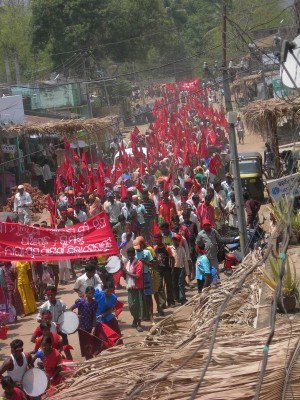
In May 2006, the violent repression of workers protesting wage cuts triggered a series of movements of fury that rapidly escalated beyond the company originally concerned. At the peak of the wave of violence, on May 22, a protest broke out at a plant where the boss hadn’t paid wages for some time. The same day, the strike movement fanned out to a number of other factories, two of which were torched and a hundred ransacked. The entire population, not just the women textile workers, took part. In the most violent battles, the women workers apparently let the men take over. The following day, the revolt widened, reaching the capital, Dhaka. Looting and destruction spread to the center of city. That, according to the account in Echanges[7], is when the demands appeared.
An agreement was finally signed between the bosses and the Textile Workers Federation. It was revised several times but rarely implemented. So the movement began again in the fall. It is remarkable that a movement defeated in a shaky collective bargaining agreement found the strength to resume a few months later, with the same fury and the same violence. As in the spring, the movement spread very quickly around a local conflict and gained ground with looting and destruction of factories. That is the striking aspect: workers in a struggle to defend their wages and working conditions destroy the factories they work in, even though the jobs those factories propose are rare and considered attractive. Most of the employees in those companies come from neighboring slums.
The movement resumed in late 2007-early 2008. As in 2006, it didn’t take long for the movement to spread, for cars to be torched and highways blocked. On January 5, 2008, the Paina Textile Mill’s 1500 workers turned up to apply for a job. They had actually been locked out in that the industry’s bosses had thought wiser to close the plants when the protests resumed. They came not so much to work as to get paid what the boss owed them. The latter only wanted to pay half, so the workers swept into the mill and broke everything in sight.
The movement continued over the following months. To cite only the most noteworthy of the numerous examples: 400 women workers who were laid off without notice or pay attacked a police camp close to the mill. The police fired on the workers, and the crowd that had assembled, no doubt in solidarity, turned around and went back into the mill, ransacking and torching it for four hours.
Recently (June, 2009), the movement erupted again in the suburbs of Dhaka. Strikers from many textile plants learned that the factories owned by the Ha Meem Group were still running. (The strikers were apparently from subcontracting plants in difficulty, whereas the Ha Meem Group is higher up on the scale ranging from subcontractors at the bottom, under the greatest pressure, to the Western principals at the top. Whatever the case, the workers at Ha Meem were not on strike since their situation was not as critical as at the small subcontracting plants). About 50,000 workers (and others) marched towards the factories. The police were forced to retreat. On their way, the demonstrators ransacked and torched some fifty factories. At the same time, small groups split off and methodically torched buildings belonging to the Ha Meem Group: a sweater factory, three apparel factories, two washing plants, two fabric warehouses, 8000 machines, and some bus and trucks. Other groups meanwhile blockaded the neighboring highway, thereby keeping the firefighters out for five hours. This episode seems to involve two closely intertwined aspects: the attack on factories in general and the attack on the Ha Meem factories, where the workers refused to go on strike. In other words, there was simultaneously an attack on capital and competition among workers. The simultaneity of the struggle against capital and clashes between groups of workers reflects the earlier mentioned fragmentation of the proletariat, here in the form of subcontracting. There is no point in regretting it. That is one way in which capital accumulation was realized over recent decades.
We stress the highly paradoxical nature of these movements, which defendthe wage-earning condition while destroying the means of production. The proletariat develops radical crisis activity, seizes the means of production, and storms factories – but to destroy them. We saw that these destructions were not “collateral damage” caused by traditional demonstrations but a little more violent than usual. From what I know about China and Bangladesh, destruction cannot arise as though due to a stroke of misfortune. It is part of the fundamental content specific to such struggles. The case of Bangladesh could represent in our times what the riots in the American ghettos represented in the 60s. With a fundamental difference between the two situations: now, that part of the productive proletariat situated at the core of global extraction of relative surplus value is directly involved in movements that leave politicians and people in power speechless.
Public transportation
If the factory destructions demonstrate that proletarians do not affirm themselves as workers in their crisis activity, I think the same is true of the destructions of public transportation. To my knowledge, this is a new phenomenon. The young Greek insurgents ransacked several subway stops in Athens. In Argentina, too, some stations in Buenos Aires were the theater of real riots over disruptions in train operation. Even in France, where trains have a good reputation, the tension is palpable in public transportation in the Paris area. The cattle wagons shuttling workers into Paris on the Troyes line have been known to run through station between two rows of CRS riot police without stopping. On that line, notorious for poor operation, when a train is cancelled and the next one isn’t scheduled to stop at a particular station, commuters call each other to find out what’s happening and do a favor by setting off the alarm so the train has to stop. And that creates real chaos![8]
The deteriorating quality of public transportation doesn’t date from the current crisis. Attacks and destruction of public transportation will in my opinion be part of crisis activity in the next insurrections. Quite simply because time spent in transportation is unpaid work time and because there is no reason why public transportation, the link between suburbs and factories or offices, should be spared when suburbs and workplaces are not. Finally, because being crammed into trains is a humiliation proletarians experience twice a day. One way in which class confrontation manifests itself in modern cities is through action rejecting public transportation. By challenging being shuttled between work and home, the proletarian attacks a fundamental division of activity. And indeed, overcoming the separation between work and leisure, between social life and private life, between production and consumption is a fundamental moment in the communist revolution.
As the standard of living declines and working and living conditions deteriorate, the proletariat’s struggles demonstrate that anti-work is back in a big way. In each of the latter’s manifestations, the proletariat is saying that when it clashes with capital, the aim is not to restore the conditions of the Fordist compromise, but something else. That something else is totally absent from the landscape, it has no existence in society. We cannot organize ourselves around an embryo of a future society to develop it. All we can do is observe that the most combative struggles are those that one or the other form (or several forms) of anti-work. It can be deduced that when the proletariat in capital’s major urban centers rises up massively, it does not follow the proletarian program model, whatever the variant. For its most advanced sectors in any case, it will not occupy factories, will not form workers’ councils to manage them or manage other aspects of its own reproduction (neighborhood councils, etc.), will not have as its principle to spread work throughout the entire society, will oppose any attempts at planning, at a return to workers’ association as the basis of society. And all of this because, right now, what proletarians are saying, to whomever is willing to see and understand, is that they are workers only under constraint, without pride and without a future, and even though their work is directly destructive of their being.
II.2.2: Demassification of the proletariat
As we’ve seen, inherent in crisis activity is a tendency to individualize proletarians by temporarily calling into question labor’s subordination to capital. Over the past 30 years, the segmentation of the working class has already led to an obvious demassification of the proletariat, and there is no point in calling for its formal reunification unless one has plans to get into politics.
The impact of demassification on struggles is recognizable in several ways. (We have just seen an instance in Bangladesh.) By noting, for example, that parties and unions have little to do with the outbreak and escalation of most major conflicts. In the West, proletarians are forced to raise the stakes and resort to violence in order to defend themselves against the most severe effects of the crisis. Union bureaucracies rarely take the initiative. And the more frequent presence of union locals does not invalidate the logical development of the proletariat’s movement which, as it becomes increasingly radical, depends more on localinitiatives than on national slogans. Such local initiatives (whether by a union or not) result from the fact that the large umbrella organizations are no longer in touch with the realities of the class relation. And they indicate that workers have to some extent overcome the passivity that characterized the phase of Fordist prosperity. Yet these are not as such insurrectionary situations.
Greece, December 2008
Throughout the history of the proletariat, insurrection has constituted an acute phase of individualization, and over time that characteristic has become more pronounced. (Other factors may come into play, such as the depth of the crisis.) The riots in Greece in December, 2008 were probably a breakthrough point in that process. Without giving a detailed account, and while fully aware of the problems posed by the lack of participation of the “traditional” working class, I would like to stress certain points.
Commentators frequently underscored the role of cell phones and the Internet in spreading the rioting right from the first evening. Yet they know that those means of communication mainly flood the world with twitter, ignorance, and prejudice. It takes more than that for communication to foster interaction between individuals and trigger rioting. In short, for all the ease of communication, there is no less fury and individual daring in the fact that individuals who were at one instant a group of young people comparing cell phones become a commando of fire-bombers in the next. Because that is another characteristic of the Greek movement: it developed as a loose conglomeration of small groups acting locally and independently, with no concern for whether “the masses” were following. I am not advocating exemplary action to make the latter conscious of their historical responsibility. Nor did the young Greek insurgents. They weren’t politicians, and their actions sometimes scared even the anarchists.
The sources I used (mainly TPTG and Blaumachen) did not analyze the demonstrations in great detail. Nevertheless, there were clearly no big demonstrations. The highest figure was 20,000 demonstrators. That was in Athens on Monday, December 8. The demonstration had been called by the “law school”, i.e. the leftists. According to TPTG, the demonstration advanced slowly, with 1500 youths entering and leaving the demo to ransack and loot. At the same time, more looting and attacks of police stations occurred in other parts of the city, but this time with no “big” demonstration. That is a far cry from the huge stroll-marches intended to show Juppé that they were two million. In general, the accounts or chronologies published by Greek comrades repeatedly refer to demonstrations of 200-300 people in the suburbs or provinces whose objective, frequently, was to attack the local police station. The meaning of those systematic confrontations between young people and the police is debatable. (Was that the best objective?) But there is no denying the advanced demassification of an insurrectionary movement which, due in particular to that dispersion (as well as the remarkable absence of demands), struck fear in many a government.
I think that this tendency is going to grow in the coming phases of the global proletariat’s crisis activity and that there lies one of the key conditions for success of the communist revolution. The 2008 Greek riots surely give an idea of what a deeper insurrectional phase could be: by multiplying the seats of struggle, not controlled by any center, the proletariat will center the struggle on the most concrete, specific forms of exploitation and subordination. The initial specificity and even localism of the confrontations will be the best guarantee against any attempt at political recuperation. In addition, by confronting capital and the State at such levels, the more the struggle succeeds, the more it will be a ferment of dislocation of the State, more powerful than if the State were attacked at its summit.
Conclusion
From the above we can see that anti-work is back, but not in the same way. The destruction of the Fordist compromise in recent decades led to far-reaching changes in the conditions and content of the proletariat’s struggle against capital. For example, casualization of labor invaded Fordist factories through outsourcing and temporary work. This phenomenon is often deplored as a factor of class division. That is true, and it plays against the proletariat in its day-to-day demands-oriented (revendicative) struggles. But we need to go further. With the rise of a stronger movement, without demands, for example, we will see the sense of identification with the workplace disappear and the enemy appear more clearly as capital in general, even in a single shop. Moreover, capital’s division of the class over the last thirty years will backfire on capital when the demassification of the proletariat decentralizes crisis activity into a multitude of nuclei, over which politics will have no hold (e.g. Greece).
Generally speaking, the changing class relationship within the last thirty years must be understood against the background of capital’s furious struggle against the falling rate of profit. The headlong flight into credit is one aspect of this. Outsourcing is another. It is one of a whole series of offensives to lower the value of an already significantly inessential labor force. This movement is not prompted by whim or cupidity on the part of the capitalists. It is the condition for reproduction of the social relationship, i.e. between capital and the proletariat. The content of at least some of the struggles against the capitalist offensive show that the way out of the crisis is not through a better balance in the exploitation of labor, that there is no possibility for “sharing the benefits of productivity”. Underneath, those struggles imply the necessity of doing away with both classes simultaneously. In the 60s and 70s, this issue appeared on a limited scale in the struggles by assembly-line workers in Fordized industry. Today, a comparable process is experienced by the entire labor force (one illustration is in the changes affecting office work). And that is true for all aspects of the proletariat’s life, not just in the “work” component of the proletariat’s reproduction, but also, by the attack on the value of the labor force as well (limits on relative surplus value lead to reduction of the subsistence basket), in every aspect of life (housing, transportation, schools, unemployment, etc.). In a way, it could be said that what was considered anti-work in the proletariat’s struggle will become anti-proletariat. Unless one conceives of a return to previously existing conditions of the capitalist social relationship, the current struggles as well as an analysis of the modes of labor exploitation point to the possibility and necessity of communisation.
III – COMMUNISATION
III.1 – Communisation and transition society
One of the major theses of communization theory is the rejection of the notion of the transition society. But let’s not confuse immediacy and instantaneity. When we talk of the immediacy of communism, we posit that the communist revolution no longer has the objective of creating a society half way between capitalism and communism, but communism directly. As a result, the problem of taking political power disappears with its questions of alliances with other social layers, of effectuation of the transition (withering away of the state, etc.). The communist revolution nonetheless has a duration, a history, phases of advance and retreat, etc.
The immediacy of communism is not a notion coming out of the blue. It appeared with the crisis of the 60′s-70′s on the basis of the inability of the left and the leftists to take into account the most advanced forms of the class struggle, especially those that I regroup under the term of anti-work. But neither the communist revolution nor communism abolish history. And this precisely why the word communisation was coined: to indicate that the abolition of classes and the transcending of the economy is a process, with a succession of “befores” and “afters” and with the passage of time. But these successive phases do not consist in putting in place a transition societybetween capitalism and communism. The meaning of the socialist society that the proletarian program puts in place there is that the proletariat bases its power on the State and the latter takes charge of creating the conditions for communism (at its own expense moreover!). One wonders hao this gross fiction could delude people for such a long time. Is it because it garanteed a job after the insurrection to the politicians who sold it to the proletariat?
Thus, the immediacy of communism is not the cancellation of time, but the fact that the revolution doesn’t create anything else than communism. Communization doesn’t mean the creation of a new form of property preceding the abolition of property, a new form of government preceding the abolition af all forms of power, etc., but means the abolition of property, the suppression of any power, etc., by creating social forms that ensure that people live better than during their crisis activity.
III.2 – The issue of gratuity
It is obvious that looting, requisitions in supermarkets, etc. will be part of the crisis activity of the communizing proletarians. But in my opinion, this is at best only a first approach to the abolition of property. In the CMP, even more so than in the precapitalist modes of production, property refers less to the fact of having (a house, a car) than to the right of access to nature as it is monopolized by the capitalist class. Consequently, property is not so much the right to enjoy one’s belongings privately as it is the possibility of compelling others to work for oneself. In other words, if I am owner, you are precarious. In short, the abolition of property is not merely redistributing everything to everybody but above all creating a social form where questions like “what is there to eat?”, “where’s a place to sleep?”, “what can be done with the children?” do not even arise.
TC’s text on Communization vs Socialization states that “gratuity, the radical non-accounting of whatever, is the axis of the revolutionary community that is building up”. Non-accounting is indeed a basic fact of communization. It is the absolute anti-planning. But it is necessary to specify whether we are talking about commodities available from capital’s inventories or things produced in the process of communisation.
In the first case, it seems obvious that commodities looted or requisitionned are freely distributed. It is less obvious that they are not counted, for this inevitably suggests utopian images of limitless abundance,of plundering, which gives anti-communizors a good opportunity to protest and call for a bit of common sense. All the same, this point of view has to be defended, and one must insist: if the proletarians of the crisis activity start counting their loot, they immediately restore an economy – be it a use value one, a power relationship, delegations (who counts what, who stores what, etc.), all of which goes against communization. One can see that gratuity and non-accounting are two different things.
In the second case, there is no reason why products produced in a communist way should be declared free. Gratuity is after all nothing but the suspension of value and price during a lapse of time or in given space. Communism satisfies needs, whatever they are, in a way which is neither free nor paying. The simplest way to understand that is to consider that there is not a system of needs face to face with a system of production and separated from it. Today, if I want to eat, I have to work – which has nothing to de with my appetite and my tastes. At work, I do not eat, I am not given anything to eat, but money instead. After work, I will go and spend the money on food. It seems that the problem with the notion of gratuity is that it takes us back to the sphere of distribution. That it maintains the separation between the need and the means of its satisfaction. Except that one doesn’t pay. This is why the notion of non-accounting is more fundamental than gratuity alone, provided that the nature of this activity for which there is no accountancy is better defined.
From the moment when the communizating proletarians start to produce on, the question is not so much that of gratuity, but rather that of the radical transformation of activiy, of all activities. We will thus try to explain how the “revolutionary community” builts itself on communizating activities that are more sunstantial than gratuity only.
III.3 – Production without productivity
The words at our disposal to describe a society did not foresee that this society could be communist. To go beyond the theme of gratuity, we need a category that is neither “production” nor “consumption”, etc. The unification of life in communism, the overcoming of all separations, and direct production of socialization at the level of the individual all pose problems of vocabulary that I could only solve with the expression, production without productivity or, put otherwise, consumption without necessity[9].
III.3.1 – The struggle for a totalizing activity
Communization starts in the crisis activity to go beyond it. Communization doesn’t correspond to an ideal or a political slogan. It is the solution to the difficulties the proletariat encounters in its reproduction in the crisis activity. The crisis activity is a struggle against capital to ensure survival, nothing more. Once the proletariat’s attemps at demands have proven ineffective in saving the proletariat economically, communization makes the jump into non-economy. There is a paradox here: the economic crisis is at its deepest, the proletariat’s needs are immense, and the solution is to reject productivism. Indeed, ‘production’ without productivity is not a production function. It is a form of socialization of people which entails production, but without measuring time or anything else (inputs, number of people, output).
During the phase of the deepening of the crisis, the revolutionary proletariat reproduces itself mainly by plundering capital’s property. Even in a lean economy, there are inventories. The crisis activity will consist (among others) in seizing them. In this phase already, one can imagine a divergence between a counter-revolutionary tendency which tries to account for eveything, to regroup the goods, to coordonate their distribution, to impose criteria for rights and obligations, etc., and a communizing tendency which rejects this looting economy and opposes the establishment of higher distribution authorities, even democratically elected, etc. This second tendency will insist that a local deepening of the revolution, absolute gratuity, are better than an abstract solidarity and an egalitarianism that can only be measured and managed by a power.
In the revolutionary process of communization, the expression production without productivity is almost indecent given the destitution in which the crisis plunges the proletariat, imparting a sense of urgency to the situation. The would-be managers of solidarity and equality will certainly insist on that point of view. There is a real paradox here: urgency because millions of proletarians don’t have even the bare minimum, and the notion of productivity should be abandoned! To this, several answers:
The question is how production can resume without work, or productivity, or exchange. The principle of ‘production’ without productivity is that people’s activity and their relationship come first and output second. To develop production without productivity is to abolish value in both its forms:
Exchange value: if nothing is accounted for, if the justification of activity is nothing other than itself, the product resulting from the activity has no abstract content.
Use value: use value in the commodity is different from its simple usefulness in that it is abstract too. The usefulness of the commodity has to be at a general, or average, level in order to satisfy the need of an unknown user whose particularity is also unknown (it is the same kind of difference as between ready-made and tailor-made clothing). Production without productivity is a particular activity by particular individuals to satisfy personally expressed needs. The use of objects produced bears the mark of this particularity. It is anti-standardization. The necessarily local character of communization, at least at its beginning, contributes to this.
We have here an important element in understanding the difference between the programmatic version of communist theory and the communization version. In the first chapter of Capital, the distinction between use value and utility is at best blurred and considered without importance. But then, if use value is considered identical to utility, the abolition of value is limited to the abolition of exchange value. And it is true that communist theory in its programmatic forms offers various versions of the abolition of value that, in the end, are limited to the elimination of exchange through planning. The activity stays the same (work, separated from consumption and from the rest of life), and planning guarantees justice, equality and the satisfaction of needs, considered exogenous, almost natural givens. On the contrary, as soon as communization is understood as a radical transformation of activity, of all activities, as a personalization of life due to the abolition of classes, use value reveals its abstract dimension of utility for a (solvent) demand unknown in its peculiarities and thus average, abstract.
In the communist revolution, the productive act will never be onlyproductive. One sign of this among others will be the fact that the product considered will be particular: it will correspond to needs expressedpersonally (by the direct producers at the time or by others) and that the satisfaction of the need won’t be separated from the productive act itself. Let’s think, for example, about how the construction of housing will change as soon as standardization disappears. Production without productivity will mean that any individual engaged in the project will be in a position to give his opinion concerning the product and the methods. Things will go much slower than in today’s industrialized building industry. The participants in the project may even wish to live there after the bulding is finished. Will it be a total mess? Let’s just say that time will not count and that cases in which the project isn’t completed, in which everything is abandoned in midstream – maybe because production of the inputs is without productivity too – won’t be a problem. Again, this is because the activity will have found its justification in itself, independently of its productive result.
In a general way, one can say that communization replaces the circulation of goods between “associated producers” with the circulation of people from one activity to another. This implies especially:
- That the “sites of production” won’t keep a permanent staff and that they will produce or not depending on the number and objectives of those present, because the “sites of production” will above all be places of life.
- That, at least in a first phase, communization will develop locally, not as autarchic communities, but as initiatives controlled entirely by the participants. Communization will take place as nebula of local initiatives. In my opinion, the local level is the only level at which communization can prove its ability to immediately improve the life of proletarians by transforming it radically – by abolishing the class. And this is fundamental: proletarians make a revolution for a better life, not for ideals.
- The “sites of production” will actually be places of life, because any “production” will build itself as a totalizing activity, not for the sake of the beauty of totality, but because this will correspond to the needs of the struggle against capital. This totalizing tendency is lacking in current rebellions, not only because they remain circumscribed by their original place or fraction, but also in the sense that they cannot broaden their scope (passing from looting of supermarkets to requisitioning apartments, for example, not to mention production).
Entering into too much detail entails the risk of drawing the outlines of a non-economy just as restrictive as the transition society. A the same time, how can we not give examples (and show the poverty of our imagination) to make clear that all the solutions brought by the communist revolution have as their principle and their end the absolute priority given to the relationship between individuals and to the activity rather than its results. This is another way of saying that the main “result” aimed at by the activity is itself. Individuals will circulate between activities according to their affinities, and every step of this circulation will be a moment of reproduction. Products will circulate along with these individuals, but without exchange.
III.3.2 – The end of separation of needs
We have written above that, in the face of communization, a tendency toward “economic realism” will most probably develop in the name of the urgency of the situation, of the deep poverty of the class and of the immensity of the needs. Of course, this realism entails sacrifices for a better tomorrow. To criticize this point of view, several remarks may be made:
a) one the one hand, the immensity of the needs we are talking about is that of the current proletarians, in the crisis without revolution for the moment. But needs are not absolute. They are related to one’s life. The wage earner who has to work feels much more comfortable if he has a car that works, a public transport pass, an au pair to fetch the kids at school and domestic help to keep the house in order, etc. There is no point in criticizing these needs, in saying that they are artificial, illusory, that the proletarians are victims of advertising. Let’s simply note that they correspond to a type of life. In the crisis activity, everything changes. Of course, there is always a need for 2500 cal per day, for shelter from the cold or rain, etc. For those who are below these basic thresholds, the first answer will be to simply take what they need. There is so much empty housing, plus all the buildings that have a purely capitalist function (banks, offices, storehouses…), all kinds of possibilities for proletarians who lack decent housing. The same is true for the other basic needs.
b) Another way of using the immensity of the needs to justify a phase of economic transition that would be more efficient is to cite the problem of gaps in development levels. Inhabitants of poor countries would somehow have to catch up with the level of development in the rich countries, where the proletarians would have to make even more effort to help the proletarians in poor countries. The point here is not to reject the notion of solidarity in general, but to wonder about the context in which this argument is used to justify economic realism. Don’t those who talk about economic realism envisage poverty in the same way as Mike Davis talks of slums? Total destitution, radical exclusion, an almost animal-like life, Mike Davis looks at the inhabitants of slums as complete outcasts, as absolutely poor, as if they didn’t belong to the global capitalist society. This simplistic point of view has been criticized in the name of all the struggles taking place in slums, which clearly show the class relationship between slum dwellers and capital. Moreover, as in Argentina, the extreme conditions of slum life have for years fostered the invention of new social forms or production processes. Since these take place at the margin of valorisation, they give some sense of the store of imagination that will be released when slum dwellers are able to reject the straightjacket that the surrounding city imposes on them. This imagination ranges from building processes (which the World Bank tried in vain to spread because they are so cheap) to urban micro-agriculture and includes attempts at self-management of slums. Nothing revolutionary, but enough imagination to show that slum dwellers know what to do and won’t need a communist “development aid”. This does not exclude solidarity, but not as a prerequisite to communization in developing countries, by the proletarians who live there – and who all have a proletarian relative in the rich countries’ slums. Of course, the needs covered there by communization won’t be the same as those in capital’s global cities. But why should they be the same? And why should the extreme poverty of the inhabitants of the developing countries prevent communization? The latter doesn’t result from a hypothetical abundance. The issue in communization is not to meet a list of pre-established needs, but to overcome the notion of need as want by abolishing ownership (all ownership) of the means to satisfy it. In the developing and central countries alike, although in different productive contexts, revolution won’t unfold as a series of measures predetermined according to a list of needs currently unsatisfied and urgent. Not only will the transformation of society abolish the separation between need and satisfaction, but it will make needs and activities appear and disappear, constantly and fluidly[10].
This whole issue is not just a figment of the imagination. It is based in the current movement of the capitalist mode of production. I particularly think of Argentina and the crisis of 1999-2000. The latter pushed a fraction of the piquetero movement towards very radical positions. The characteristic features of this fraction are the will (and the actual attempt) to produce without the product being the sole objective. The piqueteros consider that the productive act should also constitute a moment where the relationship between individuals changes. Hence the principle of horizontality, the rejection of leaders, General Assemblies without agenda, decision-making without voting but by consensus. These are limited experiments, encircled by a capitalist society that goes on as best it can. They bear the mark of these limits, especially in their voluntarism, their call to a “change of mentalities” as conditions for qualitative change in the productive act. What I wrote above about the slum dwellers points in the same direction.
On the basis of such experiments, I think that communization is not something very complicated, and certainly not more utopian than the transition society and the withering away of the State – as long as you don’t try to fit the capitalist society, with its workshops and offices, its airports and supermarkets… into a communist mould. Alternatively, I am ready to learn a lesson in realism, as long as there is no talk of economy.
III.3.3 – The issue of the individual
One of the topics which complicates the discussion of communization is the issue of the individual. There is justly emphasis on the fact that the abolition of classes is synonymous with the emergence of the free, directly social individual [11]. This is the end of class contingency, whereby the individual is and does what his class belonging dictates. This belonging may appear in various ways (belonging to a company, stigmatization of a neighbourhood, etc.). It generally means that this individual here who attends this machine, who takes care of this patient, etc., is actually nothing but the puppet of the institutions that define him. Confronted with this determinism, the individual who wants to prove his particularity (or who, due to the inevitable limits of this reification, has to do so for his work to be done) appears as a monad, a free electron whose revolt strongly resembles a whim when its purely individual. He says “I am not a puppet, I also exist as an individual”, but this is only partly true because capital has absorbed much of his personality, which he finds again as skills incorporated into the machine, as personal tastes picked up in magazines, etc. So that when he affirms his personality, he says commonplace things or become desocialized, sometimes even driven to madness.
Yet it is often this whimsical individual who is projected in thinking about communism, even when quoting the Marxian expression, social individual. I sometimes did so when I asserted loud and clear the pleasure principle against the reality principle in order to convey that, in communism, nothing would be produced if the individuals associated in this activity didn’t find in it their lot of personal satisfaction. Faced with this, accusations of utopia are easy for the realist and no-nonsense critiques. And they propose organisational schemes with rules and obligations that are so many safeguards to keep our whimsical individual under control. We have returned to the economy and the discussion goes round in a circle.
In order to get out of this vicious circle, we have to try to understand positively what the individual of communism is. Actually, this isn’t totally mysterious. To approach him, we have the insurgent proletarian, the proletarian whom we see in the crisis activity, in the insurrection, and not the rebellious individual envisioned above. The specificity of the crisis activity is that it emerges from an interactive relationship among proletarian individuals which signals concretely the crisis (not yet the abolition) of class contingency. It is what I called above the end of social automatisms. Now what do we see in the crisis activity? We see individuals, who only yesterday formed an undifferentiated mass of wage earners, invent social forms of struggle with unsuspected imagination, we see them take decisions (and often apply them), we see them adapt from one hour to the next to changing circumstances, we see them forget their personal interests of “before”, sometimes burning their bridges at the risk of their lives. And all of this without a leader, or at least a pre-existing leader, without a pre-existing organization, without a formal pledge and without responsibility towards a principal. In all the important insurrectionary moments of the proletariat’s history, those who commit themselves to the struggle didn’t wait for it to be decided by a vote. They leave one front to go elsewhere, or give up the struggle, without being accountable to anybody. The individual’s participation (at the barricade, in the workers’ council, in the riot) is optional, uncertain, left for him to decide. And it works all the same because the insurrection isn’t a sum of arbitrary, atomized revolts but the unfolding (fleeting on history’s scale) of social activity in its own right, where individuals socialize directly, and where, already, the activity comes before its result (were that not the case, how could we understand the “mistakes” that with hindsight we detect in so many insurrections?)
In spite of its extreme brevity, the crisis activity is the crucible where we can glimpse what might be a directly and personally free, social individual. It is from this viewpoint that, in my opinion, it is possible to claim that a general activity is possible without an imposed plan or coordination, without rights or duties.
III.4 – Consumption without necessity
The realm of necessity is not the sphere in which the productive forces are insufficient to ensure an abundance that would be hard to define exactly. The realm of necessity is the sphere in which the existence of property is a constant threat of want for those who are not owners. This is why, in the present society, gratuity or low prices provoke reactions of stockpiling or overconsumption. In communism, this fear of want disappears at the same time as property. Property positively abolished is also the guarantee that gratuity doesn’t mean simply “price = zero”. Rather, gratuity is gratuity of the activity (in the sense that its productive result is secondary). It is freedom of access to one’s living conditions (including the means of “production” and “consumption”).
Consumption without necessity and production without productivity are identical when taken as totalizing activities. The “producer” doesn’t leave his needs in the cloakroom. He includes in his “productive” activity his choices, his personality and the satisfaction of his needs. And vice versa, the “consumer” is not sent back to a life deprived of sociality to assume the functions of his immediate reproduction.
Conclusion
The notion of a transition society, if it was ever valid, is henceforth obsolete and reactionary. The communist revolution defines itself today as the simultaneous abolition of the two classes by the communizing proletariat. Hence it is, immediately, the radical transformation of activity, the overcoming of all separations. The communisation of society unfolds as a seizing of capitalist property and using it for the needs of the struggle, with no accounting, as production without productivity, like consumption without necessity. It is set in motion in crisis activity and overcomes that activity by affirming and spreading the space of liberty gained in the insurrection.
GENERAL CONCLUSION
For several years now, the theme of communisation has led to controversies that are very often ill-informed. I am ready to admit that it takes some naivety to assert that communisation is not all that insurmountable a problem. There are those who simply reject the whole issue of a revolutionary exit from the crisis, saying “we’ll see when the time comes what the proletarians do”. I have always challenged that view, for two main reasons
First, an analysis of the whole movement of class struggle cannot dispense with understanding what overcoming the contradiction between classes means. It is not enough to lay down the terms of a contradiction. The moment one does so, this contradiction begins moving, and one will not adequately follow that movement without understanding, as far as possible, what it must produce. Obviously, nothing is certain beforehand, and even less so in the case of communisation, in which, as we have seen, even the vocabulary tends to be lacking. Nevertheless, communist theory has always been traversed by this tension, which has to be accepted even while we recognize our limits.
Second, the proximity and intrication of revolution and counter-revolution necessitates distinguishing as clearly as possible between what advances the crisis activity of the proletariat towards communism and what makes it move backward towards the restoration of value (this aspect of the question was only mentioned here).
That was my reason for attempting in this text to say what communisation will be, based on the crisis activity of the proletariat. The examples I gave should not prevent more theoretical discussion to continually improve our understanding of what is meant, in the context of the insurgent proletarians’ action, by the abolition of value, the overcoming of labor and the liberation of activity, etc., but also by value abolished, labor overcome, libertyestablished, etc.
B.A., June 2010
Notes
[1] This does not imply that there is no struggle anymore between capital and the proletariat. This struggle is constant and is part of the continuous adjustment of the relationship of exploitation. The insurrectional phases of struggle differ from this continuum by the fact that the proletariat posits itself as a revolutionnary subject.
[2]Against the myth of self-management, project, July 2009.
[3] Michael Seidman gives interesting information on workers’ resistance to this return to self-managed work in Republic of Egos, a Social History of the Spanish Civil War, and Ouvriers contre le travail, Ed. Senonevero.
[4]Eléments sur la périodisation du capital ; histoire du capital, histoire des crises, histoire du communisme, Hic Salta, 1998. This text is available online at http://patlotch.free.fr/text/1e9b5431-1140.html
[5] Laurent Cappelletti (academic), Les Echos, July 21, 2009.
[6]Corporate Social Responsibility Asia, vol. 2, #4, 2006.
[7]Echanges #118, Fall, 2006. For more recent information, see issues 119, 124, and 126.
[8] From a colleague at work who uses the line. I’ve never seen incidents like this mentioned in newspapers.
[9] B. Astarian, Le communisme, tentative de définition, 1996, in Hic Salta1998
[10] Much could be said about the way in which the necessary productivity sets the pace of life and creates these routines which, because they save time, impose their repetition and freeze the terms of existence.
[11] I don’t consider (as does TC for instance) that “social individual” is an oxymoron. All depends on the individual and the society.