Sunday, December 18, 2011


Saturday, January 15, 2011
“Our Republic cannot bear the stain to kill its own Children."says Indian Court on Azad killing

The Hindu
Notice to Centre, A.P. on encounter killing of Azad and journalist
New Delhi: The Supreme Court on Friday sought the response of the Union and the Andhra Pradesh governments on two petitions seeking a judicial inquiry into the alleged encounter killings of Cherukuri Rajkumar alias Azad, spokesperson of the Communist Party of India (Maoist), and journalist Hemchandra Pandey by the Andhra Pradesh police on the night of July 1 last year.
A Bench of Justices Aftab Alam and R.M. Lodha issued the notice, returnable in six weeks, after hearing counsel Prashant Bhushan, appearing for petitioners Swami Agnivesh and Pandey's wife Bineeta Pandey.
Justice Alam orally observed: “Our Republic cannot bear the stain to kill its own children. We will issue notice. They will have to respond. We hope there will be good and convincing answer to the questions [raised in the petitions].”
The petitioners said the post mortem reports and fact-finding carried out by the Coordination of Democratic Rights Organisations (CDRO) clearly indicated that it was not a genuine encounter and that Azad and Pandey were killed in blatant violation of their rights under Articles 14 and 21 of the Constitution.
Azad was carrying a letter from Swami Agnivesh for peace talks when he was taken into custody along with Pandey. Then Swami Agnivesh sent a letter to Azad, suggesting three possible dates for starting a 72-hour suspension of armed resistance by the CPI (Maoist) and simultaneous cessation of action by the government forces. During that period, the government would invite Maoists for talks and initiate a mutual ceasefire agreement, the petitioners said.
However, on the intervening night of July 1-2, both Azad and Pandey were killed. According to the CPI (Maoist), Azad was scheduled to meet local contact Sahadev in Nagpur at 11 a.m. on July 1 and travel to the Dandakaranya forests for meeting senior Maoists to discuss Union Home Minister P. Chidambaram's proposal and likely dates for a ceasefire.
But he never turned up for the meeting.
“The alleged encounter, if proved fake — as indicated by the CDRO report — is in blatant violation of Article 21.” The refusal to initiate an inquiry, despite questions raised about the veracity of a police investigation by human rights activists, organisations and sections of the media, and the disruption it caused to the peace process initiated by the Home Minister himself were “unreasonable and arbitrary” and raised serious questions about the bona fides of the Home Ministry, the petitioners said.
Probe committee found holes in police version of Azad death
J. Balaji
A file photograph of the body of Cherukuri Rajkumar alias Azad, killed in an encounter with the police on the Velgi hills in Adilabad district of Andhra Pradesh on July 1.
NEW DELHI: With the Supreme Court coming down on the Centre and the Andhra Pradesh government for the alleged cold-blooded killing of Maoist spokesperson Cherukuri Rajkumar alias Azad and journalist Hemchandra Pandey, the authorities will finally be forced to answer the series of uncomfortable questions thrown up by an independent investigation into the encounter last year.
While the State police claimed the alleged encounter with Azad and a large group of Maoists took place in the limits of the Wankadi police station of Adilabad district on the night of July 1, a fact-finding team constituted by the Coordination of Democratic Rights Organisations (CDRO) poked holes in the official account.
The team, consisting of notable personalities including Supreme Court senior advocate Prashant Bhushan, opined that Azad was likely shot dead from a very close range, not more than a foot, rather than from a distance as the police said.
The CDRO argued that the duo was killed with the knowledge of the Union Home Ministry as Azad was preparing for peace talks between the Centre and the Maoists at the initiative of social activist Swami Agnivesh.
Referring to the post mortem report of Azad, the report raised doubts on the versions given by the police and pointed out: “… the fatal bullet entry wound from the chest ‘at the left 2nd intercestal space' had ‘darkening burnt edges'. The burnt mark at the entry wound is a clear indication of a bullet being fired from a very close range (no more than a foot). The corresponding exit wound is at the ninth and tenth inter-vertebral space and depth is nine inches.”
“That means the bullet entered from the upper chest and travelled downwards. This questions the police version that Maoists were on the top of the hill and they (police) were below,” the team opined.
The team, referring to the version of the police that they located the two unidentified bodies (which later turned out to be that of Azad and Pandey) only the next morning (July 2), wondered how the police were able to pinpoint the location of the Maoists in a forest of several hundred sq.km on the Andhra Pradesh-Maharashtra border.
How come, despite 30 minutes of firing (11 to 11.30 p.m.), not a single policeman suffered any injury, whereas only Azad and Pandey were killed, the report asks. If there were 20 Maoists as stated in the FIR, why were they able to locate only two kit bags and two weapons. “In any escapade there would be more belongings left behind.”
Similarly if the police were unaware of the identities of the two dead men till 9.30 a.m. on July 2 at the time of filing of the FIR, how did the electronic media learn by 6 a.m. on July 2 that Azad had been killed in an encounter? Several channels had also announced his death. “So it clearly shows that the police knew who they had killed,” the team said.
The team wondered why the police selected Wankadi mandal for the “encounter” as the “villagers clearly told us that in recent years there had been no Maoist activity in the region.”
Media reports at the time quoted human rights activists alleging that Azad and Pandey were picked up by the police at Nagpur on June 30 and brought to Andhra Pradesh in a helicopter and shot dead. They also mentioned that Azad was carrying a letter of Swami Agnivesh at the time of his arrest. Azad was a central committee member of the CPI (Maoist).
Even Railway Minister and Trinamool Congress president Mamata Banerjee raised doubts on the death of Azad and demanded a judicial probe. There were pleas in this regard in Parliament too. But Home Minister P. Chidambaram rejected them, stating the issue was a State subject and it was for the Andhra Pradesh government to decide
Saturday, January 8, 2011
CPM Harmads shoot dead Villagers in Lalgargh

Eightpersons, including a woman, were killed and around 18 injured after unidentified persons fired at villagers in Maoist-hit Lalgarh of West Bengal on Friday. While Trinamool Congress has alleged that the gunmen were armed CPI(M) activists the Left has pointed finger towards the Maoists.
On Friday morning, the villagers of Netai gheraoed the residence of local CPI(M) leader, Ranjit Dandapat, alleging that the house was used as a camp for armed party workers. After a short while, bullets were shot from inside the house, killing the villagers.
Trinamool Congress chief Mamata Banerjee on Friday blamed the Left party for the killings, saying it was utilising its “harmads” as a killing machine. “They (CPM) are claiming that we are doing politics with bodies. But they are doing the politics of killing and terror. Let them stop it, we will also not parade bodies,” Mamata, who took out a procession in Kolkata with the bodies of three party workers killed in Burdwan on Thursday, told a rally.
“We believe in democracy. We want people to give a fitting reply to CPI(M)-sponsored terror through ballots. We don’t want power at the cost of people’s blood,” she said before leaving for Lalgarh.
Mamata said her party would not call a bandh to protest the killings, but would condemn it through a “dhikkar diwas” (condemnation day) on Saturday. Senior CPI(M) leader from West Midnapore, Sushanta Ghosh, on the other hand, claimed the Maoists fired at a gathering of CPI(M) party workers, while they assembled to participate in a party programme. “Those killed were CPI(M) activists,” he said.
State chief secretary Samar Ghosh, on the other hand, ruled out the involvement of Maoists behind the massacre. “In all probability, this is a case of political clash and there is no Maoist link to it,” he said.
The Centre said it is closely monitoring the situation in Lalgarh and is in constant touch with the state government to ensure security. The chief minister countered, saying Chidambaram’s letter was written under compulsion of alliance politics with Trinamool and was far from reality. The home minister claimed that he had made the comment basing on specific inputs from different government agencies. –with PTI inputs
Friday, December 31, 2010
Intellectuals, activists join chorus for Binayak Sen’s release
Saturday, December 25, 2010
Arundhati Roy on life sentence for Binayak Sen

“After producing Marx's Das Kapital and a letter from the Indian Social Institute as evidence against him, the crisis of Indian democracy does not get more dangerous than this,” Ms. Roy said, referring to the quality of the evidence marshalled by the police in their case against Dr. Sen.
Saturday, December 11, 2010
Support and express solidarity with the Political Prisoners who are on an Indefinite Hunger Strike
Support and express solidarity with the Political Prisoners who are on an Indefinite Hunger Strike in Medinipur Central Jail from 10th December(Human Rights Day) 2010
Nearly 150 political prisoners-mostly under trail--incarcerated in the Medinipur Central Jail-which the government calls 'Correctional Home'-will start hunger strike from 10th December 2010 on the Human Rights Day for an indefinite period-true to the long tradition of hunger strikes organized by political prisoners in Medinipur as also other jails of West Bengal and outside in near and distant past. The prisoners include those arrested on the charge of having Maoist links, or becoming members of the People's Committee Against Police Atrocities (PCAPA) that spearheaded the Lalgarh movement from November 2008, or common villagers standing by the cause. Many of these prisoners have been languishing in jail for years together in abysmal conditions virtually without trial.
The Committee for the Release of Political Prisoners (CRPP) express wholehearted support to the striking prisoners and urge all democratic forces throughout India and other parts of the world to raise their voice in support of their just demands.The demands placed by the prisoners to the authorities are as follows:
- The joint forces should be withdrawn and the 'Operation Green-hunt' stopped immediately and the government should sit for a dialogue with the PCAPA without delay.
- Section 144 should be immediately withdrawn, and there should be unrestricted entry of all newspersons, intellectuals and other people.
- Legal steps should be taken against the CPI(M) hermads.
- Judicial enquiry should be initiated for the murder of all leaders, members and supporters of the People's Committee including Lalmohan Tudu, Sidhu and Umakanto Mahato, and offenders should be brought to book.
- The cooked up charges against all the prisoners incarcerated in the jails of West Bengal on political grounds, including those arrested from Jungle Mahal should be withdrawn and the prisoners released unconditionally.
- Repeal all draconian acts including the UAPA and the AFSPA.
- Prisoners imprisoned on political grounds should be given the status of political prisoners and the government should have to bear the cost of maintaining their families.
- Prisoners should be given opportunity to meet the members of their families and receive necessary articles from them in Medinipur court.
- After arrest, no participant in a movement should be made to "disappear" illegally. Everyone should be produced in court within 24 hours.
- Nobody should be 'shown arrested' by tagging in one false case after another.
- Judicial enquiry should be initiated in all cases of rape including those in Sonamukhi and the offenders brought to book.
- Old men and women in the Jungle Mahal should be given adequate old-age pension and widows given widow-pension, and all in this connection should be paid off immediately.
- All surplus grain kept in the FCI go-downs should be immediately distributed among the poor people of Jungle Mahal, and not to be allowed to either to rot or be burnt.
- Stop biased investigation into the Jnaneswari Express sabotage and initiate neutral investigation; a neutral investigation team should be formed with people from cross-sections of society and actual culprits should be punished.
- Indian army in Kashmir should be immediately withdrawn. The hopes and aspirations of the people of the land should be honoured.
- Persons involved in the destruction of Babri Masjid and subsequent riots should be given exemplary punishment.
- Prisoners confined in the cells should be allowed to meet other prisoners. The illegal system that segregates one prisoner from another should be immediately stopped.
- Those among the life-convict prisoners who have already passed 14 years of incarceration should be set free immediately.
- Telephone service should be introduced inside jails and every prisoner be allowed to avail himself/herself of this opportunity.
- Instead of every prisoner being forced to have his beard cut with one common razor, each prisoner should be allowed to have a separate arrangement of his own.
- Arrangement should be made for the supply of water inside the cells for 24 hours and the inhuman custom of carrying water drums over shoulders should be stopped immediately.
- Arrangement should be made for political prisoners to take political classes inside prisons. No political literature can be seized by the jail authority.
- Political prisoners should be allowed to contact media persons outside and they should be allowed the right to have their political writings published in different newspapers.
- Intellectuals coming to meet political prisoners should be allowed to have table interview with them.
- The newly-proposed system of payment of daily wage@ Rs.100.00 to convicts should be implemented immediately; wages should not be kept due.
- Prisoners seeking a copy each of West Bengal Correctional Services Act and the Jail Code should be provided one copy each.
- Canteens should be introduced inside Medinipur Jail.
- Political prisoners should be provided with all the daily newspapers at government expense.
- Proper infrastructure for treatment in Medinipur Jail Hospital should be made and necessary machines installed.
Tribals rally against anti-Maoist operations in Orissa
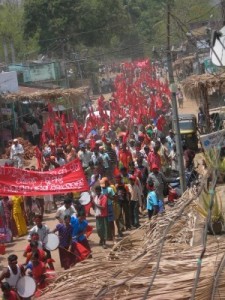
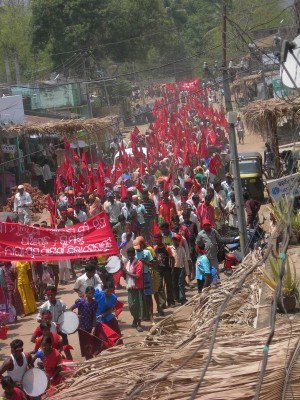
Tribals opposing ongoing anti-Maoist operation in Koraput district, where most wanted rebel Ramakrishna is suspected to be in hiding, staged a demonstration at Narayanpatna, about 70km from here, today.
The rally was organised by the Maoist-backed Chasi Mulia Adivasi Sangha (CMAS), which had recently forcibly grabbed money lenders’ lands and attacked a police station at Narayanpatna. The demonstrators also demanded immediate release of tribal men and women who were lodged in jail on charge of being rebels and attacking the police station.
About 100 tribals allegedly involved in the two counts are lodged in Koraput jail. Two of them have died in prison. The demonstrators submitted a memorandum addressed to chief minister Naveen Patnaik to local block development officer.
Meanwhile, the police have launched a manhunt for Ramakrishna, who is suspected to have taken shelter in Narayanpatna jungle along with his son Prithvi. The search operation has been stepped up since the arrest of Ramakrishna’s wife Padma on November 14 from an area near Koraput, bordering Andhra Pradesh.
CMAS marches in Narayanpatna, Orissa
Monday, September 20, 2010
The Case of Uttar Pradesh: Who Will Feed India in the Days to Come?

Survival instincts: Soni, 5, holding a lump of mud. Older children wait for the excavated moist mud to eat and the younger ones imitate them. Kamal Kishor/HT
[In April, the Wall Street Journal published an article, "With not enough food, children learn to eat mud" which revealed that "frail, malnourished children eating moist lumps of mud laced with silica—a raw material for glass sheets and soap—because they are not officially classified as poor and so ineligible for official help....in a village of eastern Uttar Pradesh (UP), under an unusually hot April sun, skinny, hungry children silently poked around on the dusty edges of a stone quarry in Ganne village...'It tastes like powdered gram, so we eat it,' said Soni, 5, a listless girl with a protruding belly.....With most families reduced to one or two daily meals of boiled rice and salt—with a watery vegetable on a lucky day—the mud is a free but deadly option at the 20 stone quarries sustaining the poorest villagers....Eating the mud worsens malnutrition and disease, but these families are not eligible for subsidized food and other state programmes." The system's structural crimes against the poor are further described below.
By Devinder Sharma
18 September, 2010, Ground Reality
Uttar Pradesh is the most populous State in the country, and is also the biggest producer of foodgrains. Land acquisitions will take away a third of the cultivable lands for non-farm use. Such huge diversion of farm lands will result in drastic cut in food production, and has threatening socio-political implications.
India is witnessing a thousand mutinies. Pitched battles are being fought across the country by poor farmers, who fear further marginalisation when their land is literally grabbed by the government and the industry. From Mangalore in Karnataka to Aligarh in Uttar Pradesh, from Singur in West Bengal to Mansa in Punjab, the rural countryside is literally on a boil. Large chunks of prime agricultural land are being diverted for non-agricultural purposes.
While the continuing struggle against land acquisition for instance by farmers in Aligarh, which took a violent turn, and became a political ploy is being projected as a battle by farmers for big money, the reality is that a majority of the farmers do not want to dispense with their ancestral land. They are being forced to do so. This has serious implications for food security.
Let us take the case of Uttar Pradesh. It is the most populous State in the country, and is also the biggest producer of foodgrains. Western parts of Uttar Pradesh, comprising the fertile Indo-Gangetic plains, have been considered part of the green revolution belt. According to the 2008 Statistical Abstracts of Uttar Pradesh, in addition to 41 million tonnes of foodgrains, the State produces 130 million tonnes of sugarcane and 10.5 million tonnes of potato.
Uttar Pradesh produces more foodgrains than Punjab but because of its huge population, it is hardly left with any surplus. What is however satisfying is that Uttar Pradesh has all these years been at least feeding its own population.
This is expected to change. And that is what I am worried about. The proposed eight Expressways and the townships planned along the route, along with land being gobbled by other industrial, real estate and investment projects are likely to eat away more than 23,000 villages, one fourth of the total number of villages. Although Mayawati government has dropped the townships along the Yamuna expressway, but the company that is investing in real estate claims that as per their pact with the State government, they have to be given land at an alternative location.
Former Agriculture Minister Ajit Singh has in a statement said that one-third of total cultivable land of Uttar Pradesh will be eventually acquired. The State government neither denies nor confirms this, but acknowledges that land diversion is ‘large’.
This means that out of the total area of 19.8 million hectares under foodgrain crops in Uttar Pradesh, one-third or roughly 6.6 million hectares will be shifted from agriculture to non-agriculture activity. Much of the fertile and productive lands of Western Uttar Pradesh will therefore disappear, to be replaced by concrete jungles. In addition to wheat and rice, sugarcane and potato would be the other two major crops whose production will be negatively impacted.
As per rough estimates, 6.6 million hectares that would be taken out of farming would mean a production loss of 14 million tonnes of foodgrains. In other words, Uttar Pradesh will be faced with a terrible food crisis in the years to come, the seeds for which are being sown now. Add to this the anticipated shortfall in potato and sugarcane production, since the area under these two crops will also go down drastically, the road ahead for Uttar Pradesh is not only dark but laced with social unrest.
Already a part of the BIMARU States, Uttar Pradesh will surely see surge in hunger, malnutrition and under-nourishment. I shudder to imagine the socio-economic and political fallout of the misadventure that the government is attempting with such a massive land takeover. If the State government’s can provide an incentive of Rs 20,000 per acre to those farmers whose lands are being taken away, I fail to understand why the same incentive cannot be provided to every farm family to protect agricultural land?
What is not being realised is that Uttar Pradesh alone will send all the estimates of the proposed National Food Security Act go topsy-turvy. At present, as per the buffer norms, the government keeps around 20 to 24 million tonnes as buffer stocks for distribution across the country through the Public Distribution System (PDS). In the last few years however the average foodgrain stocks with the government have been in the range of 45 to 50 million tonnes.
Even with such huge grain reserves, Food and Agriculture Minister Sharad Pawar has expressed his inability to provide 35 kg of grain per month to every eligible family. Imagine, what will happen when Uttar Pradesh alone will put an additional demand of 14 million tonnes. Who will then feed Uttar Pradesh?
Policy makers say that with rapid industrialisation the average incomes will go up as a result of which people will have the money to buy food from the open market and also make for nutritious choices. But the bigger question is where will the addition quantity of food come from? Already, Punjab and Haryana, comprising the food bowl, are on fast track mode to acquire farm lands. Karnataka, Andhra Pradesh, Maharashtra, Chhatisgarh, Madhya Pradesh and Punjab are building up ‘land banks’ for the industry and Rajasthan has allowed the industry to buy land directly from farmers setting aside the ceiling limit.
Internationally, the food situation is worsening ever since the 2008 food crisis when 37 countries were faced with food riots. Even now, food prices globally are on an upswing. As Russia extends the wheat export ban till the next year’s wheat harvest sending global prices on a hike, deadly food riots were witnessed last week in Mozambique killing at last seven people. According to news reports, anger is building up in Pakistan, Egypt and Serbia over rising prices.
Knowing that the world can witness a repeat of 2008 food crisis that resulted in food riots in 37 countries, the Food and Agriculture Organisation (FAO) has called for a special meeting to discuss the implications.
Extended drought and resulting wildfires has caused a 20 per cent drop in wheat harvest in Russia sending the global wheat prices on a spiral. Wheat futures obviously would take advantage, and according to Financial Times wheat prices have gone up by 70 per cent since January. India may therefore find it difficult to purchase food from the global market if it thinks it can bank upon the international markets to bail it out. This is primarily the reason why several countries, mainly China and the countries of the oil rich Middle East are buying lands in Africa, Lain America and Asia to grow food to be shipped back home for domestic consumers.
Gone are the days when a worried Jawaharlal Nehru, India’s first Prime Minister, while addressing the nation on Aug 15, 1955 from the ramparts of the Red Fort in New Delhi said: “It is very humiliating for any country to import food. So everything else can wait, but not agriculture.” That was in 1955. Fifty-five years later, in 2010, UPA-II thinks that food security needs of the nation can be addressed by importing food. Land must be acquired for the industry, because the industrial sector alone will be the vehicle for higher growth. There can be nothing more dangerous than this flawed approach. Is India slipping back into the days of ‘ship-to-mouth’ existence?
Friday, September 10, 2010
Monday, September 6, 2010
Party offices, schools and panchayats are stacked with arms. The CPM is gearing up for a bloody election in 2011
BY TUSHA MITTAL
|

DRIVING INTO Delgunda village in West Bengal’s West Midnapore district, you could almost be fooled into thinking that this is a CPM bastion. Dug into the thatched roofs of teashops, the gates of a primary school and barks of trees, red flags are everywhere. Everyone you meet on the frontlines of Delgunda will tell you that they fled in fear after the Maoists captured this village, that they have returned only with help from the CPM, which now protects them from the rebels.
It is only when you walk to the end of the village to find the poorest family and the shabbiest hut, that some semblance of reality emerges. It is only when you meet a frail tribal lady called Shanti Bai that you realise this is a captured village, but one where everyone is being held hostage by their own state government, where everyone has surrendered to the CPM.
It is not easy for Shanti Bai to speak up. Everytime she tries, her husband, a rice farmer, shushes her up, begging you to go away. “Why can’t we tell them the truth? Why should we be afraid? Even if we are killed, it is better than living with this fear,” Shanti cries. She wants to tell her story, and if you stay long enough, the tiny wooden doors firmly closed, the horror emerges in hushed whispers.
It is not easy for Shanti Bai to speak up. Everytime she tries, her husband, a rice farmer, shushes her up, begging you to go away. “Why can’t we tell them the truth? Why should we be afraid? Even if we are killed, it is better than living with this fear,” Shanti cries. She wants to tell her story, and if you stay long enough, the tiny wooden doors firmly closed, the horror emerges in hushed whispers.
Surrender or face the consequences — that has become the dominant theme in West Bengal’s countryside as the state gears up for the 2011 Assembly polls. What is playing out on the ground is a bitter turf war that promises to make 2011 one of West Bengal’s bloodiest elections. Yet, ironically, it has to be seen in the context of the state’s current battle with Naxalism. Sources say there has been a strategic decision within the CPM to take the Maoist battle head-on. This new strategy consists of propping up Harmad camps across the Maoistaffected district of West Midnapore.
“The public is fed up with the Maoists. They are with us. We have decided that this has to be fought two ways — ideologically and by mass mobilisation,” a CPM source in the party’s Alimuddin Street headquarters, told TEHELKA on the condition of anonymity. “If we go to the people and campaign against the Maoists, the people will raise their voice. We are mobilising people through daily rallies across villages.”
What is unsaid is that this mobilisation is taking place at gunpoint, and the targets have become not the Maoists, but anyone opposing the CPM. Political killings by the CPM and Trinamool Congress (TMC) have always been apart of West Bengal’s charged electoral landscape. Nandigram remains etched in Bengal’s history as one of those flashpoints that showed how both parties are armed and capable of brutal violence. The reason why the spread of Harmad camps must be seen outside that old narrative is because they are taking place in the guise of tackling Maoism.
|

In Parliament, the Left parties have traditionally been opposed to the Salwa Judum — a state-sponsored militia in Chhattisgarh disguised as local resistance against the Maoists. Yet, what CPM cadres are unleashing on the ground could be the beginning of Bengal’s own Salwa Judum. IB documents, exclusively available with TEHELKA, show the Centre is aware and actively tracking these developments.
Dated April 2010, the IB papers track the location of camps across West Midnapore, the number of cadres, the kind of arms, and the leaders of each camp. They show how state buildings — panchayat offices, government primary schools, party offices — have all been turned into armouries, storing caches of arms and ammunition.
It was the morning of 25 July in Satpati village. From 6 am to 10 am, the security forces had marched across the village, conducting regular search operations and patrolling the area. Suddenly, at 11 am, the villagers saw a procession of 400 men barging into the area, some on foot, some on motorcycles. Some wore black masks, some brandished guns and rifles, firing shots in the air. All waved CPM flags. Villagers who could not run away were picked up and beaten. Tapan Sahu, a doctor, was one of them. He shows you his leg injury, but won’t let himself be photographed. “Then there will be nothing left of the leg,” he says.
Locals allege that the Harmad assist paramilitary forces during search operations, donning the role that Special Police Officers (SPOs) play in other conflict areas. But, the police deny this. “No civilian is allowed to accompany us,” West Midnapore SPManoj Verma told TEHELKA. However, what is significant is that the Harmad rallies take place immediately after the police and paramilitary have completed regular search operations.
“The forces had finished their patrol and were waiting outside their camp, watching silently,” says Swapan Dey*, a farmer in Satpati. The CRPF camp is barely a kilometre from the village. The Harmad camps are at a distance of 2 km on either side. Since the first Harmad rally, all TMC supporters, including Satpati’s elected panchayat pradhan Tapan Manish, have fled. “Support us. Leave the TMC. We will return tomorrow to make sure you surrender,” the Harmad had warned.
For the past three months, Satpati primary school had been home to about 400 villagers who had fled from neighbouring villages in West Midnapore. When TEHELKA visited Satpati in the last week of July, the villagers had returned home, having surrendered to the CPM. Bhursa is one such village. TEHELKA tried to enter the village, but the Harmad had already set up guard outside. “Thousands of Maoists are inside. It is dangerous for you. We will not let you enter,” a belligerent cadre screamed, beating a villager who showed us the way. “Call our leader Amulya Singh. You need his permission,” he added. Singh is the CPM pradhan of Kasijora gram panchayat, overseeing 56 villages.
|

WHAT THE IB documents reveal is significant because they show how the CPM is slowly laying siege, ripping away the very fabric of a free India.
These are highlights of the IB report:
• Kasijoira gram panchayat office building No. 9 at Pathorjuri village: About 60-70 cadres are there with very sophisticated arms and ammunition like SLRs, rifles, and other small arms like sten guns, revolvers, pistols and 12- bore guns. The camp is being maintained by Nishakar Chakraborty, Mukesh Chakraborty, Shyam Pandey (brother of CPM leader Anuj Pandey)
• Camp at Bhadutala party office building: under gram panchayat office No. 10, about a distance of 19 km from the Salboni railway station. About 30-40 cadres are there round the clock with arms and ammunition. The camp is controlled by Shanti Bhuin (local committee secretary), Pasupati Singh and Jogyanath Mahato.
• Camp at Goaltore Zonal Party office. About 70-80 cadres are reportedly there with sophisticated arms like SLRs, rifles, sten guns, carbines, pistols, revolvers and hand grenades. The leadership could not be ascertained yet.
• Camp at Kasiya primary school building and Kasiya branch party office building. About 70-80 cadres are there in both camps around village Tetuldanga and Nishintapur. They are equipped with SLRs, rifles, carbines, sten guns, pistols, revolvers, crude bombs etc. Information reveals that some AK-47s and hand grenades are also with the above cadres. The camps are controlled by Ajit Patar, son of Trilochan Patar and Nirmal Mukhya, son of Subal Mukhya.
• The main source of arms and ammunition is Munger (Bihar) via Asansol. One Tapan Ghosh, son of Nirmal Ghosh (brother of a West Bengal minister), and Sukur Ali of Garbetta are training the cadres camping at various places of West Midnapore. (The IB report does not name the minister.)
• Intelligence inputs reveal that a large quantity of arms and ammunition has been moved recently to camps in Garbetta and Keshpur area and handed over to the cadres with active connivance and support of the police. Three ambulances and two cars have been used to transport the arms. Efforts are being made to ascertain their registration numbers.
• Arms and ammunition are also being transported through trains from Jharkhand, Bihar and West Bengal inside gunny bags in connivance with local police and GRP of the concerned areas. The main trains are 314 (Gomo- Kharagpur) 466 (Adra-Kharagpur) and 434 (Asansol- Kharagpur). Surveillance is being kept on these trains.
• Some country-made arms are being manufactured by cadres in a forest near Benechapra village, West Midnapore.
The CPMWest Midnapore secretary denies this is happening. “This a scandal to defame the mass upsurge,” Deepak Sarkar told TEHELKA when confronted. At the Bhadutalla party office, leader Shanti Bhuin bragged about how the CPM had “reclaimed” 50 villages. “Villagers are rallying under CPM leadership showing the Maoists they are with us,” he said, citing the example of Jara village where the gram panchayat office was closed for nine months after the elected CPM pradhan fled, fearing the Maoists. Last month, the pradhan was able to return.
As the electoral war heats up in West Bengal, democracy has begun to collapse. According to TMC numbers, more than 1,000 leaders have fled their elected posts. “Open the door or we’ll burn your house,” CPM cadres warned during a visit to Ashish Mandal’s house. Mandal, a TMC candidate, was elected sarpanch (village name withheld) in a surprise victory in the 2008 municipal elections. They told his family that he had one week to surrender. Mandal has now fled to a TMC-run relief camp in Midnapore town.
“The police said ‘We don’t have enough forces. We can’t do anything.’ My wife and children continue to stay in the village,” Mandal said. “What is the worst that can happen? Let them kill my wife and children. Then, I will become a Maoist.”
*SOME NAMES HAVE BEEN CHANGED
Sunday, September 5, 2010
The Indian State has a history of suppressing non-violent protests: Lessons from the Narmada Valley struggle
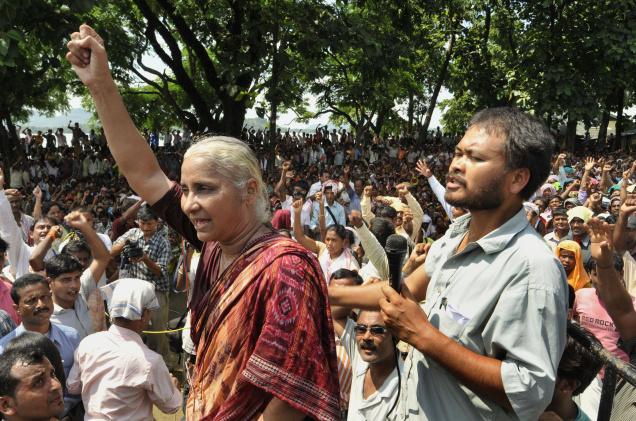
Narmada Bachao Andolan leader Medha Patkar with the leader of Krishak Mukti Sangram Samiti Akhil Gogoi at a protest rally on the Assam-Arunachal Pradesh border in Guwahati. Photo: Ritu Raj Konwar
Today in the jungles of Dantewada, it is paying the price for its follies, saysAshish Chadha.
It was during the Manibeli satyagraha of August 1991 that I met People’s War Group (PWG) activists in the Narmada Valley for the first time. The river was flowing above the danger mark thanks to incessant rain. Manibeli, a small tribal hamlet on the Maharashtra side of the river, was threatened with imminent submergence – the first victim of the Sardar Sarovar Project. But it was not going to go down with a whimper. The Narmada Bachao Andolan (NBA) had announced a jal-samarpan, a radical form of Gandhian non-violent protest that captured the imagination of the nation.
Medha Patkar along with a motley group of driven NBA activists and adivasis had decided to ‘sacrifice’ themselves in the sacred river. The largest non-violent movements in India after Mahatma Gandhi was challenging the might of the nation by sacrificing itself at the altar of development. Not a mere symbolic gesture or waive defiance, but a visceral end to a peaceful struggle.
The NBA feared that the State would violently suppress the protest. Many grassroots activists, intellectuals, journalists and students from all across India had come to show solidarity with this group of satyagrahis as they fought a battle of survival and ideology. We were camping next to the medieval Shoolpanewsar temple, secretly hoping that the Narmada River would not rise further.
Other than waiting for police action to happen, attending strategy meetings, and singing Andolan songs, we would usually sit in the ancient corridors of the eroded temple chatting about the state of the world. It was during one of these engrossing conversations that one of the PWG activists, in his halting, Telugu-accented Hindi, informed us: “We told Medha-tai to let us lead the moment for just one day. We will see to it that this dam is never made. Gandhian non-violence will not do you any good. You don’t know this government. it will trample you. It will mercilessly crush you.” I remember vigorously justifying the non-violent ideological basis of NBA. Today, nearly 20 years later, sitting in an American university campus, reading daily about the growing crisis in Dantewara, I am forced to eat my words.
“This is different from the Naxalite violence of the 60s and the 70s,” I was explaining to a Pakistani friend – a card-carrying communist who fled Pakistan 30 years ago when Zia ul-Haq’s regime brutally crushed trade unions and the communist party there. “This is not our battle, it is theirs. It is actually a people’s movement. It is a movement of the oppressed people, by the oppressed people, for the oppressed people.” On a long-distance telephone conversation, from the East coast of the West coast of America, I was explaining to him the recent slaughter of security personnel in Dantewada by the Maoists. “this is different because this time there is no Brahmin, no intellectual, no middle-class activists leading them. This time there is no one from Calcutta, Bombay or Jawaharlal Nehru University. This is their war of survival. And they are fighting their way. The rage is inevitable.” He was troubled. We are all troubled by the ferocity of the violence.
The core issue for the Maoist movement resonates with that of the NBA. Today’s Maoist movement in central india is unique. For the first time in the history of the communist movement in India, it’s not just the foundational questions of class and agrarian relations that are being raised, but also those of key issues of development, environmental destruction, post-colonial ideology of progress – problems the NBA fought for 20 years. Ours was an on-violent struggle, and today the movement is finished, the dam is complete, waters have not reached the most needy in Kutch and the displaced are devastated. A movement in shambles, its people lost, tired and hopeless. It is in the anguish of the NBA’s collapse that the Maoists have emerged.
The Indian government mocked the NBA’s quest. It humiliated it. It suppressed it. Today in the jungles of Dantewada, it is paying the price for its follies. The Maoist movement is not a law and order problem as Home Minister P. Chidambaram would want us to believe. It is not a political problem. It is a social problem. It is an ethical problem. It is a moral problem. The Indian State has to own up the responsibility of its systemic failure – the failure to govern.
In an early morning sweep of August 3, 1991, a few hundred policemen form Dhule district raided Manibeli and arrested Medha Patkar and the satyagrahis along with 63 people. The PWG activists and I evaded arrest and escaped to Baroda. As the rickety Gujarat State Transport bus navigated the potholed highway lined with babul trees, one of the PWG activists ponderously whispered in my ear, almost like a solemn dialogue from a Hindi fild: “This Gandhi-wadi will not get you anywhere. Government ko baandook ki gunje sonaye deti hai(the government only recognizes the sound of the gun)”.
(Ashish Chadha teaches anthropology at Yale University.)
Saturday, September 4, 2010
Flying the flag, faking the news
John Pilger
Loud noises from Washington about a US pull-out from Iraq are a poor disguise for America’s determination to keep waging war. And the same sort of spin is at work here in Britain

Edward Bernays, the American nephew of Sigmund Freud, is said to have invented modern propaganda. During the First World War, he was one of a group of influential liberals who mounted a secret government campaign to persuade reluctant Americans to send an army to the bloodbath in Europe. In his book Propaganda, published in 1928, Bernays wrote that the "intelligent manipulation of the organised habits and opinions of the masses is an important element in democratic society", and that the manipulators "constitute an invisible government which is the true ruling power in our country". Instead of propaganda, he coined the euphemism "public relations".
The American tobacco industry hired Bernays to convince women that they should smoke in public. By associating smoking with women's
liberation, he made cigarettes "torches of freedom". In 1954, he conjured a communist menace in Guatemala as an excuse for overthrowing the democratically elected government, whose social reforms were threatening the United Fruit Company's monopoly of the banana trade. He called it a "liberation".
Bernays was no rabid right-winger. He was an elitist liberal who believed that "engineering public consent" was for the greater good. This could be achieved by the creation of "false realities" which then became "news events". Here are examples of how it is done these days.
False reality The last US combat troops have left Iraq "as promised, on schedule", according to President Barack Obama. The TV news has been filled with cinematic images of the "last US soldiers", silhouetted against the dawn light, crossing the border into Kuwait.
Fact They have not left. At least 50,000 troops will continue to operate from 94 bases. American air assaults are unchanged, as are special forces' assassinations. The number of "military contractors" is 100,000 and rising. Most Iraqi oil is now under direct foreign control.
False reality BBC presenters have described the departing US troops as a "sort of victorious army" that has achieved "a remarkable change in [Iraq's] fortunes". Their commander, General David Petraeus, is a "celebrity", "charming", "savvy" and "remarkable".
Fact There is no victory of any sort. There is a catastrophic disaster, and attempts to present it as otherwise are a model of Bernays's campaign to "rebrand" the slaughter of the First World War as "necessary" and "noble". In 1980, Ronald Reagan, running for president, rebranded the invasion of Vietnam, in which up to three million people died, as a "noble cause", a theme taken up enthusiastically by Hollywood. Today's Iraq war movies have a similar purging theme: the invader as both idealist and victim.
False reality It is not known how many Iraqis have died. They are "countless", or maybe "in the tens of thousands".
Fact As a direct consequence of the Anglo-American-led invasion, a million Iraqis have died. This figure, from Opinion Research Business, follows peer-reviewed research by Johns Hopkins University in Washington, DC, whose methods were secretly affirmed as "best practice" and "robust" by the Blair government's chief scientific adviser. This is rarely reported or presented to "charming" American generals. Neither is the dispossession of four million Iraqis, the malnourishment of most Iraqi children, the epidemic of mental illness, or the poisoning of the environment.
False reality The British economy has a deficit of billions which must be reduced with cuts in public services and regressive taxation, in a spirit of "we're all in this together".
Fact We are not in this together. What is remarkable about this PR triumph is that only 18 months ago, the diametric opposite filled TV screens and front pages. Then, in a state of shock, truth became unavoidable, if briefly. The Wall Street and City of London trough was on full view for the first time, along with the venality of once-celebrated snouts. Billions in public money went to inept and crooked organisations known as banks, which were spared debt liability by their Labour government sponsors.
Within a year, record profits and personal bonuses were posted and the "black hole" was no longer the responsibility of the banks, whose debt is to be paid by those not in any way responsible: the public. The received media wisdom of this "necessity" is now a chorus, from the BBC to the Sun. A masterstroke, Bernays would surely say.
False reality Ed Miliband offers a "genuine alternative" as leader of the Labour Party.
Fact Miliband, like his brother and almost all those standing for the Labour leadership, is immersed in the effluent of New Labour. As a New Labour MP and minister, he did not refuse to serve under Blair or to speak out against Labour's persistent warmongering. He now calls the invasion of Iraq a "profound mistake". Calling it a mistake insults the memory and the dead. It was a crime, of which the evidence is voluminous. He has nothing new to say about the other colonial wars, none of them mistakes. Neither has he demanded basic social justice - that those who caused the recession clear up the mess and that Britain's fabulously rich corporate minority be taxed seriously, starting with Rupert Murdoch.
The good news is that false realities often fail when the public trusts its own critical intelligence. Two classified documents recently released by WikiLeaks express the CIA's concern that the populations of European countries, which oppose their governments' war policies, are not succumbing to the usual propaganda spun through the media.
For the rulers of the world, this is a conundrum, because their unaccountable power rests on the false reality that no popular resistance works. And it does.