Showing posts with label books. Show all posts

Saturday, January 15, 2011

Wednesday, October 20, 2010

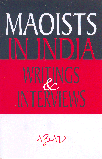
New book: Maoists in India-Writings and Interviews by Azad


This book is also available in PDF (142 pages) in Banned Thought.


This is to announce a new book – Maoists in India: Writings & Interviews by Azad, published by Friends of Azad. Below are the Preface and Table of Contents to generate your interest. The book is priced Rs 100 in India and $ 6 outside India. The books can be had from Varavara Rao, 203, Lakshmi Apartments, Malakpet X Roads, Hyderabad, India 500036.
With regards

Friends of Azad

In Honour of Our Friend

We, the friends of Cherukuri Rajkumar (Azad), present this bouquet of his writings and interviews collected from popular newspapers and websites, to all those who are interested to know the ideas of the Maoist politics in India in general and Azad’s articulation of the politics in particular. Azad has been our friend for more than thirty years and as much time, two thirds of his short life of 56 years, he spent developing, exploring, elucidating and debating these ideas.

A voracious reader and prolific writer that he was, the writings collected here might be less than a tenth of his literary output. Much of his writing was anonymous or under different pseudonyms in clandestine journals and documents and we leave it for future research to prepare his collected works, most probably with active support from the party for which he was a spokesperson, member of Central Committee and Politbureau at the time of his brutal killing by police on July 2, 2010 in Adilabad forests of Andhra Pradesh.

His death brought back his memories to us and we, from different walks of life, began cherishing his recollections more after his death. Indeed he began living amongst us more vigorously after his death, justifying the saying “a tyrant dies and his rule is over, a martyr dies and his rule begins”. Azad’s writings, statements, opinions, letters and his expositions of the revolutionary movement that is spreading leaps and bounds are reverberating in the present more vociferously. During the last three months after his cold-blooded killing by the police his name is more visible in the news than when he was alive.

We, as friends of Azad, thought it was our duty to propagate his ideas, his personality and his thoughts and writings. Even as we understand that his party would be in a better position to undertake that effort, we also wanted to add our bit to the task. Within one week of his death, we brought out a small collection of obituary articles written by prominent journalists and civil libertarians in Telugu. We were overwhelmed by the international response against his killing and brought out another slim volume of statements of solidarity and condolence issued by various parties, oraganisations and individuals across the world.

This book, in that process, is our third attempt to propagate Azad’s ideas. All these articles and interviews appeared in popular newspapers like Economic and Political Weekly, The Hindu, Mainstream, People’s March, etc. and available on the net. We gratefully acknowledge all the publications and websites.

We distributed our earlier publications to all those people we knew but we thought this book should be available to all those whom we may not know, but really want the book. We would like to remind all those that given the kind of repression prevailing in India now it would be difficult to identify ourselves. Hence we requested revolutionary writer Varavara Rao, who was an emissary of the CPI (Maoist) when the latter had peace negotiations with the government of Andhra Pradesh, to lend his address to the book. We are thankful to him for accepting our request.

Our friend Azad lives here in his words. In his eloquence. In his turn of phrase. In his penchant for truth. In his meticulous approach. In his incisive analysis. In his steadfast practice. In his supreme sacrifice. Azad continues to inspire.

Table of Contents

Preface

A Brief Biography

Azad’s Writings and Interveiws

1. Maoists in India October 2006

2. On the ‘Comprehensive Peace Agreement’ in Nepal December 2006

3. Interview on the Developments in Nepal May 2008

4. On V Prabhakaran May 2009

5. On Patel Sudhakar Reddy & Venkataiah May 2009

6. On the Election Boycott Tactic of the Maoists September 2009

7. Interview on the Governments’ military offensive October 2009

8. On Talks October 2009

9. On Balagopal October 2009

10. On Telangana December 2009

11. On Sakhamuri Appa Rao & Kondal Reddy March 2010

12. On Dantewada Guerilla Attack April 2010

13. Interview to The Hindu April 2010

14. Letter to Swami Agnivesh May 2010

15. On Jnaneswari Express Tragedy May 2010

16. On Bhopal Verdict June 2010

17. A Last Note to A Neo-Colonialist July 2010

Monday, October 18, 2010

The Communist Hypothesis


A short review appeared in the Irish Left Review on Alain Badiou latest book The Communist Hypothesis.

Seán Sheehan

Alain Badiou could be the most important philosopher alive today - time will tell - and his work is gradually reaching English-speaking readers. His magnum opus, Being and Event, took 17 years to appear in English but its follow-up Logics of Worlds only three and his What is The Meaning of Sarkozy (see the ILR review here) has hit the mark in the UK as well as in France. Badiou’s term Communist Hypothesis has been circulating since The Meaning of Sarkozy appeared, first in a piece he wrote for the New Left Review early in 2008 and then at the On The Idea of Communism conference in London last year.

Along with Žižek and other important voices opposing the pop-politics of postmodernism - the age of ideology is over, its us versus Islamic fascism, the big society, we’re all in this together, save the planet - the conference asked what meaning communism can now have for us. Is it not a discredited term, already in the dustbin of history and waiting for the lid to be firmly closed before being taken off and recycled as pap for academics and dumbed-down scare stories for our grandchildren?

We seem to be at a point of impossibility when it comes to radical change and fidelity to emancipatory politics. InThe Communist Hypothesis Badiou traces two historical sequences: the first from the French Revolution to the 1871 Paris Commune, the second from the Bolshevik revolution of 1917 to the Cultural Revolution in China. We are now in a limbo, like that between 1871 and 1917, an ‘interval phase dominated by the enemy’ and the challenge is to break through to a third sequence - hence the communist hypothesis. What there cannot be is a belief in some ‘objective’ agent written into the social order and destined to subvert it; nor the concomitant belief in a party organizing this agent of change. What there must be is the belief in, a commitment to, a world not run for private profit. Without holding on to this, Badiou argues, if post-modern capitalism and parliamentary politics is accepted as the only game in town, then the other possibilities are simply not seen even though they are inherent in the situation.

‘We have to convince ourselves that there is nothing ridiculous or criminal about having a great idea. The world of global and arrogant capitalism in which we live is taking us back to the 1840s and the birth of capitalism …. Too many people now think that there is no alternative to living for oneself, for one’s own interests. Let us have the courage to cut ourselves off from such people.’ (p. 67)

The hypothesis has to be a communist one because otherwise we will find ourselves being persuaded by listening to something very similar coming from the mouths of a Cameron or Obama. It is not that difficult to imagine one of them using a similar form of words to those just quoted in their next election campaign. Communism means not buying into some fatuous ‘vision thing’, subtracting out instead and thinking a new kind of politics based on the dispossessed, not aligned with existing parties and institutions.

Of course the word ‘communist’… has been cheapened and prostituted. But if we allow it to disappear, we surrender to the supporters of order, to the febrile actors in the disaster movie …. a politics reinvented at the grassroots level of the popular real, and the sovereignty of the idea …it will distract us from the disaster movie and remind us of our uprising. (P. 100)

What, though, prevents communism from being unrealizable, visionary, intrinsically unsafe given Stalin, the show trials, the gulags? Badiou’s transformative philosophy, a metapolitics that seems quite improbable given its basis in the mathematics of set theory, is the short answer to this. His central claim that ‘mathematics is ontology’ does not mean that being is mathematical but that mathematics expresses the ontological truth that there is no ‘one’, no ultimate harmony or consistency to being. There is no God, not totality, only what Badiou calls the ‘multiple’. So while a set presents a unified grouping it only does so because multiplicity is counted, as a ‘one’. What this means in practice is that the seemingly impossible, that which is not counted, is possible.

The realm of politics is concerned with the contingencies of every situation, the forms of subjectivity that can arise, and the unpredictability of the new. Revolutionary change is the bringing into the count what was previously excluded, the undoing of the rules, insurrection by the uncounted, and the challenge to the State which operates to stabilize the multiple, to limit the possibilities. Most of The Communist Hypothesis is about how this happened in May 1968 in France, in China’s Cultural Revolution and in the Paris Commune of 1871 and how a truth, a term of special meaning for Badiou, emerges from the consequences of these ‘events’. A term that also has a special significance in Badiou, an event is a rupture in the normal order of things that inaugurates possibilities from the seemingly impossible. This abstruse territory is the concern of the last section of The Communist Hypothesis but it is rooted in real life and one realises how the philosophy does give substance to the political. In practice and as consciousness, a blending of ‘facts’ with possibilities is always there, an elusive dimension that connects an ordinary individual with the idea that surprises happen, things could be very different. This is the idea of communism and the name is worth keeping because it connects us with all those who struggled in the past and keeps the possibility of change in the foreground. ‘We can, so we must’ Badiou concludes.

The Communist Hypothesis, like The Meaning of Sarkozy, can be read unaided but when it comes to most of his other works readers are likely to banjaxed without some assistance. Alain Badiou: Key Concepts can be recommended as a sound introduction to the range of Badiou’s thought. Its virtue, especially for a collection by different writers, is an unpretentious style that carries the reader along despite some fairly difficult ideas. The essays on Ontology and Politics relate most directly to The Communist Hypothesis but there is plenty more to whet your appetite and point the way forward to a reading of the formidable Being and Event. There is a title in the Reader’s Guides series from Continuum that sets about explicating the text. The style is off-putting at times, overloading itself with academese but it provides useful pointers and before you know it you’ll be googling set theory and back at school poring over mathematical symbols.

Sunday, October 17, 2010

Revolution Highway - Book by Dilip Simeon


The Revolutionary Road - Review by Subodh Verma

What happens to a dream deferred?

Does it dry up
like a raisin in the sun?
Or fester like a sore—
And then run?
Does it stink like rotten meat?
Or crust and sugar over—
like a syrupy sweet?
Maybe it just sags
like a heavy load.
Or does it explode?

It was 1951 when these famous lines were penned by Langston Hughes, a Black writer and poet who shot to fame in the Harlem Renaissance of the 1920s. He was, of course, thinking about the American Blacks' struggle for dignity and justice. Dilip Simeon's novel on the Naxalite movement in the late sixties comes close to giving answers – if rhetorical questions like these need answers.

Naxalbari dramatically came into the public consciousness in 1967 and, for the next few years, a violent peasant revolution was on the agenda – or so it seemed. Simeon sketches out the ingredients of what went into making those heady, intoxicating days. There was a worldwide upsurge against the brutal US war against Vietnam, with dozens of US university campuses turning into battlefields. In France, a student rebellion broke out backed, for some time, by a general industrial strike. The Chinese Communist Party emerged as an active supporter of all kinds of uprisings in the third world, propelled by its extreme Cultural Revolution ideology. Within China, intellectuals and party leaders were thrown aside as students quit their studies and left for the countryside to continue the revolution.

Inspired by this ferment, and angered by extreme poverty and injustice in India, many middle class intellectuals and students joined the Naxalite struggle. Among these were a group of students from Delhi's St. Stephen's college. Simeon narrates their story, referring to the college by its other, less well known name, Mission College. Although his sympathy lies with the students, Simeon spares nothing in describing their doctrinaire understanding, their Chaplinesque attempts to incite the leaden peasant to revolutionary acts, their pathetic attempts to understand their failures. Simeon's knowledge of those years and events is authentic, right down to the hideouts in north Delhi's poor colonies and the strains of Hendrix and Joplin. The depressing inevitability of what is to come – complete and total rout – fills the whole book. Mercilessly ground down by the police, the movement descends into squabbling, bloodthirsty packs fighting a bitter battle for survival on the streets of Calcutta.

It is a vast, epic theme – the crushing of dreams – and Simeon succeeds in showing that it was foretold – because of false premises and erroneous means. The text is deconstructed, flitting between times and places. The prose is laconic, often unattractively so, although Simeon's penchant for Hindi swear words is in full play.

Yet, the novel leaves one tortured – is there no hope? Is all action futile? Is injustice infinite? Simeon is unable to hint at anything because this work is an attempt to show that all violence is doomed to fail. In that ahistorical straitjacket, answers are not easy. One is reminded of lines from a Pink Floyd song, ca.1979 – "The child is grown, the dream is gone. I have become comfortably numb.

Wednesday, August 6, 2008

Book review: Red Sun: Travels in Naxalite Country


Following is a slightly abridged review of the book Red Sun: Travels in Naxalite Country by Sudeep Chakravarti (Penguin/Viking) from the Communist Party of India (Maoist) Information Bulletin (no. 2, 10 May 2008). Editor’s added clarifications are in brackets.


The Maoist movement in India is one of the oldest and longest-sustained revolutionary movements in the contemporary world. Spanning four decades beginning with the first earth-shaking volcanic eruption in a tiny village in Naxalbari, it has become part of folklore in some regions in the country. It had risen, phoenix-like, every time the political pundits had confidently pronounced its certain demise. Top political and police brass had time and again boasted that they had "finished off" the revolution, which, they claimed, had been "imported from abroad". They asserted that Maoist revolution is something alien to the conditions in Gandhi's India where, they claim, people are not prone to violent ways. The latest in this long list of liars, wishful thinkers and vicious propagandists is Mahendra Karma [Congress Party leader in the state of Orissa], who declared amidst much fanfare in June 2005 that he would decimate the Maoists within a year through his state-sponsored terrorist campaign christened salwa judum (peace campaign). When his armed gangsters and the state's khaki-clad goons took a beating in the hands of the Maoists, this scab of the imperialist- big business-feudal combine kept on barking over the past two years that he would finish off the Maoists within a short time. However, nailing all these lies and disgusting boasts by the mediocre politicians and police officials ruling the country, the resilience and growth of the Maoist movement had surprised many sceptics who see the Indian state as an almighty behemoth that can snuff out any armed resistance.


Surprisingly, given the great international significance of revolution in a vast country like India – the second most populous in the world – very few scholars have attempted any serious research into this social phenomenon and books dealing with this protracted insurgency are very few. But of late, several research scholars belonging to various persuasions and particularly so-called independent agencies have suddenly jumped into the fray. There is very less objectivity and realistic analysis in most of these writings. Many of these have begun to paint a scary picture of a rapidly growing “Red Terror” which is supposed to undermine development measures undertaken by the government. They talk of the Maoist movement spreading at an alarming speed to the majority of the states in India.


In Red Sun, published by Penguin (Viking) Books India in early 2008, the author, Sudeep Chakravarti, makes an attempt to understand and present the phenomenon of the Maoist movement in India. It is not, as the writer himself claims, a history of the Maoist movement, but a travelogue that tries to understand the Other India, as he christens it. The positive side of the book is the writer's attempt to present the conditions of the vast majority of the common people – their grinding poverty, excruciating indebtedness, horrific tales of their destitution and displacement by so-called development – leading to extreme helplessness and heart-rending suicides. The writer tries to focus on the aspirations of the majority in India that have been left out of every development scheme and model touted as great boons for the poor by the Indian ruling classes. Overall, the writer has been able to present in a lucid manner the explosive socio-economic milieu that gave rise to, and continues to nurture, the Maoist movement in India. And as a travelogue, this aspect often comes forcefully through conversations with people from various walks of life. He logically anticipates the inevitable spread of the Maoist movement to the urban areas, since similar conditions had pushed the vast majority of the urban poor into utter wretchedness.


Good exposure of state-sponsored terror campaign in Dandakaranya


The exposure of the state-sponsored terrorist campaign in Dandakaranya through the so-called salwa judum comes out forcefully in the book. It is here that the writer is seen at his best and he boldly exposes the havoc created by the state-sponsored vigilante gangs combined with the state and central [Delhi] forces. There is some amount of depth in the writer’s presentation of the movement in one of the crucial regions of the Maoists. He vividly describes the war theatre, the explosive situation and the strategies and plans of the state. As far as the writer’s description of the Maoist movement goes this is the best part in the entire book. After this, the presentation of the movement elsewhere is shallow and based more on hearsay.


None of the movements in other regions such as Jharkhand, Bihar, West Bengal, or Andhra Pradesh are given any in-depth analysis. This reflects a lack of real interaction with the actual players. Even the conversations with such an eminent personality in the revolutionary camp like VV [prominent Andhra Pradesh intellectual Varavara Rao, accused of connections with CPI(M)] lack punch and analysis. The principal weakness of the travelogue is that the writer travelled more along the periphery of the war zone and had hardly any interaction with the Maoist fighters and leaders in any of these regions. Whether this is deliberately done, or the writer found no opportunity to meet the Maoist revolutionaries in the battlefield, is not clear. With the right contacts – and the writer claims to have many such contacts – it is, of course, not difficult to meet CPI (Maoist) underground cadre.


The excerpts from the Fact Finding Report by a team of democratic intellectuals released to

the media in December 2005 and from the Report of April 2006 entitled "When the State Makes War on Its Own People" [see AWTWNS 18 December 2006], Mahendra Karma's statement on the aim of salwa judum ("Unless you cut off the source of the disease, the disease will remain. The source is the people, the villagers.") , the presentation of the full text of Bijapur SP D.L. Manhar's instructions on the wireless to his men which was taped by the Maoists, the story of local journalist Kamlesh Paika, conversations with K.R. Pisda, Collector of Dantewara, the abuse of journalists in the most filthy and uncivilized manner by Alok Awasthi, additional director in Chattisgarh' s Directorate of Public Relations, etc., are well brought out. The aim of the salwa judum as admitted by the government in the official document is also quoted exhaustively.


The most chilling story of the evacuation and setting afire of the village of Darzo in Mizoram by the Indian Army during the early 1970s as part of the sordid plan of resettlement of the villages is very much relevant in the context of the salwa judum campaign and the planned resettlement of the tribals in Dantewara. The comparison with the Mizoram of the 1970s is a commendable job.


At several places in the book, during conversations with the revolutionaries, bureaucrats and police officials, the activities and viewpoints of the two opposing forces in this class conflict are brought into sharp contrast. Some of the remarks by top political and police brass make interesting, and at times, disgusting, reading. For instance, the health minister of Jharkhand, Bhanu Pratap Shahi, says in an interview: "One vasectomy in a Naxalite dominated village means that many potential comrades less… when you have too many mouths to feed and too little food to eat, you may turn into a Naxalite. All I want is to minimize the number of mouths."


The cynical revelation by an officer of the military intelligence of how he and his team had hacked off the heads of six militants just to petrify their Islamic colleagues and to serve as a spiritual insult makes chilling reading. "Then we heard these human rights chaps were coming. So we put the heads back on somehow, crudely stitched them up. We didn't bother with matching head and body." That cynical laughter of the officer while narrating this ghastly incident shows the general sadistic mindset of the police and security establishment, whether it is in Kashmir, the North East, Dandakaranya, Jharkhand, Andra Pradesh or elsewhere. Their proposed solution to the Naxalite issue is outright murder and fascist suppression, despite their occasional declarations to the contrary, meant only to please and appease civil rights activists and liberal-minded intellectuals.


Chattisgarh' s DGP OP Rathor (who died of heart attack on Anti-Terrorist Day) bursts out venom against the Naxals: "Bloody nuisance. There's not a socio-economic one, rather than a law and order problem. Khadi and Khaki bandits are all one and the same with regard to this. Marxism, Leninism or Maoism about them. When I was young I at least sensed some ideology about the Naxalites. But these chaps (now) are nothing but thugs and extortionists. " The Additional Chief Secretary (Home), Government of Chattisgarh, BKS Ray, shows the same abysmally crude attitude and approach towards the Naxalite movement. "These people are just thugs and extortionists. That's why in Chattisgarh you have a spontaneous popular movement against them – these tribals are fed up of the Naxals", he says. Why the tribals were not fed up with the Naxals for 25 years and why all of a sudden they became restive is something this arrogant bureaucrat will never be able to grasp or explain. And why will the tribals be angry with Naxals, even if one accepts the allegations of the rulers that they are extortionists, since the tribals have nothing to lose and everything to gain? Is it not only the big contractors, bureaucrats, traders and industrialists who have big property amassed through primitive methods of exploitation of tribals and loot and plunder of the entire region that actually fear the Maoists and try to snuff them out with all means at their disposal? No wonder, this bureaucrat with a police mind set can only think of exterminating the Maoists as the solution.


It has become a fashion for every police officer and political bigwig to express nostalgic feelings about the Naxals of yesteryears as if they really believed Naxals were sincere in the bygone times and had become a nuisance now. They say they were an educated lot in earlier times but now have lumpen elements in dominance. The fact is today Naxals have the real oppressed classes behind them, which is why it is becoming increasingly difficult for the reactionary ruling classes to suppress them. The change in the composition of the Naxalite movement shows the maturity and grass-roots strength of the movement.


Ideological biases


As is natural in a class-divided society, the presentation in the book, and the conclusions drawn, are subject to the limitations set by the class [outlook] of the writer, in addition to the inescapable influence of oft-repeated verdicts on the movement by earlier writers of various hues. It is not easy to wriggle oneself out of the shackles of ruling ideology, culture and long-inculcated values that continue to reinforce upon one's mind ever since one's childhood. Some of the remarks of the writer bring home this point. For instance, referring to VV's speech at the Tehelka summit in November 2006 in Delhi, the writer says: "Democracy, with all its ills, allows him this public space. I hope he realizes the irony that dogma and undemocratic institutions have no space for others, tolerate no dissent. Mao didn't. The bloom of a Hundred Flowers turned into deepest tragedy. Maybe when the Maoists talk about New India, they really need to talk about gentler Maoism – possibly an oxymoron – as their counterparts have done for Nepal's fragile peace." (p. 292)


The author also cites some instances of punishment given to informers in Dandakaranya, Jharkhand, Orissa by the "dreaded Jan Adalat, or People's Court, which is little more than kangaroo court" and concludes that "These acts are as gruesome, and gratuitous, as what the Maoists accuse state security of."


Another comment or rather conclusion of the author without any analysis runs thus: "In Dantewada, democracy is quite dead, on both sides of the battle line." Surprisingly, he cites the game of chor-police (cops and robbers) played by tribal children to arrive at such an obviously biased conclusion! The author's ideological biases can be seen also from his bland statements regarding the future postrevolutionary society and about Maoist China. He says: "What would it be like if ever revolution were to succeed in India, enough to impose its imprint beyond tribal and caste-roiled areas? Most probably, instant justice, dogmatic and Puritanical life, Soviet-style post-revolutionary rot, vast May Day parades." And he goes on: "Perhaps even brutal China-style state control and a repeat of the Cultural revolution of Mao himself, that ended up killing and damning millions of unbelievers. " He concludes: "From available historical evidence, a Maoist state might do little else but backslide all of India's hard-won victories despite the mire of grand corruption and the utter small-mindedness of administration. "


Needless to say, this writer, as any other writer without living links with the lives of the oppressed masses and the movement, has also become a victim to the almost inescapable influence of the imperialist and ruling class ideological biases as regards comrade Mao and the Great Proletarian Cultural Revolution in China, post-revolutionary societies, and so on. From the opinions expressed by the writer such as the above one cannot but come to the conclusion that he prefers the status quo in place of a new revolutionary order where, he imagines, freedom will be the first casualty. He forgets that Maoists are also learning from the socialist experiments of the past and will certainly imbibe the positive aspects while rejecting the negative ones.


Some factual errors


There are a few minor factual errors in the book, which could have been avoided with a little more diligence and care by the writer [here the review cites a number of mistakes regarding the identification of individuals, organisational matters and historical questions].


Another problem with the presentation is that several allegations are made regarding the activities of the Maoists by some police officials and political leaders, while no opportunity is available to the former to refute these allegations. When an author quotes these officials it will also be the bounden duty to get the response from the Maoists. Or else, it would mislead the people and amounts to gross injustice to the other side in the ongoing war. For instance, the superintendent of police of Dantewada district, Prabir Kumar Das, alleges that Maoists are against development and do not allow bore-wells to be sunk in their stronghold villages. He is quoted as saying: "When we entered an area 50 kilometres from here, deep inside, we found they had broken hand pumps. Initially, we thought it was to deny police water. Later, when we went to areas we hadn't been to before, there too the pumps were broken. Villagers told us that they were asked by the Maoists to drink only from wells and other natural water sources." The rationale of the Maoists, behind this move, is attributed to their perception of bore-wells as a sign of oppression (!!) "Hand pumps were provided by the state or NGOs with state funding; they were a sign of oppression, and therefore taboo" says this gentleman.


Nothing could be farther from truth. This even goes against common sense, which the top police brains in India pitifully lack. How can the Maoists (the police can at least get their own mineral bottles), survive if they break the hand-pumps? If the author had verified the facts by touring the areas deep inside it would have been really useful in exposing the deliberate concoctions of the police chief. And all this is only to justify the brutal state-sponsored terror campaign in the name of salwa judum with the pretext that the villagers are fed up with Maoist attempts to block development schemes and such trash.


The writer comes to the conclusion that the Maoist movement will soon encompass the urban areas and mobilize the vast masses of the have-nots living in the most distressing conditions in the slums and factories. He rightly says that all the material conditions for the spread of Maoists to the urban areas exist there. He includes entire sections from the document of the CPI(Maoist), "Perspective of Urban Areas", as an appendix and quotes extensively from this document to prove how the Maoists will emerge as a strong urban force too.


The author also tries to place his own theories of In-Land, Out-Land, City States, etc., which he says will characterize the country’s social scenario in the future. Or in other words, that India will increasingly be divided into two: one inhabited by the haves and the other by have-nots, with continuous friction between the two. Although the essence of his thesis will be the unfolding reality – the pointers to this division are already emerging with the fast multiplying expressways, multiplexes, shopping malls, super fast trains, amusement parks, high cost of education, housing and health, drastic cuts in social welfare schemes, and so on – the emerging scenario will be one of acute class struggle with the vast majority of the Indian population locked up in bitter struggles, armed and unarmed, against the exploitative set-up, and fascist state dictatorship becoming the norm. In this cruel, bitter class war the Maoist movement is certain to gain ground and advance towards the goal of liberation of our country from the clutches of the imperialist marauders, decadent feudal forces and comprador big business sharks.

Followers